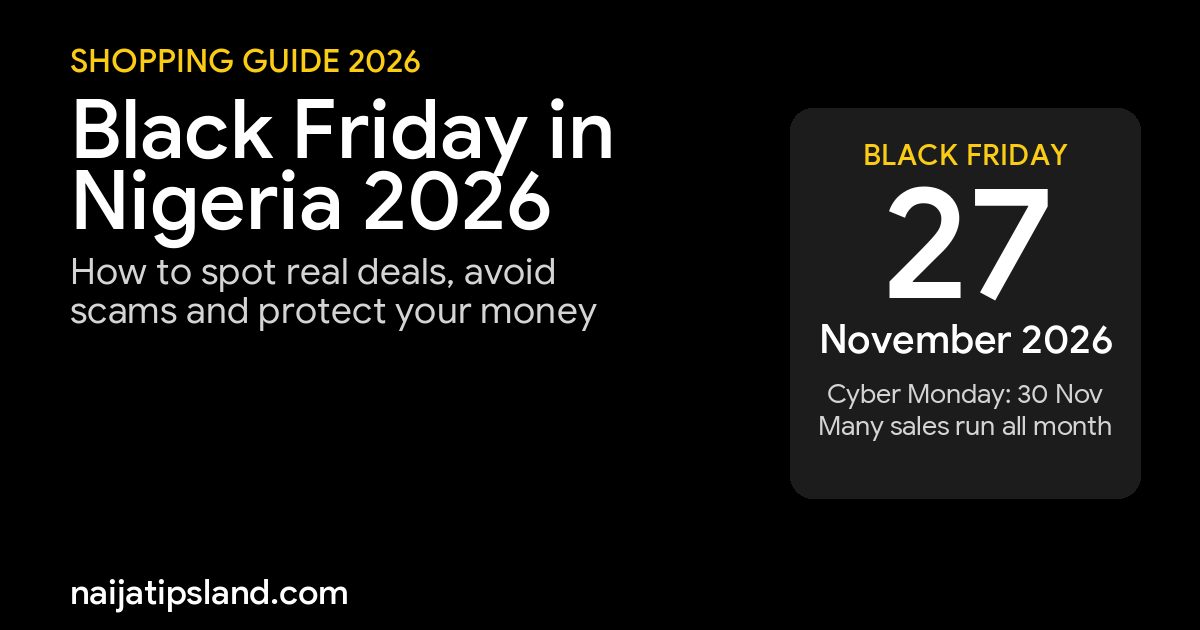
Black Friday 2026 falls on Friday, 27 November, and in Nigeria it is no longer a one-day event. Online marketplaces, phone shops, supermarkets and fashion brands now run promotions across much of November, with some stretching into December. For shoppers, that means real chances to save on phones, appliances and groceries, but also more fake discounts and more scams.
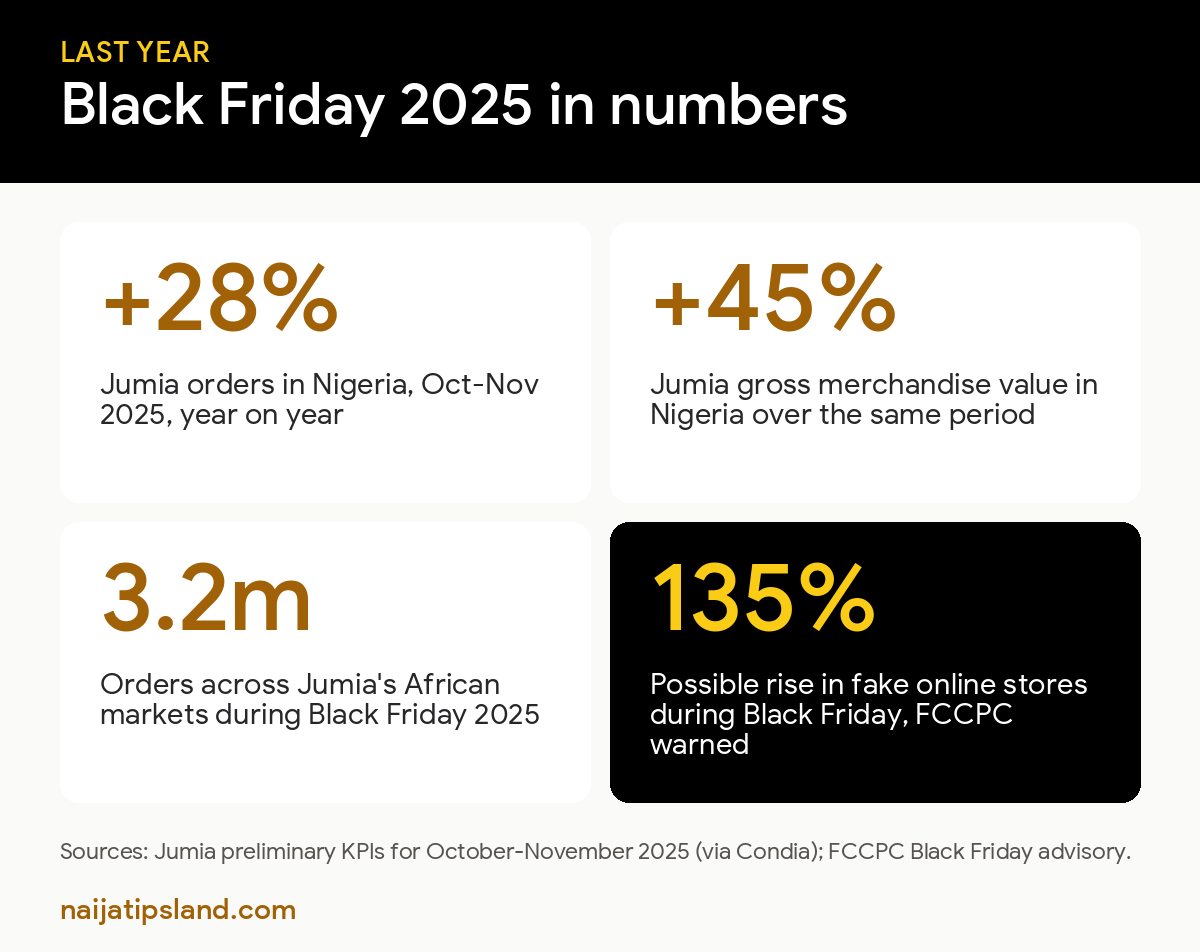
Black Friday has become a major shopping event in Nigeria. During October and November 2025, Jumia reported that its orders in Nigeria grew by 28% and the value of goods sold by 45% compared with a year earlier, with growth spreading well beyond Lagos and Abuja. This guide explains when the 2026 sales run, how to tell a real deal from a fake one, the scams to watch for, and what to do if something goes wrong.
Last updated: 20 October 2026. Retailers announce their Black Friday plans at different times; we will add confirmed campaigns as they are published.
The short answer
- Date: Black Friday is 27 November 2026, and Cyber Monday is 30 November 2026. Many Nigerian retailers run sales for the whole of November.
- Real deals: track prices from early November, compare the same model across stores, and add delivery fees before deciding.
- Scams: watch for fake websites, phishing texts, social media vendors who demand full payment upfront, and fake bank alerts.
- Your rights: sellers must not mislead you about prices or products. You can complain to the Federal Competition and Consumer Protection Commission (FCCPC).
When are the Black Friday 2026 sales?
The official date is Friday, 27 November 2026, the day after the US Thanksgiving holiday, followed by Cyber Monday on 30 November. In Nigeria, however, the big platforms usually stretch the promotion across the month. Jumia, for example, ran its 2024 Black Friday campaign from 1 to 30 November, and other retailers often start in early or mid-November.
Not every store takes part, and start dates differ. Some offers sell out within hours, especially flash sales on phones. Others apply only to certain models or to app purchases. A deal directory review in August 2026 found more than 500 Nigerian deal pages across 12 categories, from electronics to groceries, which shows how scattered the offers have become.
What sells, and where the best deals usually are
- Phones and accessories: the most popular Black Friday category. Brands such as Xiaomi, Infinix, Tecno and Samsung often run time-limited offers with marketplaces.
- Home appliances: TVs, fridges, freezers, air conditioners and generators, which many households buy ahead of Christmas.
- Groceries and household goods: bulk buys of rice, oil, detergents and toiletries can bring real savings, especially as food prices rise towards Christmas.
- Fashion and beauty: local and international brands discount clothing, shoes and cosmetics.
Jumia reported 3.2 million orders across its African markets during Black Friday 2025, and 61% of its orders came from outside capital cities. Delivery to smaller towns has improved, but check delivery times and fees for your area before you buy.
How to tell a real deal from a fake discount
A big percentage sign is not proof of a bargain. Some sellers raise prices in October so that a November “discount” brings them back to normal. Others discount older or lower-specification models that look similar to the latest ones.
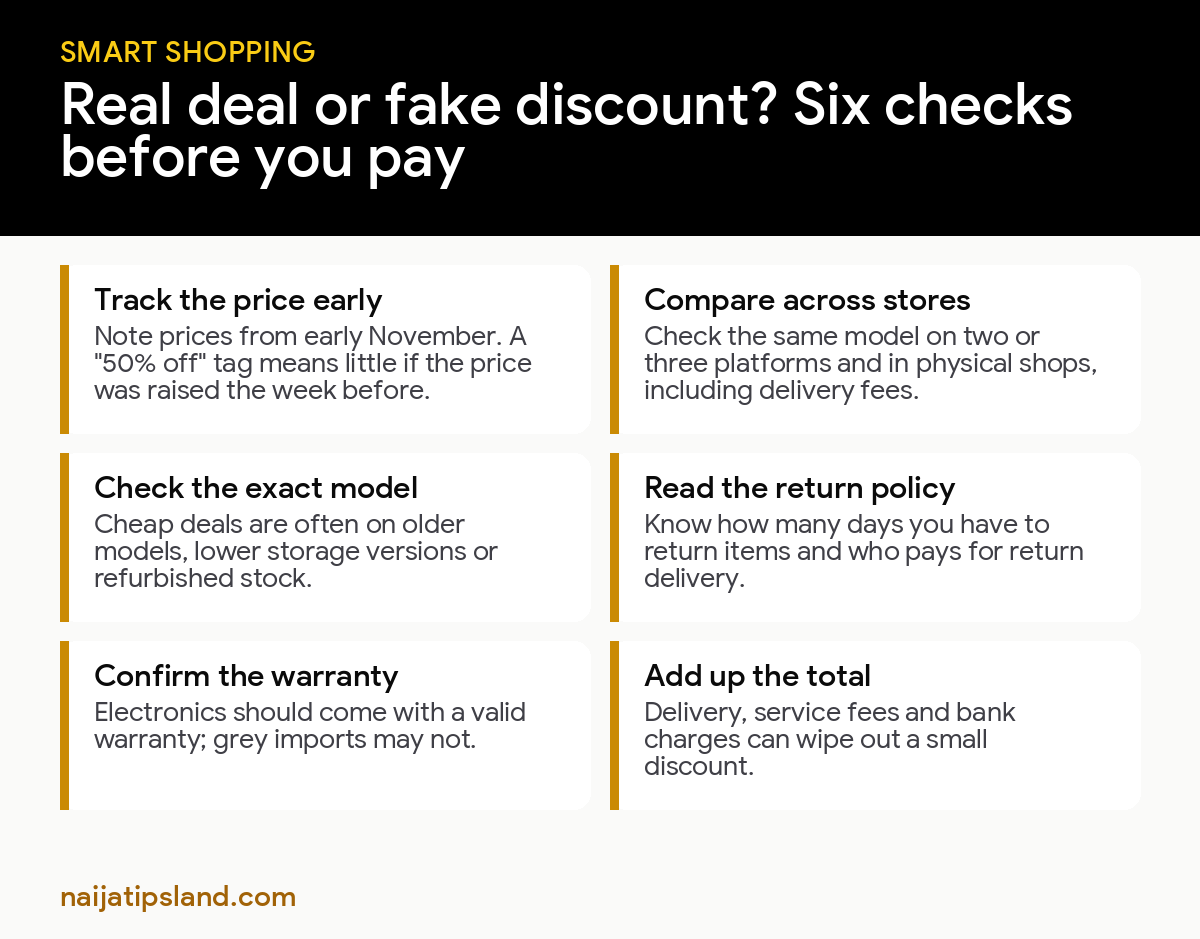
- Track the price early. Save screenshots or a list of prices for the items you want from late October or early November. Then you will know whether a Black Friday price is really lower.
- Compare across stores. Check the same item on at least two or three platforms and in a physical shop if you can.
- Check the exact model. Look at the model number, storage size, year and whether it is new, refurbished or “UK used”.
- Read the return policy. Know how many days you have to return an item, the condition it must be in, and who pays for return delivery.
- Confirm the warranty. Official warranties matter for phones and appliances. Grey imports may not be covered locally.
- Add up the total. Delivery, service fees and bank or card charges can cancel out a small discount.
Make a Black Friday plan
The easiest way to overspend on Black Friday is to shop without a list. A simple plan helps:
- Set a budget before the sales start, and decide what you can afford to spend in total, not per item.
- List what you actually need, such as a replacement phone, a freezer before Christmas or bulk groceries, in order of priority.
- Do your research early: pick the models you want, read reviews and note normal prices.
- Avoid buying on credit for things you do not need. Short-term loans and “buy now, pay later” offers can cost far more than the discount saves; if you do borrow, use only lenders approved by the FCCPC.
- Keep some money aside for Christmas and January, which are expensive months for most families.
Buying a phone on Black Friday
Phones are the most popular Black Friday purchase in Nigeria, and the most common target for fakes. Before you pay:
- Check the IMEI (dial *#06#) and confirm it matches the box and, where possible, the manufacturer’s checker.
- Confirm whether the phone is new, refurbished or used, and whether the warranty is valid in Nigeria.
- Check that the phone is not locked to a foreign network and works on Nigerian networks.
- Test the phone, or buy where you have a clear right to return it.
Black Friday scams to watch for
In a Black Friday advisory, the FCCPC warned that fake online stores could increase by as much as 135% during the sales period and urged consumers to shop only on trusted, credible platforms. Common scams include:
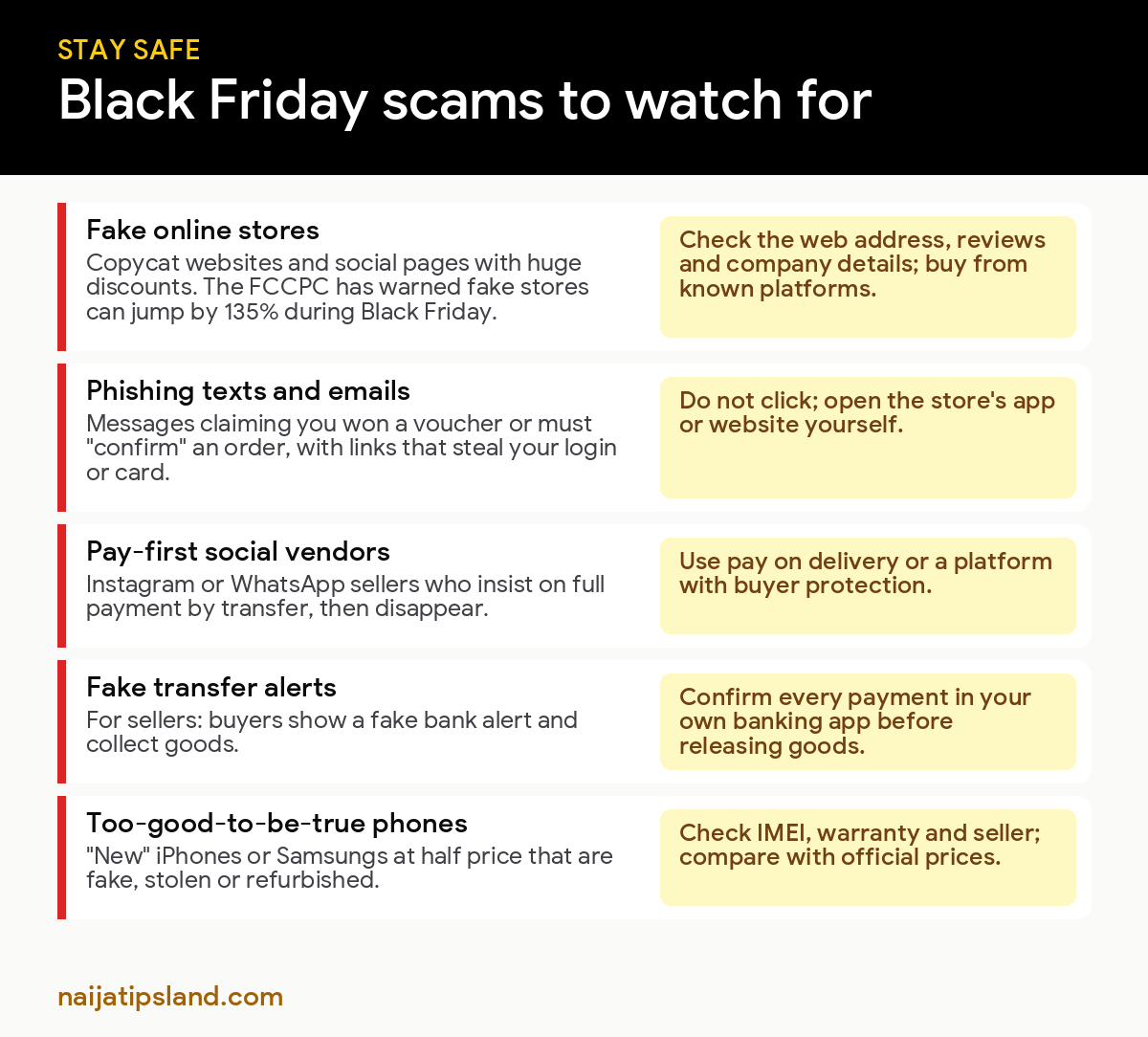
- Fake online stores: copycat websites and social media pages using big brand names and unbelievable discounts. Check the web address carefully, look for a real company name and address, and read independent reviews.
- Phishing texts and emails: messages saying you have won a voucher, your order failed or your account needs confirmation, with a link that steals your login or card details. Open the store’s app or website yourself instead of clicking links.
- Pay-first social vendors: Instagram, TikTok and WhatsApp sellers who demand full payment by bank transfer and then disappear. Prefer pay on delivery or platforms with buyer protection, and see our guide to common WhatsApp scams.
- Fake bank alerts: a risk for sellers and small businesses. Buyers show a fake transfer screenshot or SMS and leave with the goods. Always confirm payments in your own banking app.
- Counterfeit and stolen phones: “brand new” premium phones at half price that turn out to be fake, refurbished or stolen. Check the IMEI, the seller and the warranty.
If you are not sure whether a company is genuine or licensed, our guide on checking whether a business is licensed explains where to look.
Paying safely
- Use pay on delivery where it is offered, especially with sellers you do not know.
- Pay through the platform, not directly into a seller’s personal account outside the marketplace.
- Use cards or payment methods with dispute options, and turn on transaction alerts.
- Never share your OTP, card PIN or BVN with anyone, including people claiming to be from the store or your bank.
- Keep records: screenshots of the advert and price, the order confirmation and payment receipt.
If a card payment fails but you are debited, our guide to failed transactions explains how to get your money back.
Your rights as a consumer
The Federal Competition and Consumer Protection Act 2018 protects shoppers in Nigeria. Sellers must not mislead you about prices, discounts or the quality of goods, and you are entitled to clear information about what you are buying. If goods are faulty or not as described, ask the seller for a repair, replacement or refund under their policy and the law.
If the seller will not help, you can complain to the FCCPC:
- Online: complaints.fccpc.gov.ng (via the “File a Complaint” link on fccpc.gov.ng)
- Email: contact@fccpc.gov.ng
- Toll-free: 0800 000 2121
- Social media: @fccpcnigeria
For online fraud, you can also report to the police and the EFCC; our guide to reporting cybercrime in Nigeria explains how.
Tips for sellers
If you sell online, Black Friday can bring a big jump in orders. Be honest about your “before” prices, keep enough stock to honour your offers, state delivery times clearly, and confirm every payment before releasing goods. Our guide to where to sell online in Nigeria compares marketplaces, social commerce and your own store.
Frequently asked questions
When is Black Friday 2026 in Nigeria?
Friday, 27 November 2026. Many Nigerian retailers run Black Friday sales for most of November, and Cyber Monday is on 30 November.
Are Black Friday deals in Nigeria real?
Some are, some are not. Track prices before the sale, compare the same model across stores and include delivery costs to see whether a discount is genuine.
Which stores have Black Friday sales in Nigeria?
Large online marketplaces, phone and electronics retailers, supermarkets and many fashion brands. Campaigns are usually announced in late October or early November.
How do I avoid Black Friday scams?
Buy from known platforms, type web addresses yourself, avoid paying strangers upfront, never share OTPs or PINs, and confirm every payment in your banking app.
Where do I report a bad seller?
To the FCCPC through complaints.fccpc.gov.ng or its toll-free line, 0800 000 2121. For fraud, also report to the police or EFCC.
Bottom line
Black Friday 2026 can save you real money on phones, appliances and groceries, as long as you prepare. Make a list, track prices from now, compare stores, read return policies and pay safely. If a deal looks too good to be true, it probably is. We will update this guide as Nigerian retailers announce their 2026 campaigns.
Sources
- The Guardian: Black Friday calendar and Nigeria’s scattered retail promotions (September 2026)
- Condia: Jumia sales in Nigeria and Ghana, October-November 2025
- Jumia: Preliminary KPIs for the two months ended 30 November 2025
- The Guardian: Jumia Nigeria launches Black Friday campaign (November 2024)
- FCCPC: Advisory on possible Black Friday fraud
- Techeconomy: How to spot fake deals this Black Friday