


TL;DR:
- News satire plays a significant civic role by exposing contradictions and educating audiences through humor. It relies on mainstream reporting for raw material while signaling its comedic intent to avoid misinformation.
Satire acts as a civic watchdog, educator, and engagement amplifier inside the modern news ecosystem. When Jon Stewart’s The Daily Show reframed the 2003 Iraq War coverage, or when John Oliver’s Last Week Tonight spent 20 minutes dissecting payday lending, those weren’t comedy bits that happened to touch the news. They were journalism wearing a different coat. A content analysis of 150 satirical segments published in Journalism Practice found that news-satire formats score high on Advocate, Watchdog, and Civic Educator roles while scoring very low on the neutral Reporter role. A three-level random-effects meta-analysis covering 70 studies and 22,969 participants confirmed that satire increases positive affect and audience engagement. The practical takeaway for you: treat satirical news as opinion journalism with a comedic frame, not as a substitute for straight reporting, and always verify the underlying facts it points to.
Table of Contents
- What news satire is and how it differs from fake news
- The main roles satire plays in civic life and the news ecosystem
- How satire works: the rhetorical tools behind the punchline
- Where news satire appears today and how format shapes impact
- How satire interacts with mainstream journalism: cooperation and tension
- What research shows about satire’s effects and the main risks to watch for
- Three case studies showing satire influencing public discussion
- Ethical and legal considerations for creators and platforms
- How audiences and journalists should interpret and use satire responsibly
- What academic research and recent studies conclude about news satire
- Key Takeaways
- Why satire matters more now than most journalism critics admit
- Useful sources for deepening your understanding
What news satire is and how it differs from fake news
News satire is a hybrid genre that combines entertainment and opinion to comment on current events, public figures, and media itself. It draws on mainstream reporting as raw material while using humor, irony, and exaggeration to expose contradictions, hypocrisy, or absurdity. Scholars call this form “comedic journalism,” and it sits at a distinct crossroads between the newsroom and the comedy stage.
The line between satire and fake news matters enormously, and it comes down to three things: intent, transparency, and factual grounding.
“Comedy in this case should not be seen as a pejorative obstacle to ‘real’ journalism, but as an expansion of journalistic role performances more in tune with contemporary interpretations of journalisms in the plural.” — Sara Ödmark and Nicolaï Jonas, Journalism Practice (2024)
Fake news intends to deceive. Satire intends to critique, and it signals that intent through exaggeration, absurdity, or a clearly labeled comedic frame. Here is how you can tell them apart:
- Intent: Satire aims to expose or ridicule; fake news aims to mislead.
- Transparency: Satirical outlets (The Onion, Weekend Update) signal their comedic frame openly; fake news mimics straight reporting.
- Factual basis: Good satire builds on verifiable events and then distorts them for effect; fake news fabricates the underlying facts.
- Parody markers: Satire uses recognizable exaggeration, absurdist headlines, or imitation of real formats; fake news avoids those signals.
- Accountability: Reputable satirical programs employ fact-checkers and researchers; fake news operations do not.
Literary satire, by contrast, targets timeless human vices through fiction (think Jonathan Swift’s A Modest Proposal). News satire is time-bound, topical, and explicitly tied to real events. That specificity is what gives it journalistic weight.
The main roles satire plays in civic life and the news ecosystem
News satire is not one thing. Researchers at Mid Sweden University and KU Leuven identified six journalistic roles in satirical news programs, and five of them carry direct civic weight. Understanding those roles tells you why the genre matters beyond the laugh track.
Watchdog and accountability. Satirists hold power to account by exposing contradictions between what officials say and what they do. Last Week Tonight regularly forces policy issues into mainstream conversation by presenting documented evidence in a comedic frame, making it harder for politicians to ignore.
Advocate and agenda-setter. News satire takes explicit stances. The Colbert Report spent years satirizing media coverage of the Iraq War and campaign finance, pushing those critiques into prime-time conversation. A NiemanLab synthesis argues that journalistic comedy expands what we call journalism by adding emotional, subjective, and dialogic roles that increase audience involvement.
Civic educator. Satirical programs often explain complex policy in accessible language. The Daily Show broke down the Affordable Care Act debate for younger audiences who weren’t reading policy briefs. The Journalism Practice study found that civic educator was one of the highest-scoring roles across all three programs analyzed.
Comedic interlocutor. This is the role that most distinguishes news satire from straight reporting. The comedic interlocutor uses humor, emotional metaphors, and direct audience address to build a relationship with viewers, functioning as a trusted friend who guides you through confusing news.
“The comedic interlocutor is not just about being funny — it’s about creating a relationship with the audience, being in dialogue, a friend who guides you through the news, educates you, and helps you strengthen your beliefs.” — Sara Ödmark, Journalism Practice (2024)
- Navigational sense-making during crises. When political events feel disorienting, satire provides a shared emotional register. Researchers note that humor helps audiences process rapid political change by lowering barriers to engagement and offering a community frame for discussion. During the Trump administration, many viewers reported that satirical programs helped them contextualize events that straight news struggled to frame without appearing partisan.
These roles don’t operate in isolation. A single Last Week Tonight segment can simultaneously educate, advocate, and build community, which is why the genre punches above its weight in civic impact.
How satire works: the rhetorical tools behind the punchline
Satire’s power comes from specific rhetorical techniques. Scholars identify five core devices that satirists deploy, often in combination, to make their critiques land.
Irony says the opposite of what it means, forcing the audience to do interpretive work. When The Colbert Report praised a politician’s policy in an obviously exaggerated tone, viewers understood the real critique precisely because of the gap between the words and the delivery.

Hyperbole and exaggeration amplify a real flaw until it becomes impossible to ignore. The Onion’s headline “No Way To Prevent This, Says Only Nation Where This Regularly Happens” — published repeatedly after mass shootings — uses exaggeration to make a factual point about U.S. gun policy that a straight news headline cannot.
Imitation and parody mimic the style of a real news format or public figure to expose its conventions or contradictions. Saturday Night Live’s Weekend Update has parodied news anchors since 1975, using the familiar format to highlight the absurdity of real events.
Ridicule targets individuals or institutions directly, using mockery to signal social disapproval. It is the oldest satirical device and the one most likely to provoke legal scrutiny when it crosses into defamation territory.
Incongruity places two incompatible ideas side by side and lets the gap do the work. A satirical segment that cuts between a politician’s speech about fiscal responsibility and footage of a lavish government expense creates meaning through contrast alone.
Production choices shape how these devices land. Transparency of point of view is critical: audiences who know they are watching satire process the message differently from those who stumble on a clip out of context. Tone, pacing, and on-screen labeling all signal the satirical frame and determine whether the critique registers as humor or misinformation.
Where news satire appears today and how format shapes impact
Satire reaches audiences across multiple formats, and the format itself shapes how persuasive, credible, and far-reaching the content becomes.
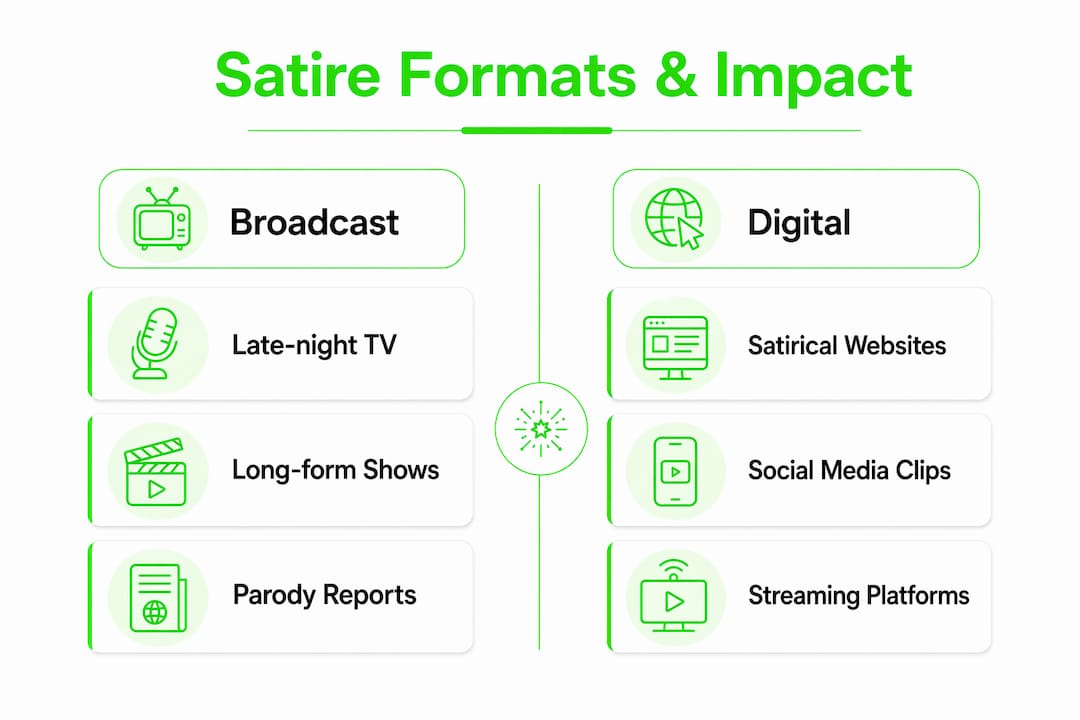
| Format | Key Examples | Audience Profile | Credibility Signals |
|---|---|---|---|
| Late-night TV segments | The Daily Show, Last Week Tonight, The Colbert Report | Broad, politically engaged adults; strong 18–49 demographic | Network/cable production values; research teams; fact-checking staff |
| Sketch comedy (TV) | Saturday Night Live Weekend Update | Mass-market; multigenerational | Institutional brand (NBC); long track record |
| Dedicated satirical websites | The Onion | Digital-native readers; younger adults | Consistent satirical framing; widely recognized brand |
| Social video / clips | Clips from the above, plus standalone creators | Fragmented; algorithm-driven; global | Variable; depends on source labeling and platform context |
The Daily Show, which Jon Stewart transformed into a cultural institution starting in 1999, pioneered the model of using real news footage as the raw material for satirical critique. Its production team includes researchers and journalists, blurring the line between comedy writing and reporting.
Last Week Tonight with John Oliver takes a long-form approach, dedicating 15–25 minutes to a single topic per episode. That depth allows for genuine investigative-style work: the show has prompted regulatory responses and mainstream news follow-up on topics from net neutrality to municipal fines.
The Colbert Report (2005–2014) ran a sustained parody of cable news punditry, using the character of a right-wing commentator to expose the conventions and contradictions of that format. It remains one of the most studied examples of satire as a journalistic tool in academic literature.
Saturday Night Live’s Weekend Update is the longest-running satirical news format in American television, dating to 1975. Its sketch-comedy context means it operates with less factual accountability than the long-form shows, but its cultural reach is unmatched.
The Onion operates as a dedicated satirical news website, using the conventions of straight news writing to expose absurdity. Its headlines function as compressed arguments, and its format has been widely imitated globally.
Social media has complicated all of this. A clip from any of these programs, stripped of its framing, can circulate as though it were straight news. That decontextualization is one of the format’s biggest risks.
How satire interacts with mainstream journalism: cooperation and tension
The relationship between satirists and traditional news organizations is genuinely complicated. Scholars describe it as parasitical but symbiotic: satire depends on mainstream reporting for its raw material, while mainstream journalism benefits from the scrutiny and amplification satire provides.
Satirists cannot do what they do without straight reporters doing their jobs first. A Last Week Tonight segment on prison labor starts with documented reporting from newspapers and government records. The satirical layer adds critique, emotional resonance, and reach. Without the underlying journalism, there is nothing to satirize.
“Scholars characterize satire as ‘parasitical’ — it relies on mainstream reporting for raw material — but also symbiotic because it can drive media literacy and public scrutiny of news coverage.” — Journalism Practice (2024)
The tension runs in the other direction too. Satirists can call out journalistic failures in ways that straight reporters cannot. During the Trump administration, many viewers felt that satirical programs were more direct about labeling falsehoods than news networks constrained by both-sides framing. That critique, delivered through comedy, put pressure on mainstream outlets to reconsider their own conventions. You can see this dynamic explored further in Naijatipsland’s analysis of how traditional media shapes civic life.
The production reality reinforces this overlap. Satire teams often include journalists and researchers working alongside comedy writers. The GIJN reporting on satirical news production found that some satirists pursue investigative-like work, conducting interviews and reviewing documents before writing a single joke. That blurring of genre boundaries is not a problem to solve. It reflects how the information ecosystem actually works.
What research shows about satire’s effects and the main risks to watch for
The evidence on what satire actually does to audiences is more nuanced than either its defenders or critics usually admit.
The three-level meta-analysis covering 70 studies and 22,969 participants found three consistent effects. First, satire reliably increases positive affect: audiences enjoy it and feel more engaged. Second, satire increases learning compared to receiving no information at all, but it does not consistently outperform regular news on knowledge gain. Third, persuasion effects are real but limited overall, with stronger effects among Republicans, students, TV satire viewers, and when satire targets social actors rather than abstract issues.
Key finding: Across 70 studies and 22,969 participants, satire reliably boosts engagement and positive affect, but its persuasion effects are modest and depend heavily on who is watching and what the satire targets.
The risks are concrete and worth taking seriously:
- Misreading satire as literal news. Audiences unfamiliar with a satirical outlet can share Onion headlines as fact. This happens regularly on social media and has been documented in multiple studies.
- Decontextualized clips. A satirical segment stripped of its framing and shared on social platforms can function as misinformation, even when the original intent was clearly comedic.
- Message discounting. The same meta-analysis found that satire also increases message discounting: audiences may dismiss the underlying factual claim because it arrived in a comedic package.
- Increased cynicism. Some research suggests heavy satire consumption can deepen political cynicism without translating into constructive civic action.
- Credibility trade-offs. News organizations that integrate satirical formats risk blurring their brand authority if they do not clearly signal the distinction between opinion and reporting.
Researchers recommend two mitigation strategies: clear labeling of satirical content at the source, and contextual framing that helps audiences connect the satirical claim to its factual basis. Platforms that surface satirical clips algorithmically without labeling them carry significant responsibility here. Understanding how news impacts daily life helps clarify why these distinctions matter beyond academic debate.
Three case studies showing satire influencing public discussion
Case 1: Last Week Tonight and net neutrality (2014–2017)
John Oliver’s June 2014 segment on net neutrality is one of the clearest documented cases of satire driving civic action. Oliver explained a complex regulatory issue using accessible language and direct humor, then directed viewers to the FCC’s public comment system. The FCC’s website crashed under the volume of responses. The segment was widely credited with mobilizing public participation in a regulatory process that most Americans had never engaged with. Mainstream outlets followed with their own coverage, citing the public response the segment had generated. The FCC ultimately adopted net neutrality rules in 2015, though the policy has since been revised.
Case 2: The Daily Show and the 9/11 first responders bill (2010)
Jon Stewart dedicated the final week of The Daily Show before Congress’s holiday recess to the James Zadroga 9/11 Health and Compensation Act, which had stalled in the Senate. The segments combined emotional interviews with first responders and sharp satirical critique of senators who opposed the bill. Mainstream news had covered the bill’s stalling, but Stewart’s sustained satirical pressure reframed it as a moral failure rather than a procedural delay. The bill passed in December 2010. Multiple senators and journalists credited the show’s coverage with shifting public attention and political will.
Case 3: Satire as navigational tool during political disruption (2016–2020)
Researchers studying the Trump era documented a specific function: satire helped audiences navigate disorienting political events by providing a shared emotional register and a community frame for processing rapid change. Programs like SNL, The Daily Show, and Last Week Tonight saw significant audience growth during this period. Scholars noted that humor lowered the psychological barrier to engaging with events that felt overwhelming in straight news format, contributing to both community-building and agenda-setting. This navigational function is distinct from persuasion: it is less about changing minds and more about helping audiences stay oriented.
Ethical and legal considerations for creators and platforms
Satire operates in a legally protected but legally bounded space. Three principles govern the U.S. framework.
Defamation basics: A satirical statement can become defamatory if a reasonable person could interpret it as a statement of fact rather than obvious exaggeration. Courts generally protect satire when the comedic intent is clear, but ambiguity creates risk.
Transformative parody protection: U.S. copyright law protects parody as a form of fair use when the new work comments on or critiques the original. Straight imitation without commentary does not qualify.
Safe labeling practices: Clearly labeling content as satire, opinion, or parody reduces both legal and ethical risk. This is not just a legal formality; it is the primary tool for preventing audience misinterpretation.
Beyond the legal layer, an ethical checklist for creators covers four areas:
- Transparency of intent: Make the satirical frame unmistakable through format, tone, and explicit labeling.
- Fact-check the underlying claims: The satirical layer should distort real facts for effect, not fabricate them. Verify the events you are satirizing.
- Disclaimers where needed: When a satirical piece could plausibly be mistaken for straight news, add a clear disclaimer.
- Accessibility of context: Provide enough context that audiences unfamiliar with the subject can understand what is being critiqued and why.
Pro Tip: Before publishing a satirical piece, ask whether a reader encountering it without context could mistake it for a factual report. If the answer is yes, add a label or adjust the framing. Transparency about point of view is the single most effective tool for maintaining both credibility and satirical impact, as researcher Sara Ödmark notes from her interviews with satirical news production teams.
For deeper guidance on media transparency practices, Naijatipsland’s coverage of accountability in journalism offers a practical framework.
How audiences and journalists should interpret and use satire responsibly
Knowing how to read satire is a media literacy skill, and it is one that matters more as satirical content circulates on social platforms without its original framing.
Audience checklist: how to identify and interpret satire
- Check the source: Is it a known satirical outlet (The Onion, The Babylon Bee) or a news organization?
- Look for tone cues: Exaggeration, absurdist logic, and obvious irony signal satire.
- Check the headline against straight news sources. If no mainstream outlet is reporting the same event, the piece may be satirical or fabricated.
- Read past the headline. Satirical pieces often signal their intent in the first paragraph.
- Verify the underlying facts the satire points to, not the satirical claim itself.
- Ask: Is this piece transparent about its point of view? Satire is opinion journalism, not neutral reporting.
Journalist checklist: how to engage with satire responsibly
- Label clearly when your outlet uses satirical or comedic framing. Do not let readers guess.
- Source the underlying facts independently before building a satirical argument on them.
- Contextualize satirical claims when reporting on them: explain what the satire is responding to and what the factual record shows.
- Avoid false equivalence: treating a satirical claim and a factual report as equivalent sources is a journalistic error.
- When covering a satirical program’s impact (e.g., the FCC comment surge after Oliver’s net neutrality segment), report on the civic response separately from the satirical content itself.
The examples of civic news stories that drive public engagement show how the line between satirical and civic reporting can blur productively when both sides are transparent about their methods.
What academic research and recent studies conclude about news satire
The scholarly literature on news satire has grown substantially over the past decade. Here is what the strongest studies actually show, and where the evidence remains uncertain.
| Study / Source | Key Finding | Limitation |
|---|---|---|
| Ödmark & Jonas, Journalism Practice (2024) | News satire scores high on Watchdog, Advocate, and Civic Educator roles; low on neutral Reporter role; introduces “comedic interlocutor” role | Sample of 150 segments from 3 Western shows; limited geographic scope |
| Three-level meta-analysis, Communication Research (SAGE) | Satire increases positive affect and learning vs. no-information controls; limited persuasion effects overall; stronger effects for Republicans, students, TV satire | Effect sizes vary by context; most studies use U.S. student samples |
| NiemanLab synthesis (2024) | Journalistic comedy expands journalism’s emotional, subjective, and dialogic roles; increases audience involvement | Synthesis of existing studies; not primary data |
| The Conversation (crisis navigation) | Satire helps audiences process disorienting political events; lowers engagement barriers; contributes to community-building | Largely observational; causal claims are difficult to establish |
| GIJN practitioner report | Satire teams often include journalists and researchers; some pursue investigative-like work | Field reporting; not a controlled study |
Several moderators shape how strong satire’s effects are. TV satire tends to outperform text-based satire on persuasion. Satire targeting specific social actors (politicians, executives) produces stronger effects than satire targeting abstract issues. Audience political identity matters: the meta-analysis found stronger persuasion effects among Republican viewers, which researchers attribute partly to the novelty of encountering critique in an entertaining format.
The honest limitation of this literature is that most studies use U.S. student samples in experimental settings. Real-world effects, measured at scale across diverse audiences, are harder to establish. The civic engagement evidence from programs like The Daily Show is compelling but largely observational. Researchers are still working out the causal mechanisms.
Key Takeaways
News satire functions as opinion journalism with a comedic frame, performing watchdog, educator, and engagement roles that straight reporting often cannot, while carrying real risks of misinterpretation that both creators and audiences need to manage.
| Point | Details |
|---|---|
| Satire’s core civic roles | News satire scores high on Watchdog, Advocate, and Civic Educator functions in peer-reviewed content analysis. |
| Meta-analysis evidence | Across 70 studies and 22,969 participants, satire reliably increases positive affect and engagement. |
| Persuasion is limited | Satire’s persuasion effects are modest overall, with stronger results among specific audiences like students and TV viewers. |
| Misinterpretation risk | Decontextualized satirical clips circulate as misinformation; clear labeling is the primary mitigation tool. |
| Verification habit | Always check the underlying facts a satirical piece points to, not the satirical claim itself. |
Why satire matters more now than most journalism critics admit
The conventional critique of satirical news is that it trades credibility for laughs and leaves audiences entertained but uninformed. The research does not support that framing. What the Journalism Practice content analysis and the large-scale meta-analysis together show is that news satire performs genuine journalistic functions, reaches audiences that straight reporting often misses, and can drive civic action in documented, measurable ways. The net neutrality case and the 9/11 first responders bill are not flukes. They are evidence of a genre that, at its best, does something traditional journalism struggles to do: make complex, slow-moving policy feel urgent and personal.
The risk is real too. Satire that circulates without its framing becomes misinformation. Audiences who consume satire without verifying its factual basis can mistake comedic exaggeration for documented fact. The solution is not less satire. It is more media literacy, better labeling, and a clearer understanding of what the genre is actually doing. Naijatipsland’s coverage of media accountability reflects that same commitment: transparency about point of view is not a weakness in journalism. It is the foundation of trust.
Useful sources for deepening your understanding
Between Headlines and Punchlines, Journalism Practice (2024): The primary content analysis of 150 satirical segments that introduces the six journalistic role taxonomy, including the comedic interlocutor. Start here for the most current empirical mapping of what news satire actually does.
Three-Level Meta-Analysis, Communication Research (SAGE): The most comprehensive quantitative synthesis of satire’s effects on affect, learning, and persuasion. Covers 70 studies and 22,969 participants. Essential for understanding what the evidence base actually shows and where it is uncertain.
NiemanLab synthesis (2024): Accessible overview of the Journalism Practice study with extended interview material from researcher Sara Ödmark. Best entry point for readers who want the scholarly findings in plain language.
The Conversation: satire and disorienting politics: Practitioner and researcher perspectives on satire’s navigational function during political crises. Useful for understanding the emotional and community-building dimensions of the genre.
GIJN: Engaging journalism audiences through satire: Field reporting on how satirical news teams are structured and how they approach verification. Practical and grounded in real production experience.
Comedic journalism, Wikipedia: A readable overview of the genre’s history and key examples. Useful as a starting reference, though it should be paired with peer-reviewed sources for any serious claim.
Satire, Wikipedia: Accessible summary of satire’s rhetorical devices and historical context. Good for grounding the definition section before moving to more specialized sources.
This article is general information about how satire functions in journalism and is not professional legal or media-practice advice. For specific legal questions about defamation or parody, consult a qualified attorney familiar with U.S. media law.