

TL;DR:
- Community platform founders can grow through memberships, newsletters, digital courses, and consulting, leveraging existing user habits. They should validate demand early with micro-products and focus on distribution channels like WhatsApp and Facebook groups to attract Nigerian users. Starting with services and connecting dual payment systems ensures quick income, while careful tracking and legal compliance protect long-term success.
The seven most practical internet business opportunities for Nigerian community platform founders are: community memberships, paid newsletters, digital products and courses, consulting and services, affiliate curation, events and workshops, and e-commerce or marketplace listings. Each one maps directly to what a news and discussion forum like Naijatipsland already does well.
- Community memberships — Charge a monthly or annual fee for premium threads, early news access, or ad-free browsing. Suits diaspora founders with an existing audience.
- Paid newsletters — Curate Nigerian current affairs analysis into a weekly email. Low setup cost, high trust value. Best for solo creators with editorial skills.
- Digital products and courses — Sell guides on content creation, Nigerian business law, or diaspora finance. One-time build, recurring sales. Ideal for subject-matter experts.
- Consulting and services — Offer community management, social media strategy, or SEO audits to Nigerian brands. Fast income, no product build required. Great for beginners.
- Affiliate curation — Recommend Nigerian-relevant tools, VPNs, fintech apps, or hosting services and earn commissions. Works alongside any other model.
- Events and workshops — Host virtual town halls, career panels, or Afrobeats listening parties. Ticketed or sponsored. Suits small teams with an engaged list.
- E-commerce and marketplace listings — Sell digital goods, merchandise, or curated product bundles through the forum. Fits platforms with high repeat-visit traffic.
Table of Contents
- What does each internet business opportunity look like day-to-day?
- How do you pick the right model for your community?
- What should you sell first, and how do you price it?
- What does your MVP look like, and what will it cost?
- Where do you find Nigerian users, and how do you keep them?
- What legal and tax risks should US-based operators know about?
- Which payment gateways work best for Nigerian community platforms?
- Key Takeaways
- What building a community business actually taught us
- Further reading and authoritative resources
What does each internet business opportunity look like day-to-day?
On a community forum, these models are not abstract. They show up in specific user behaviors and platform features.
A membership tier means registered users pay $5–$15 per month to access a “Members Only” subforum where moderators post deeper analysis of Nigerian politics or exclusive entertainment scoops. The key driver is repeat visits: members who check in daily are far more likely to renew. Naijatipsland’s civic discussion threads already create this habit.
Paid newsletters pull the best forum discussions into a curated weekly digest. A founder who covers Nigerian economic policy or Nollywood releases can charge $7–$12 per month. The newsletter becomes a lead funnel back to the forum, and the forum feeds newsletter content. Both grow together.
Micro-courses on topics like “How to grow a WhatsApp community to 1,000 members” or “Nigerian freelancing for beginners” sell well to the same audience that reads forum how-to threads. Digital storytelling formats that work in forum posts translate directly into course modules.

Consulting is the fastest path to cash. If you run a forum, you already understand community management, content moderation, and audience engagement. Nigerian brands and diaspora nonprofits will pay for that expertise. No product build needed.
Affiliate curation works when the recommendations feel native. A thread titled “Best VPNs for Nigerian users in 2026” with honest reviews and affiliate links earns commissions without breaking community trust, provided the editorial standards stay clear. Naijatipsland’s approach to media transparency makes this credible.
Because barriers to entry are low, the real competitive edge is knowing where your audience already gathers and serving them there first.
How do you pick the right model for your community?
Ask these four questions before committing to any model:
- Do you have existing expertise? Founders who build on skills they already have reach profitability about 3x faster than those entering unfamiliar domains. If you know Nigerian immigration law, a paid newsletter or consulting service beats starting a dropshipping store.
- How fast do you need income? Consulting and services pay within weeks. Courses and memberships take 1–3 months to build an audience. Affiliate income is slow at first but compounds.
- Where does your audience already gather? WhatsApp groups, Facebook Groups, and X communities are where Nigerian users spend time before they find your forum. Your distribution plan must start there.
- Can you defend your niche? A defensible niche and a documented acquisition plan matter more than the product itself. “Nigerian diaspora finance” is defensible. “General business tips” is not.
Checklist before you choose:
- You can name at least three specific topics your audience asks about repeatedly.
- You know which two or three channels your first 100 users will come from.
- You can describe one competitor and explain why your angle is different.
- You are willing to spend 90 days building before expecting consistent revenue.
Pro Tip: Validate demand before building. Post a simple Google Form or a pinned forum thread asking your audience if they would pay $10 for a specific guide or newsletter. If 20 out of 100 respondents say yes, that is enough signal to build the micro-product.
What should you sell first, and how do you price it?
The most reliable monetization sequence for community-first platforms is: services first, then digital products, then memberships. Community-centric businesses typically begin with high-touch consulting or freelancing and move to asset-based models as trust builds.
| Revenue Model | Margin | Setup Time | Churn Risk | Best For |
|---|---|---|---|---|
| Consulting / services | Medium | 1–2 weeks | Low | Beginners, fast income |
| Paid newsletter | High | 2–4 weeks | Medium | Solo creators, editorial skill |
| Digital products / courses | Very high | 4–8 weeks | Low | Subject-matter experts |
| Memberships / subscriptions | High | 6–12 weeks | Medium–High | Established audiences |
| Affiliate curation | Medium | 1-week | Low | Any stage |
| Events / workshops | Medium | 2–3 weeks | Low | Engaged lists |
| E-commerce / marketplace | Low–Medium | 4–8 weeks | Low | High-traffic forums |
Start with micro-products priced $7–$49 to test willingness to pay before investing in a full course. A $19 “Nigerian Freelancer Starter Pack” PDF validates the audience before you spend eight weeks building a $197 course. Bundling a micro-product with a 30-day free membership trial is a proven launch offer for forum platforms. For detailed tactics, Naijatipsland’s guide on content monetization strategies covers pricing frameworks specific to Nigerian creators.
What does your MVP look like, and what will it cost?
A community forum MVP needs four core features: user registration, threaded discussions, basic moderation tools, and a payment integration. Nothing else is required at launch. Typical monthly and yearly costs may be minimal, often under a few hundred dollars for basic hosted platforms and domain services.
Many online businesses launch under $500, and a community forum is no exception. The real cost is time: expect 1–6 months of consistent, largely unmonetized work before you see traction.
90-day launch checklist:
- Week 1–2: Register domain, set up forum software, configure Stripe and Flutterwave.
- Week 3–4: Publish 10 seed discussion threads on your core topic. Invite 20 people personally.
- Week 5–8: Post daily. Recruit three moderators. Launch a free newsletter.
- Week 9–10: Release your first micro-product ($7–$19). Announce to your list.
- Week 11–12: Run your first paid acquisition test (Facebook Group posts, WhatsApp broadcasts).
Document exactly how your first 100 users will find you before you write a single line of code. Distribution is a written plan, not an assumption. The Naijatipsland user registration guide covers onboarding flows worth reviewing before launch.
Where do you find Nigerian users, and how do you keep them?
Nigerian audiences are concentrated on a handful of platforms before they discover niche forums. Your acquisition strategy must start where they already are.
- WhatsApp groups are the highest-trust channel for Nigerian users. Share forum threads as links in relevant groups. Never spam; add value first.
- Facebook Groups focused on Nigerian diaspora, Naija professionals, or specific cities (Lagos, Abuja, London Nigerians) are high-intent discovery pools.
- X (Twitter) communities around Nigerian current affairs, tech, and entertainment drive traffic when you post thread summaries with a link back to the full forum discussion.
- TikTok and Instagram Reels work for entertainment and lifestyle verticals. Short clips summarizing forum debates drive curious viewers to sign up.
- Referral programs with a small incentive (one free month of membership, a free guide) consistently outperform paid ads for community platforms at early stage.
Track three metrics weekly: activation rate (did a new user post within 7 days?), 7-day retention (did they return?), and monthly revenue per active member. A focused, engaged community can generate consistent monthly revenue reflecting meaningful member engagement and effective monetization. Naijatipsland’s guide on engagement metrics and its social growth workflow are practical starting points for building this measurement habit.
What legal and tax risks should US-based operators know about?
If you operate from the United States while serving Nigerian users, four risk areas need your attention before you launch.
Payments and chargebacks: Stripe is the standard US processor, but Nigerian users often prefer Flutterwave, Paystack, or mobile money. Chargebacks on digital goods run higher than physical products; set clear refund policies in your terms of service.
Content liability: Section 230 of the Communications Decency Act gives US-based forum operators broad protection for user-generated content, but it does not cover content you create or curate yourself. Moderate actively and document your moderation policy.
Data privacy: If any users are in California, the California Consumer Privacy Act (CCPA) applies. If you collect email addresses from EU-based Nigerian diaspora users, GDPR applies. Use a cookie consent tool and a clear privacy policy from day one.
US tax obligations: As a US-based operator, you owe federal income tax on all revenue regardless of where users are located. If your gross receipts exceed $400 in a year from self-employment, you file Schedule C. Consult a US-licensed CPA before your first paid product launch.
Warning: Many first-time founders skip the terms of service and privacy policy to save time. This is the single most common legal exposure point for community platforms. A basic legal template from a service like Termly or a one-hour consultation with a US attorney costs far less than a CCPA complaint or a payment processor account suspension.
This article is general information, not legal or tax advice. Confirm your specific obligations with a qualified US attorney or CPA.
How Naijatipsland runs a community hub and earns from it
Naijatipsland operates as a news aggregation and community forum covering Nigerian current affairs, entertainment, politics, and lifestyle. Its model combines user-generated discussion threads with editorial content, creating a platform where members return daily for both news and conversation. The site monetizes through display advertising, user participation, and post submissions, keeping the barrier to entry low for new members.
Three lessons other Nigerian community builders can take from this approach: First, lead with content, not commerce. Naijatipsland built its audience on free, relevant news before introducing any monetization layer. Second, test small paywalls early. A single premium newsletter or members-only thread reveals willingness to pay without risking the broader community. Third, support local payment methods. Nigerian users convert at higher rates when they can pay in naira via Flutterwave or Paystack rather than USD via credit card alone.
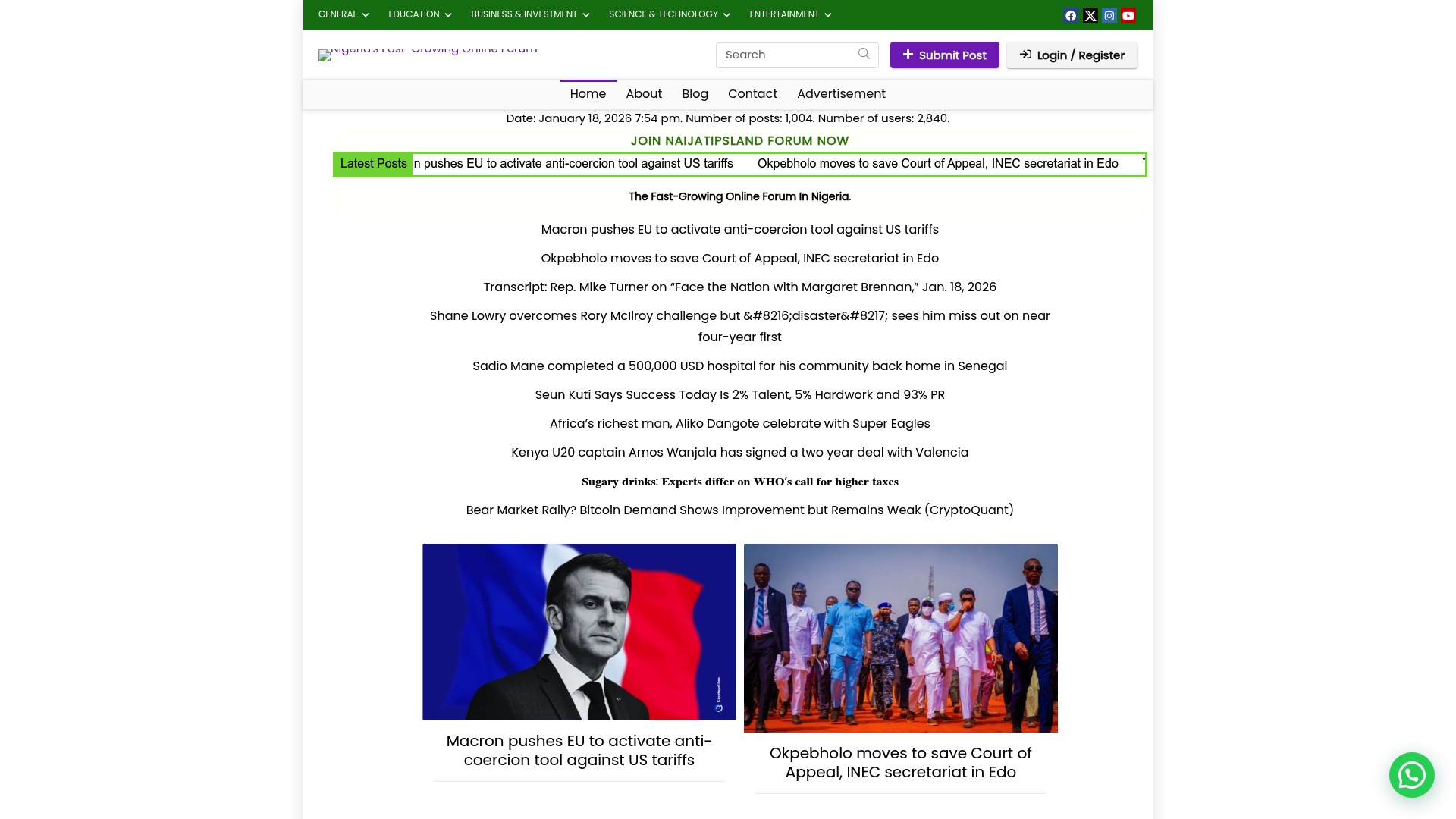
Explore Naijatipsland’s current affairs coverage and entertainment updates to see how a community-first editorial model works in practice, and register to join the discussion.
Which payment gateways work best for Nigerian community platforms?
For US-based operators serving Nigerian users, the payment stack needs to handle both USD and naira transactions reliably.
Flutterwave supports card payments, bank transfers, and mobile money across Nigeria and 30+ African countries. It integrates with Stripe for US-side settlement, making it the most practical dual-market solution. Paystack (owned by Stripe) is the dominant Nigerian gateway for card and bank transfer payments and offers a clean API for forum subscription billing. Both charge transaction fees in the 1.4%–3.8% range depending on card type and currency.
For mobile money specifically, OPay and PalmPay are widely used in Nigeria for peer-to-peer and merchant payments. If your audience skews toward users without international cards, offering a Flutterwave bank transfer option alongside a card option typically increases conversion.
On the US side, Stripe handles subscription billing, invoicing, and payout to your US bank account. Connect Stripe to Flutterwave or Paystack so Nigerian users pay in their preferred method while you receive USD. Set up webhook notifications for failed payments and automate dunning emails to reduce involuntary churn on membership subscriptions.
Pro Tip: Launch with Flutterwave and Stripe connected from day one. Retrofitting payment infrastructure after you have paying members is far more disruptive than setting it up correctly at the start.
Key Takeaways
A tightly focused, engaged community of 800–2,000 members can generate $1,000–$3,000 per month — proof that depth of engagement matters more than raw traffic volume.
| Point | Details |
|---|---|
| Start with services | Consulting and freelancing generate income within weeks while you build your audience. |
| Validate before building | Use micro-products priced $7–$49 to confirm willingness to pay before investing in a full course. |
| Document your first 100 users | Write down exactly which two or three channels will deliver your first 100 members before launch. |
| Use dual payment stacks | Connect Flutterwave or Paystack for Nigerian users and Stripe for US-side settlement from day one. |
| Track three core metrics | Monitor activation rate, 7-day retention, and monthly revenue per active member every week. |
5-step next-steps checklist:
- Pick one model from the shortlist that matches your existing expertise.
- Validate demand with 100 users via a Google Form or pinned thread before building.
- Launch a micro-product ($7–$49) as your first monetization test.
- Set up Flutterwave and Stripe before your first paid offer goes live.
- Run your first acquisition test on WhatsApp groups or a relevant Facebook Group.
For follow-up reading, Naijatipsland covers side hustle ideas for Nigerian young adults and how digital communities drive social change in depth.
What building a community business actually taught us
The conventional advice says “start cheap and iterate fast.” That is correct, but it misses the harder truth: cheap to start does not mean cheap to sustain. The real cost of a community platform is the hours you spend showing up before anyone pays you. Most founders underestimate this by a factor of three.
Distribution deserves more attention than the product itself. The forums that grow are not always the best-designed ones. They are the ones whose founders spent the first 60 days in WhatsApp groups, Facebook communities, and X threads, building relationships before dropping a link. Trust is the product. Everything else is packaging.
For diaspora founders and Nigerian youth reading this: start with what you already know. Your lived experience of navigating two cultures, two economies, and two sets of expectations is a genuine competitive advantage. Build the community you wish existed when you were starting out.
Further reading and authoritative resources
- Naijatipsland: How to Monetize Content — Practical pricing frameworks and monetization sequences tailored to Nigerian content creators. Start here before setting your first product price.
- Naijatipsland: Side Hustle Ideas for Nigerian Young Adults — Localized first steps and realistic income expectations for beginners building online income in 2026.
- Naijatipsland: Engagement Metrics Guide — Covers the KPIs that matter for community retention and how to measure them without expensive analytics tools.
- Shopify: 25 Online Business Ideas for 2026 — Broad overview of models from dropshipping to coaching; useful for benchmarking startup costs and income potential across categories.
- Xero US: Online Business Ideas — Covers realistic cost ranges and the time investment required for content and community models; good for expectation-setting.
- Naijatipsland: SEO Success in 2026 — SEO tactics for community and content sites that improve organic discoverability without paid ads.
- Naijatipsland: Social Media Growth Workflow — Step-by-step acquisition workflows built for Nigerian creators on WhatsApp, Instagram, and X.
All claims in this article are backed by the sources linked above. For legal and tax matters specific to your situation, consult a US-licensed attorney or CPA.