


TL;DR:
- Media transparency involves openly disclosing how news is produced, funded, and governed to build public trust. Embedding brief transparency explanations within stories and revealing ownership and funding sources help media outlets foster credibility. Transparency standards are especially critical for Nigerian media to strengthen democracy and rebuild audience confidence.
Media transparency is defined as the open disclosure of how news is produced, funded, and governed so that audiences can judge journalism on evidence rather than faith. The importance of media transparency goes far beyond good intentions. It is the foundation of public trust, civic accountability, and informed citizenship. In Nigeria and across the globe, audiences are more skeptical than ever about what they read and watch. Promoting media transparency gives readers the tools to evaluate news sources themselves, rather than simply accepting or rejecting them. This article breaks down the key standards, daily practices, and emerging challenges that make transparency the most critical issue in journalism today.
Why promote media transparency: the case for open journalism
Media transparency replaces demanded faith with observable evidence, enabling readers to judge journalism reliability themselves. That shift matters enormously. When a news outlet explains its sourcing, discloses its funding, and publishes its correction policy, readers gain the context they need to decide whether to trust it.

One media analyst makes a striking point: transparency may matter more than trust itself. The reasoning is direct. Trust is an emotion that can be manipulated. Transparency is a set of observable facts. When audiences understand who owns a media outlet, who funds it, and what editorial principles guide it, they can navigate bias on their own terms.
The benefits of media transparency extend beyond individual readers. Open journalism strengthens democracy by holding power to account. In Nigeria, where public trust in institutions is often fragile, a transparent press gives citizens the credible information they need to participate in civic life. Transparency in news reporting is not a luxury. It is a structural requirement for a functioning democracy.
What are the key elements that define media transparency standards?
The Journalism Trust Initiative and the Oxford Declaration 2026 identify five core disclosure areas that define credible, transparent journalism. These are not optional best practices. They are the minimum standard for any outlet that claims public accountability.
| Disclosure Area | What it requires |
|---|---|
| Ownership | Public identification of who owns and controls the outlet |
| Governance | Clear editorial leadership and decision-making structures |
| Editorial policy | Published standards for sourcing, fact-checking, and fairness |
| Revenue sources | Disclosure of advertising, grants, subscriptions, and other funding |
| Correction procedures | A visible, accessible process for fixing errors |
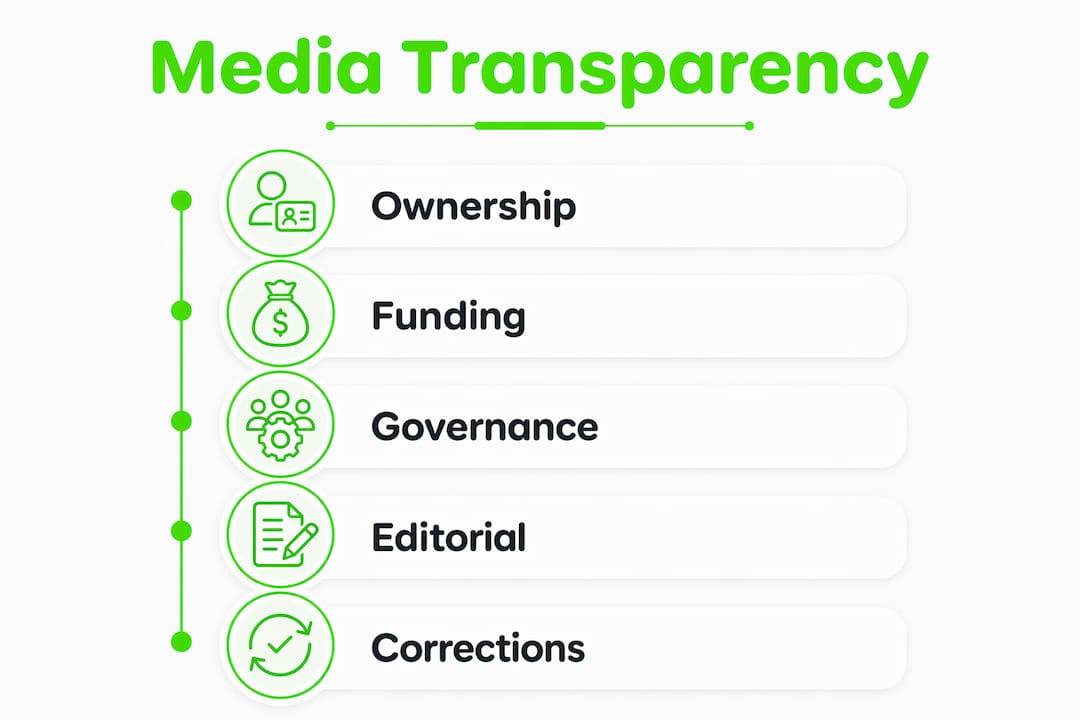
Each of these areas addresses a specific trust gap. Ownership disclosure prevents hidden conflicts of interest. Revenue transparency shows whether advertisers or donors influence coverage. Correction procedures signal that the outlet values accuracy over pride.
For Nigerian media, these standards carry particular weight. Many outlets operate without published editorial policies or accessible correction processes. Adopting the five-area framework from the Journalism Trust Initiative gives local newsrooms a credible, internationally recognized path to rebuilding public confidence.
- Ownership disclosure prevents hidden conflicts of interest from shaping coverage.
- Editorial policy transparency lets readers hold journalists to stated standards.
- Revenue disclosure separates editorial decisions from business pressures.
- Correction procedures demonstrate that accuracy matters more than reputation protection.
- Governance clarity shows readers who is responsible when things go wrong.
How does embedding transparency into daily reporting improve trust?
Embedding transparency directly into news stories improves audience trust more than general policy statements do. A policy page buried in a website footer reaches almost no one. A brief explanation inside a story, telling readers why a source was chosen or why a story was covered, reaches everyone who reads that piece.
Audiences and community leaders respond positively when journalists explain their reporting process within the content itself. This is not about adding lengthy disclaimers. It is about brief, honest notes that show the work behind the story. A journalist covering a government contract dispute might note that the official declined to comment after three requests. That single sentence tells readers the journalist tried, and it tells them something about the official too.
The practical steps for day-to-day transparency are straightforward:
- State why a story matters to your specific audience.
- Name your sources and explain why they were chosen.
- Acknowledge what you do not know or could not confirm.
- Note when officials or subjects declined to respond.
- Explain any corrections clearly and promptly.
Pro Tip: When deciding what transparency details to include in a story, ask yourself: “What would a skeptical reader want to know about how I reported this?” That question cuts through overthinking and points you to the one or two details that actually build trust.
The impact of media transparency at the story level is cumulative. Each transparent story adds to a pattern that readers recognize over time. That pattern becomes the outlet’s reputation for honesty.
Why is capital transparency critical for overcoming skepticism about media motives?
Capital transparency is the open disclosure of a media outlet’s business model, profit motives, and financial relationships with advertisers, donors, and investors. Research identifies capital transparency as a necessary supplement to traditional editorial transparency, specifically because it addresses the public’s deepest suspicion: that news coverage is shaped by money.
“Separating editorial content from business motives and embracing capital transparency fills the public’s perceived transparency gap. Audiences do not just want to know what a journalist believes. They want to know who is paying for the journalism and whether that payment shapes the story.”
The tension between profit and public good is real in every media market. In Nigeria, commercial pressures on newsrooms are intense. Advertising revenue is scarce, and some outlets depend heavily on government contracts or politically connected sponsors. Without capital transparency, readers have no way to assess whether those relationships affect coverage. With it, they can make an informed judgment.
Capital transparency also protects outlets from unfair accusations. When a newsroom openly publishes its funding sources and explains its editorial firewall, it gives critics less room to claim hidden bias. The disclosure itself becomes a form of credibility. Understanding how media incentives affect coverage is the first step toward evaluating any news source with clear eyes.
What role does transparency play in AI-generated content and digital media?
The 2026 Oxford Declaration calls for radical transparency in response to the growing use of artificial intelligence in news production. The core demand is straightforward: audiences must be able to identify the real human being responsible for any piece of journalism, regardless of how much AI assisted in its creation.
The risks of failing this standard are concrete:
- Readers who discover undisclosed AI authorship lose trust in the entire outlet, not just the individual story.
- AI-generated errors that go uncorrected damage credibility faster than human errors, because they suggest no human reviewed the work.
- Outlets that use AI without disclosure face growing regulatory scrutiny in multiple jurisdictions.
- Audiences in Nigeria and across Africa are already alert to misinformation. Undisclosed AI use feeds that suspicion directly.
- Competitors who do disclose AI use gain a credibility advantage simply by being open.
The role of digital journalism in Nigeria is expanding rapidly. That expansion brings both opportunity and risk. Outlets that adopt radical transparency standards now, including clear AI disclosure policies and named human editors for every published piece, will be better positioned to hold audience trust as the technology evolves.
Media ethics and transparency in the AI era require more than a policy statement. They require visible, story-level disclosure every time AI plays a meaningful role in production.
How can media organizations build two-way transparency with their audiences?
Two-way engagement mechanisms such as ombudspersons and public complaint processes build more trust than one-way transparency statements. The distinction matters. Publishing a transparency page tells readers what you believe about yourself. Creating a feedback channel lets readers tell you what they believe about your coverage.
An ombudsperson is an independent representative who investigates audience complaints about editorial decisions and publishes findings publicly. This role exists at major outlets worldwide and is recognized by the Journalism Trust Initiative as a gold standard for promoting media accountability. Nigerian newsrooms that cannot afford a dedicated ombudsperson can achieve similar results through a published complaints email, a regular “reader questions” column, or a community advisory board.
Practical steps for building two-way transparency include:
- Publish a clear, accessible complaints process with a named contact.
- Respond publicly to significant audience criticisms, even when you disagree.
- Invite local community leaders to editorial meetings on issues affecting their communities.
- Partner with civil society organizations to audit coverage of key public interest topics.
- Use community journalism principles to give underrepresented voices a direct role in shaping coverage.
The shift from broadcasting transparency statements to building interactive accountability is the most important evolution in media ethics today. Audiences who feel heard are far more likely to trust an outlet that makes mistakes than audiences who feel ignored. Knowing how to ensure media transparency as a reader also means knowing how to engage with outlets that invite that dialogue. Reviewing editorial standards from credible outlets gives you a clear benchmark for what genuine openness looks like.
Key Takeaways
Promoting media transparency is the single most effective way to rebuild public trust in journalism, because it replaces demanded faith with observable, verifiable evidence.
| Point | Details |
|---|---|
| Five disclosure standards | The Journalism Trust Initiative requires ownership, governance, editorial policy, revenue, and correction disclosures. |
| Story-level transparency | Embedding transparency directly into news content builds trust more effectively than policy pages alone. |
| Capital transparency | Openly disclosing business models and funding sources addresses the public’s deepest doubts about media motives. |
| AI disclosure | The 2026 Oxford Declaration requires outlets to reveal real human authorship whenever AI assists in news production. |
| Two-way accountability | Ombudspersons and public complaint processes build more trust than one-way transparency statements. |
Naijatipsland’s take on transparency and Nigeria’s media future
Nigeria’s media environment is one of the most complex in Africa. Hundreds of outlets compete for attention in a market where public trust is low and misinformation spreads fast. I have watched this dynamic play out across political cycles, economic crises, and social upheavals. The outlets that survive and grow are not always the ones with the biggest budgets. They are the ones that treat their audiences as partners rather than passive consumers.
What strikes me most about the transparency conversation is how practical it actually is. You do not need a large newsroom or an international grant to explain why you chose a source, name the person who owns your outlet, or publish a correction clearly. These are decisions, not resources. The Nigerian outlets I find most credible are the ones that make those decisions consistently, even when it is uncomfortable.
The uncomfortable truth is that transparency sometimes means admitting you got something wrong, or that your funding comes from a source your readers might question. That discomfort is exactly the point. Audiences respect honesty about limitations far more than they respect the performance of perfection. Nigeria’s democratic health depends on a press that is willing to be seen clearly. Transparency is how that happens.
— Naijatipsland
Naijatipsland: your resource for informed media engagement
Staying informed in Nigeria means knowing how to evaluate what you read, not just what you read. Naijatipsland covers current affairs, entertainment, politics, and community issues with a commitment to helping you engage with credible information.
Whether you want to understand why reading credible updates matters or you want to take part in online discussions about Nigeria’s pressing issues, Naijatipsland gives you the platform to do both. The site brings together news, analysis, and community conversation in one accessible space. Explore the latest topics, share your perspective, and stay connected to the stories that shape Nigerian life.
FAQ
What is media transparency in journalism?
Media transparency is the open disclosure of how a news outlet is owned, funded, and governed, along with its editorial standards and correction processes. It gives audiences the evidence they need to evaluate journalism on their own terms.
Why is media transparency essential for public trust?
Transparency replaces demanded faith with observable facts, allowing audiences to assess credibility rather than simply accepting or rejecting coverage. Research shows that transparency embedded in stories builds more trust than general policy statements.
How does capital transparency differ from editorial transparency?
Editorial transparency covers sourcing, methods, and corrections. Capital transparency covers business models, profit motives, and financial relationships with advertisers or donors. Both are required for full accountability.
What does the 2026 Oxford Declaration say about AI and transparency?
The 2026 Oxford Declaration calls for radical transparency in AI-assisted journalism, requiring outlets to identify the real human author responsible for every published piece to prevent credibility erosion.
How can Nigerian media outlets improve transparency today?
Nigerian outlets can start by publishing ownership information, a clear editorial policy, and a named complaints contact. Adding story-level explanations of sourcing and reporting choices builds trust with every article published.