


TL;DR:
- Content monetization involves generating income from online content through various channels such as affiliate marketing, ads, sponsorships, digital products, and memberships. Building a stable income requires diversifying revenue streams, leveraging an email list, and understanding platform-specific monetization strategies. Starting early with low-barrier methods like UGC and affiliate marketing can lead to faster earnings and long-term success.
Content monetization is the process of generating revenue from your online content through multiple channels, including affiliate marketing, ads, brand sponsorships, digital products, and memberships. Knowing how to monetize content effectively separates creators who earn consistently from those who post without profit. Platforms like YouTube, Patreon, and Teachable have made it possible for creators at every level to build real income. This guide covers the most proven content monetization strategies, the tools you need, and the exact steps to start earning, whether you have 500 followers or 500,000.
Which content types and platforms work best for monetization?
Not every content format earns equally. Video, written blogs, podcasts, online courses, and user-generated content (UGC) each have distinct monetization paths, and the platform you choose determines which paths are open to you.
Here is how the major content types break down:
- Video content on YouTube qualifies for the YouTube Partner Program after 1,000 subscribers and 4,000 watch hours. Ad revenue is the entry point, but sponsorships and digital products scale far higher.
- Blog content earns through display ads (Google AdSense, Mediavine), affiliate links, and sponsored posts. Blogs with strong SEO traffic are among the best platforms for content monetization because they generate passive income long after publication.
- Podcasts monetize through dynamic ad insertion, Patreon memberships, and listener-supported models on platforms like Spotify and Apple Podcasts.
- Online courses on Teachable or Gumroad convert deep expertise into high-margin digital products with profit margins of 85–95%.
- UGC (user-generated content) is the fastest entry point. Brands pay creators to produce raw content for their own channels, with no follower count required.
Pro Tip: Match your platform to your audience’s behavior. High-traffic content favors ad revenue, while deep audience engagement supports memberships and paid communities.
To assess your fit, ask three questions: Where does your audience already spend time? What content format do you produce consistently? How much time can you invest in audience interaction? Your answers point directly to the right platform and monetization model.
What are the proven content monetization methods?
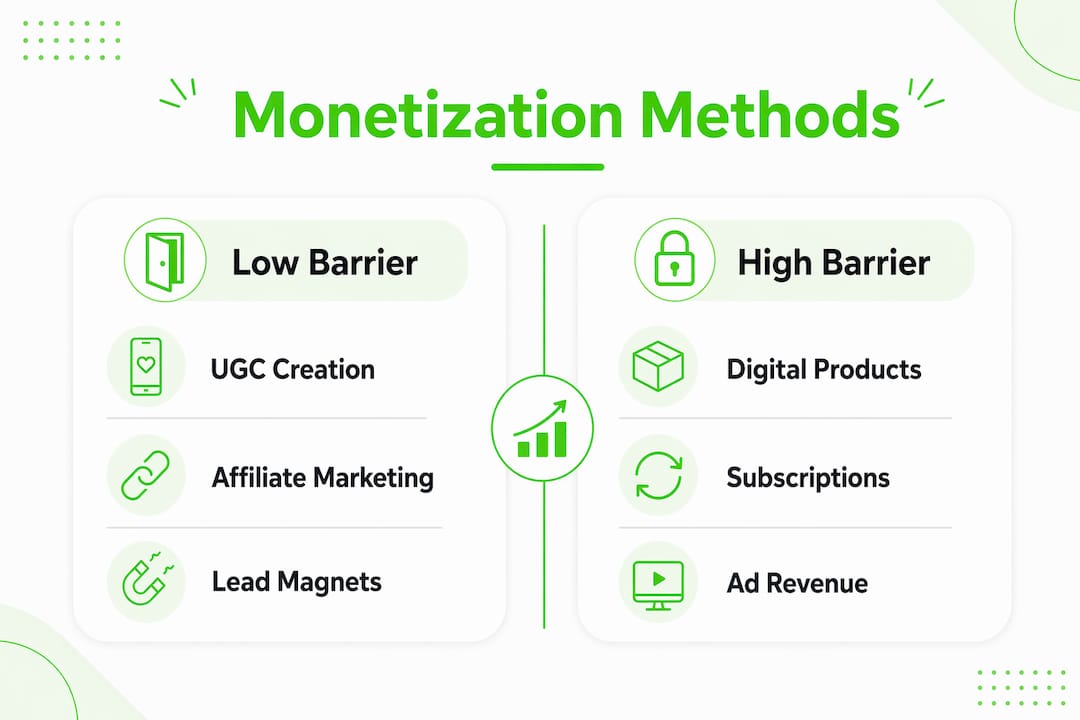
The most effective content monetization strategies fall into six categories. Each has a different entry barrier, income ceiling, and time to first dollar.
Affiliate marketing. You promote products you already use and earn a commission on each sale. Top affiliate programs pay 20–50% recurring commissions, and a well-placed affiliate link can generate $500–$2,000 per month indefinitely. No product creation is required, and there is no follower minimum to start. Programs like Amazon Associates, ShareASale, and Impact are accessible from day one.
User-generated content (UGC). UGC is content you create for a brand’s channels, not your own. UGC creators earn $75–$300 per video with zero followers, and most beginners see their first payment within one to four weeks. This is the fastest way to earn from content without building an audience first.
Platform ad revenue. YouTube, Facebook, and blog ad networks pay based on views and clicks. The income potential is real but limited at small scale. Only 34% of creators earn their primary income from platform ads. Treat ad revenue as a bonus, not a foundation.
Brand sponsorships. Sponsorships become viable at roughly 5,000–10,000 followers with CPMs ranging from $20 to $100. A single $5,000 sponsorship deal can equal the ad revenue from about 1 million views. That math alone explains why sponsorships are worth pursuing early.
Digital products. Courses, ebooks, templates, and toolkits convert well even with modest audiences. Creators with around 5,000 engaged followers can generate $2,000–$5,000 per month from digital products, with profit margins that exceed 85%. Platforms like Gumroad and Teachable handle delivery and payment processing automatically.
Memberships and subscriptions. Patreon and Substack let you charge recurring fees for exclusive content, community access, or early releases. Memberships create predictable monthly income and deepen your relationship with your most loyal readers or viewers.
Pro Tip: Combine affiliate marketing with one low-priced digital product. Creators who do this can generate their first $100–$500 per month within 60 days, even with under 1,000 followers.
How do you build a monetization infrastructure that lasts?

Sustainable income from content requires more than posting consistently. You need to build assets that work independently of any single platform’s algorithm.
Why your email list is your most valuable asset
An email list is the one asset no platform can take from you. Building an email list via gated content enables direct communication and stable conversions, regardless of algorithm changes on YouTube, Instagram, or Facebook. Start collecting emails from your first piece of content, not after you hit a follower milestone.
How to use gated content and lead magnets
A lead magnet is a free resource you offer in exchange for an email address. Effective lead magnets include checklists, mini-courses, templates, or exclusive reports. Place your lead magnet prominently in your content, your bio, and your website. Tools like ConvertKit, Mailchimp, and Beehiiv make setup straightforward. You can also use engagement metrics to identify which content drives the most sign-ups and double down on those topics.
Mixing revenue streams for stability
Here is a practical overview of how different monetization streams compare:
| Revenue Stream | Entry Barrier | Income Ceiling | Time to First Dollar |
|---|---|---|---|
| UGC creation | Very low | Moderate | 1–4 weeks |
| Affiliate marketing | Low | High | 30–60 days |
| Platform ad revenue | Medium | Moderate | 2–6 months |
| Digital products | Medium | Very high | 60–90 days |
| Brand sponsorships | Medium | Very high | 3–6 months |
| Memberships | Medium | High | 1–3 months |
Diversifying across 3–5 revenue streams leads to more stable and higher income for creators. Relying on a single stream, especially platform ads, leaves you exposed to policy changes and traffic drops.
Pro Tip: Build your monetization infrastructure, including affiliate links, a digital product idea, and an email opt-in, in parallel with content creation rather than waiting until you have a large audience.
What mistakes kill content monetization early?
Most creators who fail to earn from content make the same avoidable errors. Recognizing these patterns early saves months of wasted effort.
- Treating content as the product instead of the funnel. Your content is marketing. The product is what you sell through it. Creators who treat content as a marketing funnel for higher-margin products earn 10x to 100x more than those who rely on ad clicks alone.
- Overrelying on platform ad revenue. Ad income is unpredictable and platform-dependent. A single algorithm update can cut your revenue by half overnight.
- Ignoring conversion data. Posting without tracking which content drives clicks, sign-ups, or sales is guesswork. Use Google Analytics, ConvertKit’s reporting, or your platform’s native analytics to identify what actually converts.
- Failing to diversify. A creator earning entirely from one source, whether YouTube ads or a single sponsor, is one policy change away from zero income.
- Waiting too long to monetize. Many creators delay monetization until they feel “ready” or have a large enough audience. The data says otherwise. You can start earning from UGC and affiliate marketing with no audience at all.
“Monetization requires a value-first approach. Paid offerings arise naturally from trust, not forced ads.” — UxerWave, 2026
The fix for most of these mistakes is the same: build your email list, diversify your income streams, and track your conversion data from the start. Treat every piece of content as a step in a sales process, not an end in itself.
Key takeaways
The most effective way to monetize content is to combine low-barrier methods like UGC and affiliate marketing with high-margin products like digital courses and brand sponsorships, all supported by an email list you own outright.
| Point | Details |
|---|---|
| Start with UGC and affiliates | Both require no audience and can generate income within 30–60 days. |
| Build your email list immediately | An email list is your only algorithm-proof asset for long-term monetization. |
| Diversify across 3–5 streams | Multiple revenue sources protect you from platform changes and income drops. |
| Treat content as a funnel | Content drives traffic to higher-margin products, not the other way around. |
| Track conversion data | Use analytics to identify which content actually generates revenue, then produce more of it. |
Naijatipsland’s take on what actually works
Most monetization advice tells you to pick one method and master it before moving on. That sounds logical, but it is wrong in practice. The creators who build real income fastest are the ones who run two or three streams simultaneously from the beginning, even imperfectly.
Here at Naijatipsland, we have watched Nigerian creators get stuck waiting for their YouTube channel to hit 1,000 subscribers before they try anything else. That wait costs them months of potential income. A creator who starts a UGC side income on week one, places affiliate links in their blog posts on week two, and launches a simple ebook on week six is in a completely different financial position by month three.
The value-first principle is real, but it does not mean giving everything away for free indefinitely. It means your free content should be good enough that people trust you when you ask them to buy something. That trust builds faster than most creators expect. The mistake is not monetizing too early. The mistake is monetizing without delivering genuine value first.
Start simple. Pick one quick-win method and one long-term asset to build. Then scale what works. The social media growth strategies that drive audience engagement are the same ones that make your monetization convert.
— Naijatipsland
Ready to build your monetization foundation?
Monetizing your content starts with the right infrastructure, and that includes how your audience registers, engages, and converts on your platform.
Naijatipsland has put together a detailed technical guide for creators and digital marketers who want to set up proper user engagement workflows from the ground up. A well-built user registration workflow lets you track conversions, segment your audience, and deliver gated content reliably, all of which directly support your monetization goals. If you are serious about turning your content into a revenue system, this guide is the right next step. You can also explore the content submission process for Nigerian creators to get your work in front of a wider audience on the Naijatipsland platform.
FAQ
Can you monetize content without a large following?
Yes. UGC creators earn $75–$300 per video with zero followers, and affiliate marketing generates commissions with no follower minimum. Both methods are accessible from day one.
What is the fastest way to earn from content?
UGC creation pays within one to four weeks for beginners and requires no existing audience. It is the fastest documented path to a first paycheck from content work.
How many revenue streams should a creator have?
Creators who diversify across three to five revenue streams report more stable and higher overall income. Starting with two streams and adding more as you scale is the practical approach.
What platform is best for content monetization?
The best platform depends on your content format. YouTube suits video creators, Substack and blogs suit writers, and Teachable or Gumroad suit course creators. Match the platform to where your audience already spends time.
When should you start monetizing your content?
Start monetizing from your first month of content creation. Combining affiliate links and UGC work early, then adding digital products and sponsorships as your audience grows, is the most effective sequence.