

TL;DR:
- Online debate is a structured exchange of arguments on digital platforms that promotes thoughtful discussion and evidence-based reasoning. Maintaining a respectful tone doubles the chances of productive responses and helps reduce toxicity, civility fostering healthier engagement. For Nigerian youth, online debates build critical skills while shaping public opinion and personal reputation in civic and professional spaces.
Many Nigerians who argue passionately on Twitter, Facebook, or WhatsApp groups assume they already know what online debate is. But what is online debate really, and how is it different from the usual back-and-forth insults that flood most comment sections? Understanding the real online debate definition changes how you engage, how others see you, and how much influence your words actually carry. This guide covers everything from how online debate works and the types of online debates available, to practical tips for online debating that protect your digital reputation and sharpen your thinking.
Table of Contents
- What is online debate and how does it work?
- The role of respectful tone and compromise in improving online debates
- Challenges in online debates: incivility and polarization risks
- Comparing online debate formats and best practices for Nigerians
- How online debates impact Nigerian youth and public discourse
- Rethinking online debate culture: a fresh perspective for Nigerian youth
- Enhance your online debate skills and digital image with Naijatipsland
- Frequently asked questions
Key Takeaways
| Point | Details |
|---|---|
| Respectful tone matters | Using respectful language and showing willingness to compromise doubles chances of quality responses in online debates. |
| Structured formats help | Timed stages and turn-taking in online debates reduce toxicity and improve evidence-based discussions. |
| Challenges are real | Online debates face risks like incivility and polarization but can be mitigated by mindful participation. |
| Impact on youth | Active participation in online debates shapes Nigerian youth’s civic engagement and digital reputation. |
| You can improve | Developing debate skills and managing your digital image opens up career and personal growth opportunities. |
What is online debate and how does it work?
Online debate is a structured or semi-structured exchange of arguments between two or more sides on a digital platform. Unlike the chaotic comment wars you see daily on Nigerian social media, a proper online debate has clear positions, evidence, and a goal of examining an issue from multiple angles.
One precise online debate definition comes from academic research: debate-based discussion is a form of asynchronous online discussion where participants divide into groups to debate controversial topics, boosting engagement through structured formats. Asynchronous means the conversation does not happen in real time. You post your argument, your opponent reads it and replies later. That gap actually works in your favor because it gives you time to think, research, and craft a strong response.
How online debate works depends heavily on the format. Here are the core elements found in most structured online debates:
- Two or more sides are assigned or chosen based on a specific debate topic.
- Arguments and counterarguments are posted in turns, with each participant responding to the previous point.
- Evidence and reasoning support each claim rather than opinions alone.
- Structured turn-taking prevents one person from dominating the conversation.
- A moderator or platform rules keep focus on the topic.
- A conclusion or summary wraps up the key points made by both sides.
The goal is not necessarily to crush the other person’s argument or get the most likes. Real online debating skills mean engaging honestly with opposing views, even when you disagree. If you want to practice starting online discussions on forums, understanding this structure is the first step.
The role of respectful tone and compromise in improving online debates
Here is something that surprises most people: the way you phrase your argument matters more than the strength of your facts. Research from King’s College London found that respectful tone and compromise in online political debates doubles the likelihood of receiving high-quality, reasoned responses that avoid toxicity. That is not a small difference. Doubling your chances of a productive reply just by being civil is one of the most underused advantages in Nigerian online spaces.
Tone does two things at once. First, it signals to the other person that you are worth engaging with seriously. Second, it invites others watching the debate to take your side more credibly. When you insult someone or use aggressive language, you shift the focus from the argument to the personality clash. You lose the debate before you even make your point.
“The key to better online debate is not the strongest argument, but the most respectful approach. Compromise signals and civil language open doors that aggression permanently closes.”
Compromise signals are phrases like “I can see where you’re coming from” or “That’s a valid concern, however…” These phrases do not mean you are giving up your position. They show you have actually processed the other person’s argument. That distinction is critical to forum etiquette importance and to shaping respectful online political discussion.
Pro Tip: Before you reply in any online debate, read your own draft and ask: “Would I say this to someone’s face in a professional setting?” If the answer is no, rewrite it. This single habit will change how people respond to you online.
Challenges in online debates: incivility and polarization risks
Benefits of online debate are real, but so are the risks. Knowing what you are walking into helps you navigate it better.
Incivility is the most common problem. One study found that incivility in online discussions leads to punishing co-partisans more than out-partisans and intensifies hostility between groups. In plain terms, you are more likely to lash out at someone who shares your general views but disagrees on one issue than at someone from the opposite side entirely. That internal hostility is what tears apart communities and online groups.
Key risks to watch for in online debates:
- Polarization: Toxic discourse pushes people further into opposing camps rather than toward understanding.
- Algorithm amplification: Social media platforms surface provocative content because it generates more clicks, making aggressive debates more visible than calm ones.
- Misinformation spread: When debates lose their evidence base, false claims spread as quickly as facts.
- Hostility fatigue: Constant exposure to incivility discourages good-faith participants from engaging at all.
The global picture supports this concern. Societal polarization is ranked the third most severe global risk over the next two years, with 54% of UK social media users already verifying political news due to the toxic online environment. Nigeria is not immune to these trends. Read any political thread on Nigerian Twitter and you will see the same patterns playing out at scale.
Understanding the impact of political debate civility research helps you recognize when a conversation is worth continuing and when stepping away is the smarter choice.
Comparing online debate formats and best practices for Nigerians
Not all online debate platforms or formats work the same way. Knowing the differences helps you choose where and how to engage.
| Format | Structure level | Response timing | Toxicity risk | Best for |
|---|---|---|---|---|
| Structured debate platforms | High | Timed rounds | Low | Practicing formal debate |
| Forum-based discussions | Medium | Asynchronous | Medium | Research-backed topics |
| Social media comment threads | Low | Real-time | High | Awareness and reaction |
| WhatsApp and Telegram groups | Low to medium | Real-time | Medium to high | Community discussions |
Structured debate platforms use timed stages with controlled speaking order to prevent toxicity and dominance by loud voices, unlike unstructured social media comments where anyone can pile on. These platforms move through introduction, argument, counterargument, rebuttal, and conclusion in sequence.
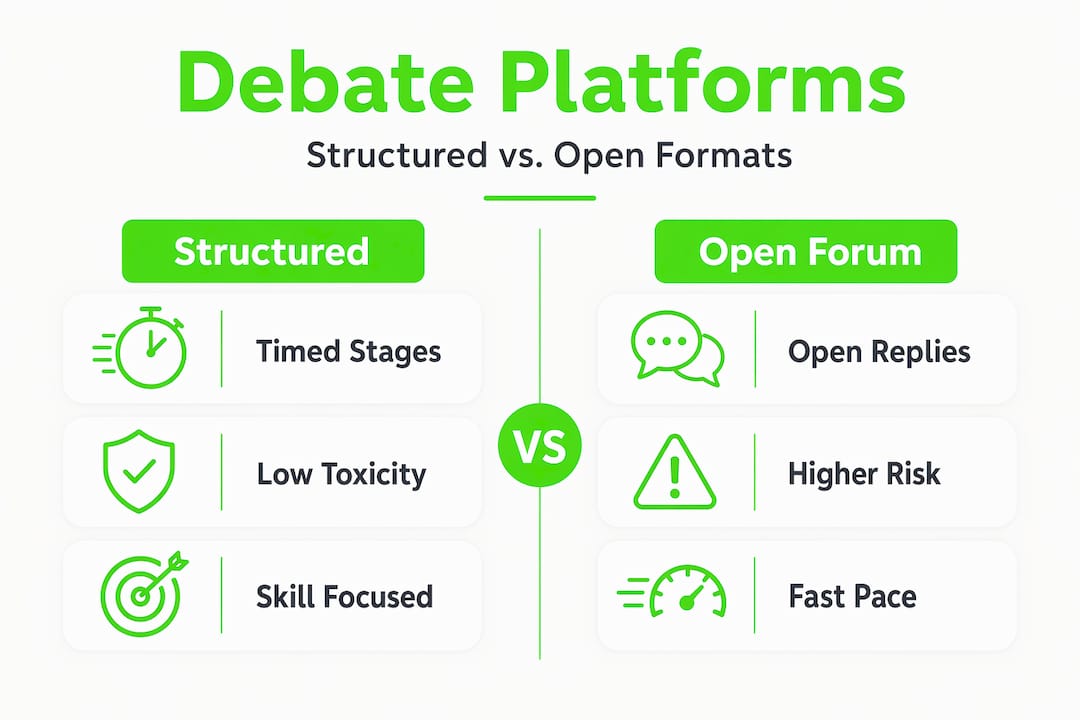
Asynchronous turn-based debates with deadlines allow research and evidence-based arguments, producing higher quality discussions overall. This is the format Nigerian university debate clubs often use online, and it transfers well to professional and civic contexts.
Here are the best practices every Nigerian young adult should follow when participating in any format:
- Prepare your evidence before you post. Search credible sources, not just what supports your view.
- State your position clearly in your opening message. Ambiguity invites misinterpretation.
- Address the argument, not the person. Respond to what was said, not who said it.
- Acknowledge valid points from the other side. This builds credibility rather than undermining it.
- Signal openness to updating your view if evidence warrants it. This is a strength, not a weakness.
- Know when to end the exchange. If the other party is only insulting, disengage without drama.
Pro Tip: Keep a personal note of online debate topics you engage with regularly. Reviewing your past arguments shows you where your reasoning has improved and where you still have blind spots.
You can explore an online debate skills and platforms guide tailored specifically for Nigerian youth to go deeper on format choices.
How online debates impact Nigerian youth and public discourse
Online debate is not just an intellectual exercise. For Nigerian young adults, it shapes real outcomes in civic life, career prospects, and community standing.

When you debate online about issues like education policy, unemployment, or governance, you are contributing to a broader public conversation. Your arguments, if well-reasoned and respectfully made, can shift how others think. That is a form of civic power most young Nigerians do not fully claim.
What consistent online debate participation builds:
- Critical thinking: You learn to evaluate claims, spot logical fallacies, and construct stronger arguments.
- Research habits: Finding evidence to support your positions builds information literacy.
- Communication skills: Writing clearly under pressure, especially in a public forum, is a skill employers notice.
- Digital reputation: Every thread you participate in becomes part of your online identity.
That last point deserves attention. Your digital image shaped by online debates impacts career and life opportunities in ways that are easy to underestimate at 22 but very hard to undo at 32. Employers, collaborators, and institutions increasingly search names online. What they find in your debate history matters.
| Skill developed | How online debate builds it | Real-world benefit |
|---|---|---|
| Critical thinking | Evaluating opposing arguments | Better decision-making |
| Research literacy | Finding credible evidence | Academic and career advantage |
| Written communication | Expressing ideas clearly in public | Professional credibility |
| Civic engagement | Discussing national issues publicly | Community leadership |
To understand why active participation in online discussions benefits Nigerian society, and how to begin if you are new to the space, the beginners guide to online discussions is a solid starting point.
Rethinking online debate culture: a fresh perspective for Nigerian youth
Most people treat online debate like a courtroom where someone must lose. That framing is the single biggest reason Nigerian online spaces produce more heat than light.
The uncomfortable truth is that you will rarely change someone’s mind in the comments. But that is not why well-run online debates matter. They matter because of the audience, the silent observers who read everything and form opinions based on how people argue, not just what they argue. When you debate well in public, you influence far more people than the one person you are replying to.
Experts warn that algorithm-driven provocative content risks brutalizing online debate culture, but individuals can choose to promote democratic discourse through respectful argument. That choice is entirely yours. No algorithm forces you to insult someone. No platform requires you to share unverified claims. The decision to debate with integrity is a personal one, and Nigerian youth who make that choice consistently are already reshaping the tone of local online spaces.
AI tools and structured platforms now offer moderation support that reduces extreme language before it derails a conversation. These are worth using. But technology alone does not fix culture. The deeper shift happens when you decide that being understood matters more than being right, and that contributing to a healthier public conversation is worth more than winning a single thread.
The internet in Nigeria is young, and its culture is still forming. You have real influence over what it becomes. Use it thoughtfully through improving your debate culture one exchange at a time.
Enhance your online debate skills and digital image with Naijatipsland
If this guide has shown you anything, it is that how you show up in online debates has lasting consequences for your digital reputation and civic influence. Naijatipsland is built for Nigerian young adults who want to engage meaningfully, not just loudly.
Explore practical guides on how your digital image and career are linked, discover the benefits of online discussions in Nigeria, and get step-by-step guidance on starting online discussions in forums and communities. Naijatipsland offers resources tailored to the Nigerian context, covering everything from debate etiquette to managing your digital presence. Join a community of Nigerians committed to constructive, credible online engagement and take your participation from reactive to influential.
Frequently asked questions
What exactly is online debate?
Online debate is a structured or unstructured exchange of arguments on digital platforms where participants discuss controversial topics, often asynchronously to allow thoughtful responses. Research confirms it is a form of asynchronous discussion where groups debate controversial topics to boost engagement.
How does respectful tone affect online debate outcomes?
A respectful tone doubles the chance of receiving reasoned, high-quality responses, and it reduces toxic language and partisan attacks in the thread. A King’s College London study confirmed that compromise signals alongside civil language produce significantly better discussion outcomes.
Why is online debate important for Nigerian youth?
Online debate helps Nigerian youth engage civically, shape public opinion, build critical thinking, and strengthen their digital reputation, which directly affects career and life opportunities. Your digital image in debates is visible to employers and communities and can work for or against you.
What are common challenges in online debates?
The biggest challenges are incivility, polarization, algorithm-driven provocative content, and misinformation, all of which reduce constructive dialogue and increase hostility. Studies show that online incivility intensifies hostility between groups, making it harder for genuine debate to take place.