

Last updated: 13 October 2026. The Nigeria Immigration Service (NIS) sets passport fees, forms and procedures, and they can change. Confirm the amount and steps on the official NIS website before you pay.
Nigerian passport at a glance (October 2026)
- Fees for applications made in Nigeria: ₦100,000 for the 32-page, 5-year passport and ₦200,000 for the 64-page, 10-year passport, in force since 1 September 2025.
- Fees abroad: $150 for the 32-page booklet and $230 for the 64-page booklet, which the NIS said did not change.
- How to apply: start online on the NIS passport portal, pay online, then attend biometric capture in person.
- You need: a valid NIN whose details match your documents.
- Processing time: typically 4 to 6 weeks after biometrics, with an official target of about 6 weeks. There is no official fast-track fee.
Getting a Nigerian passport is now a mostly online process, but it is more expensive than it was two years ago and several steps still trip people up, especially NIN mismatches and unofficial agents. This guide explains the current fees, each step from NIN to collection, how long it takes, and how to avoid the common problems.
Nigerian Passport Fees in 2026
On 28 August 2025 the NIS announced a review of passport application fees for applications made in Nigeria, effective 1 September 2025. The new fees were widely reported to have doubled the previous ones of ₦50,000 and ₦100,000.

- 32-page booklet, 5-year validity: ₦100,000 in Nigeria, $150 abroad.
- 64-page booklet, 10-year validity (adults 18 and over): ₦200,000 in Nigeria, $230 abroad.
- 64-page booklet, 5-year validity: the NIS lists this option too, but the amount can depend on the application flow, so check what the portal shows at payment.
- Renewals are reported to cost the same as a first application. There is no cheaper renewal rate.
- Discounts: reports say the older reduced rates for children and older applicants no longer apply, but confirm this on the portal for your category.
- Embassy charges: missions abroad may add appointment or postage charges. Treat the NIS portal fee as the baseline.
Which booklet should you choose? A 32-page passport suits occasional travellers, but it fills up quickly if you collect many stamps, and you would pay again after five years. A 64-page, 10-year passport costs more upfront but lasts twice as long and has more pages, which many frequent travellers prefer.
How to Apply: Step by Step
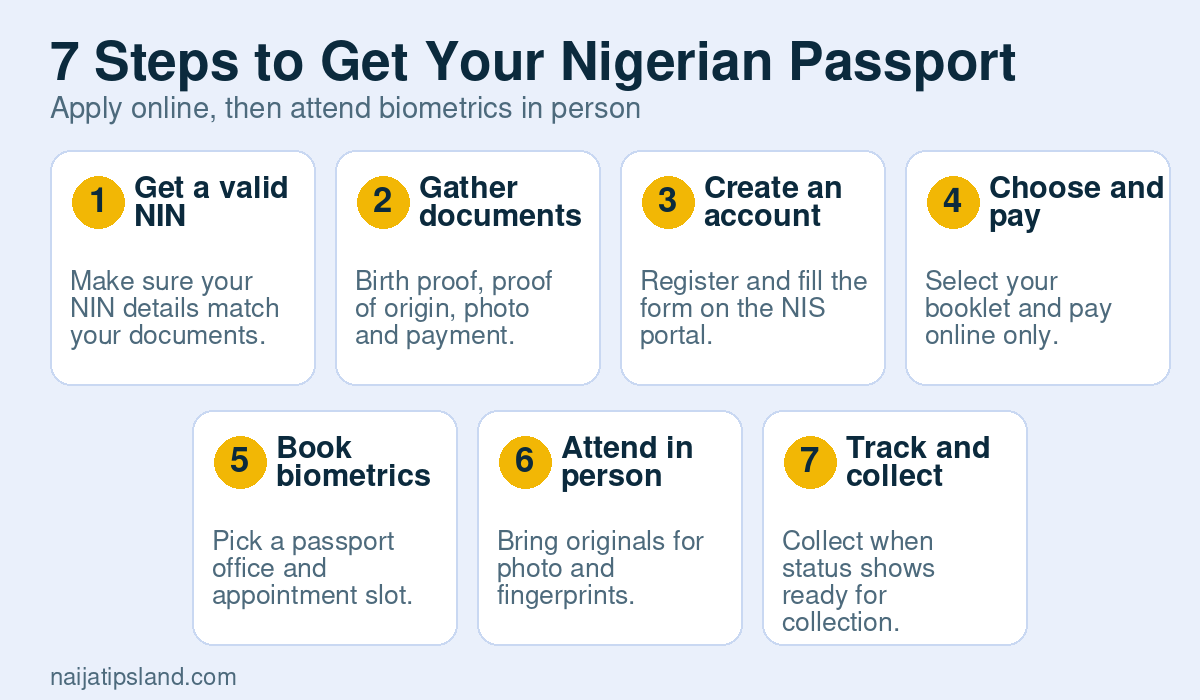
- Make sure your NIN is valid and correct. The application checks your details against your NIN record. If your name or date of birth differs, correct it with NIMC first, because applicants have reported that this can add weeks. Our guide on how to verify your NIN shows how.
- Gather your documents. Typically you need proof of birth or age, proof of your state or local government of origin, a passport-standard photograph, your NIN and, for renewals, your old passport. The portal states the exact list for your category.
- Create an account and complete the form. Use the NIS website (immigration.gov.ng), which links to the passport application portal. Enter your details exactly as they appear on your documents.
- Choose your booklet and pay online. Select the passport type and pay through the portal. Keep your payment receipt, because you will need it later.
- Book your biometric appointment. Choose a passport office and an available date. If you are abroad, the appointment is at the Nigerian embassy or consulate.
- Attend biometric capture in person. Take your original documents, your receipt and your appointment details. Your photograph and fingerprints are captured at this stage.
- Track and collect. After biometrics you can follow your application on the portal with your application and reference numbers. The portal includes a status for a produced passport that is ready for collection, so wait for that before you go to collect it.
How Long Does It Take?
The NIS gives a standard processing target of about six weeks. In practice most applicants report waiting between four and six weeks after biometric capture, and renewals have been reported to move faster, at around three weeks. Delays happen when there are booklet shortages, NIN mismatches or backlogs at a processing centre. The NIS has not published an official express service fee, so anyone who asks you to pay extra for faster processing is outside the official system.
What to Have Ready and What to Avoid
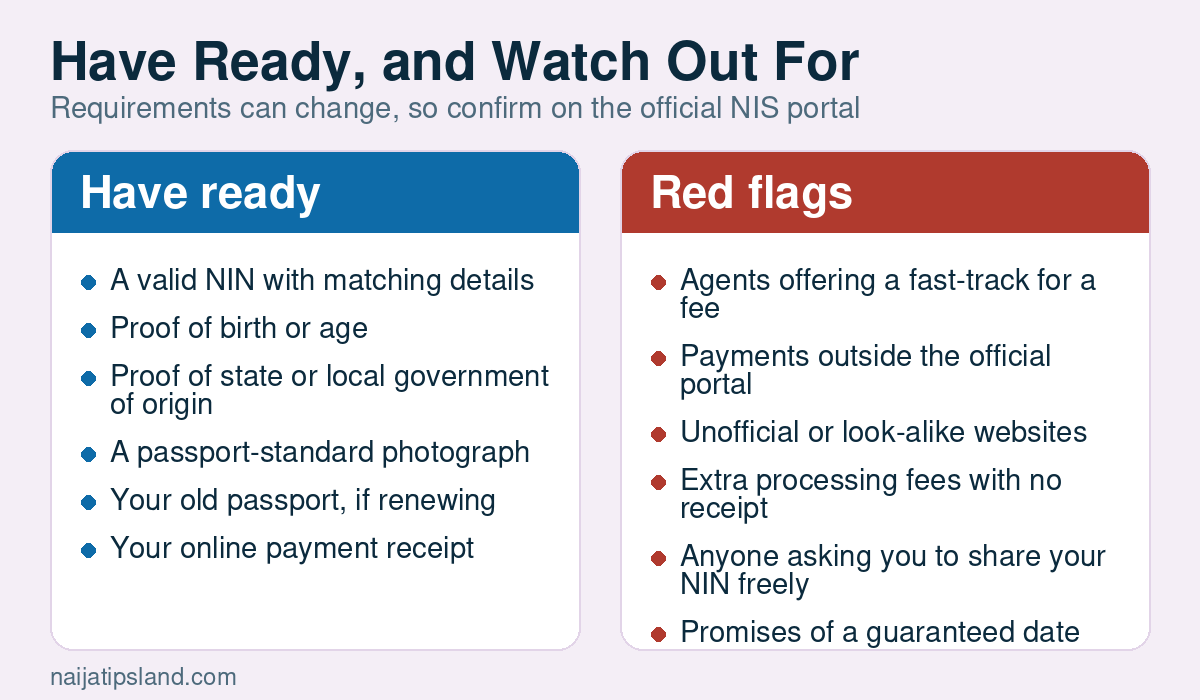
Passport offices attract touts. Pay only on the official portal, do not hand your NIN or documents to strangers, and be wary of any agent promising a guaranteed date. For more on staying safe, read our guides on avoiding internet scams and Nigeria’s cybercrime laws.
Renewing, Replacing and Fixing Problems
- Renewing an expired passport: apply again using your NIN and old passport details. The fee is the same as for a new passport.
- Lost or damaged passport: report the loss and make a fresh application. Missions abroad may charge an additional penalty, so check with yours.
- Payment problems: keep your Remita or payment receipt and contact the NIS through its official channels rather than paying again outside the portal.
- NIN issues: correct the NIN record at NIMC first, then repeat the step on the passport portal.
- Travelling soon? Apply well ahead of your trip. Visa processing takes extra time, so see our guide on common reasons a UK visa is denied before you apply.
Fee History: What Changed Since 2024
Before 1 September 2025, applicants in Nigeria paid about ₦50,000 for the 32-page passport and ₦100,000 for the 64-page, 10-year passport, according to reports. The September 2025 review doubled both. The NIS said that review affected only applications made in Nigeria, so diaspora fees stayed at $150 and $230. If you see lower figures on older websites, they reflect the earlier schedule.
Applying From Abroad
Nigerians in the diaspora start on the same NIS portal, but biometric capture takes place at a Nigerian embassy or consulate. Fees are listed in dollars, and missions may add appointment, postage or other local charges, so confirm the total with the mission you will attend. Processing from abroad is generally reported at six to eight weeks. If you urgently need to travel and your passport has been lost, ask the mission whether an emergency travel certificate is available.
Passport Types
The standard e-passport is the document most citizens apply for. Official and diplomatic passports are separate categories for government business and are not part of the standard public application. The standard booklet has 32 or 64 pages depending on your choice, with the 10-year validity available on the 64-page booklet for adults.
Tips to Avoid Delays
- Apply early. Start at least three months before you plan to travel, longer if you also need a visa.
- Check validity rules. Many countries require your passport to be valid for at least six months beyond your travel dates, so do not leave renewal until the last minute.
- Match names exactly. Use the spelling, order and date of birth on your NIN and supporting documents.
- Keep records. Save your receipt, application number and reference number, and take screenshots at each stage.
- Choose your location carefully. Appointment availability and queue lengths vary by passport office.
- Track your status. Check the portal instead of visiting the office repeatedly.
Common Mistakes That Delay Passport Applications
- Using a nickname or shortened name. Enter your names exactly as they appear on your NIN and birth records, in the same order.
- Submitting a non-compliant photograph. Passport photos must meet international standards. Use a plain background, a neutral expression and a recent image.
- Paying through an unofficial link. If your payment does not appear on the portal, your application cannot progress, and recovering money from a fake site is difficult.
- Booking before fixing your NIN. If your details do not match, you may be stopped at the verification stage and lose time.
- Missing your appointment. Arrive early on the day, bring every original document, and rebook promptly if something prevents you from attending.
- Choosing the wrong booklet. A frequent traveller who picks the 32-page option may need a replacement long before the five years end.
What to bring to your biometric appointment
Take your original supporting documents, your NIN details, your payment receipt, your application and reference numbers, and your old passport if you are renewing. Dress simply, because your photograph is taken on the day. If something looks different from what you were told online, ask for it to be written down and confirm it on the official portal rather than paying anything extra.
Frequently Asked Questions
How much is a Nigerian international passport in 2026?
For applications made in Nigeria, ₦100,000 for the 32-page, 5-year passport and ₦200,000 for the 64-page, 10-year passport. Abroad, the NIS fees are $150 and $230 respectively.
Is the NIN compulsory for a Nigerian passport?
Yes. The application uses your NIN, and the details must match your records. If they do not, correct your NIN record with NIMC before you continue.
How long does it take to get a passport in Nigeria?
Usually four to six weeks after biometric capture, against an official target of about six weeks. Delays can occur.
Can I pay passport fees in cash at the passport office?
Payments should be made online through the official portal. Do not pay cash to an individual or agent for passport fees.
Is there an express passport service?
The NIS has not published an official express service fee, and agents who offer fast-track services are not part of the official process.
What should I do if I lose my passport?
Report the loss and make a fresh application with the required documents. If you are abroad, ask your embassy or consulate about any penalty fee.
Related Guides
- How to verify your NIN in Nigeria
- Nigerian visa types: short visits, residence and more
- Common reasons a UK visa is denied in Nigeria
- Top scholarships in Nigeria 2026
Sources
- WithinNigeria: Nigerian passport online application in 2026
- WithinNigeria: How to get an international passport in Nigeria, complete guide 2026
- TheCable: FG doubles passport fees to N100k for 32-page booklet and N200k for 64 pages
- Vanguard: FG raises passport fees to N100,000 and N200,000 effective 1 September
- Wikipedia: Nigerian passport
- TravelingNG: How much is an international passport in Nigeria
- Nigeria Immigration Service