


You send out application after application, and the silence that follows is deafening. Many Nigerian job seekers face this exact frustration, not because they lack qualifications, but because their CV fails to meet what local recruiters actually expect. A poorly structured CV can end your chances before a human even reads your name. This guide walks you through every practical step, from formatting and content to ATS optimization, so your CV works as hard as you do. Whether you are a fresh graduate or a seasoned professional, these tips are built specifically for the Nigerian job market.
Table of Contents
- Understand Nigerian CV requirements
- Prepare your CV content: What to include
- Optimize for applicant tracking systems (ATS)
- Common CV mistakes and how to avoid them
- What most guides get wrong about Nigerian CVs
- Take your next step with Nigerian career resources
- Frequently asked questions
Key Takeaways
| Point | Details |
|---|---|
| Ideal CV length | Keep your CV concise—1-2 pages for graduates, up to 3 for experienced roles. |
| ATS compatibility | Use simple formatting and keywords to ensure your CV passes Nigerian companies’ screening software. |
| Modern content choices | Omit personal details and focus on relevant skills, achievements, and sections that recruiters value. |
| Avoid common errors | Proofread and update your CV regularly to avoid typos and misrepresentations that hurt your chances. |
| Leverage local resources | Use forums and networking to boost applications and access insider tips for Nigeria’s job market. |
Understand Nigerian CV requirements
Before you type a single word, you need to understand the rules of the game. Nigerian employers have specific expectations, and ignoring them is one of the fastest ways to land in the rejection pile.
How long should your CV be?
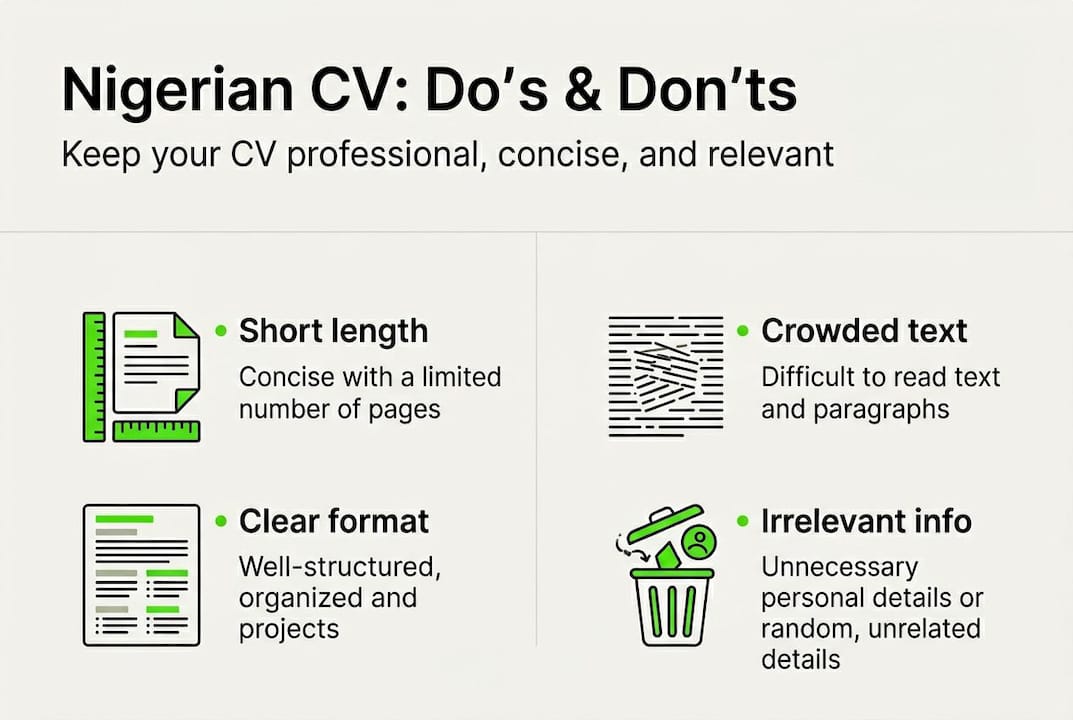
Nigerian CVs are typically 1-2 pages for fresh graduates and up to 2-3 pages for experienced professionals, using reverse-chronological format. Reverse-chronological means your most recent job or qualification appears first, working backward in time. This format helps recruiters quickly spot your latest and most relevant experience.
| Candidate type | Recommended CV length | Preferred format |
|---|---|---|
| Fresh graduate | 1-2 pages | Reverse-chronological |
| Mid-level professional | 2 pages | Reverse-chronological |
| Senior professional | 2-3 pages | Reverse-chronological |
Keeping your CV within these limits signals professionalism. A 6-page CV from a recent graduate tells a recruiter you do not know how to prioritize information.
Font and layout basics
Stick to clean, readable fonts like Arial, Calibri, or Times New Roman at 10-12 point size. Use consistent margins, clear section headings, and enough white space so the page does not look crowded. Avoid colored backgrounds, decorative borders, or multiple font styles. These elements may look creative, but they distract from your content and can confuse automated screening tools.
For Nigerian applications, always save and send your CV as a PDF. A PDF preserves your formatting across all devices and operating systems. A Word document can shift layouts depending on the software version the recruiter uses, which can make your carefully designed CV look messy.
You can find more career tips for Nigerian professionals to complement your CV strategy and stay competitive in the job market.
- Use a professional, single-column layout for most applications
- Bold your section headings so they stand out clearly
- Align text consistently, either left or justified throughout
- Use bullet points under each role to describe responsibilities
- Save as PDF before submitting unless the employer requests otherwise
For roles at companies that use digital screening, building an ATS-friendly CV is no longer optional. More on that shortly.
Pro Tip: Before sending your CV, open the PDF on your phone to confirm it looks clean on a smaller screen. Many Nigerian recruiters review applications on mobile devices.
Prepare your CV content: What to include
Knowing the structure is only half the work. What you actually put inside each section determines whether a recruiter keeps reading or moves on.
Core sections every Nigerian CV needs
- Contact information: Full name, phone number, professional email address, city and state, and your LinkedIn profile if you have one.
- Professional summary: Two to three sentences that capture who you are, your key skills, and what you bring to the role. Tailor this for every application.
- Education: List your degrees, institutions, graduation years, and any relevant academic honors. Place this near the top if you are a fresh graduate.
- Work experience: Each role should include your job title, employer name, dates of employment, and three to five bullet points describing your achievements and responsibilities.
- Skills: A short, focused list of both technical and soft skills relevant to the role you are applying for.
- Optional sections: Certifications, volunteer work, professional memberships, and relevant projects can strengthen your application significantly.
For the Nigerian CV format, modern practice has shifted noticeably. Avoid personal details like age, marital status, and religion on your CV. These details were common in older Nigerian CV templates, but including them today can actually expose you to bias and is no longer considered best practice by most professional recruiters.
Quick stat: Studies show that recruiters spend an average of 6-7 seconds scanning a CV before deciding whether to read further. Your top third of the page is your most valuable real estate.
Your email address matters more than you think. An address like [email protected] immediately undermines your professional image. Create a simple address using your first and last name. This small detail signals that you take your career seriously.
- Avoid nicknames or numbers that look informal in your email
- Do not list a physical home address unless specifically requested
- Include your LinkedIn URL only if your profile is complete and up to date
- Use action verbs to start each bullet point under your experience section
Think of your professional summary as your elevator pitch. It should tell the recruiter exactly why you are the right fit in the time it takes to read three sentences. Understanding how viral news impact works can actually teach you something valuable here: the most shareable content leads with the most compelling point. Your CV summary should do the same.
Optimize for applicant tracking systems (ATS)
An ATS, or Applicant Tracking System, is software that companies use to scan, sort, and filter CVs before a human recruiter ever sees them. Many Nigerian companies, especially in banking and tech, now use these tools as a first filter.

75% of CVs are rejected by ATS globally before a recruiter reads them. That statistic should change how you approach every CV you write.
ATS-friendly vs. ATS-unfriendly formatting
| Element | ATS-friendly | ATS-unfriendly |
|---|---|---|
| Headings | Standard labels (Experience, Education) | Creative labels (My Journey, What I’ve Done) |
| Layout | Single-column, simple | Multi-column, text boxes |
| Fonts | Arial, Calibri, Times New Roman | Decorative or script fonts |
| Images | None | Photos, logos, icons |
| File format | PDF or .docx | JPEG, PNG, or image-based PDF |
Keywords are the backbone of ATS optimization. Read the job description carefully and mirror the exact language used. If the posting says “financial reporting,” use that phrase in your CV, not “finance documentation.” The system matches text, not meaning.
- Use standard section headings the ATS can recognize
- Avoid placing important information inside tables or text boxes
- Do not use headers or footers for contact details
- Spell out abbreviations at least once before using the short form
- Keep graphics, charts, and icons off your CV entirely
Pro Tip: Copy the job description into a word cloud tool. The largest words are the keywords you need to include in your CV naturally.
If you are exploring ways to build skills while earning online in Nigeria, those experiences count as real work history. List freelance or contract roles clearly with dates and outcomes. ATS systems treat them the same as formal employment when formatted correctly.
Understanding the role of a CV in your job search goes beyond just getting past software. Your CV is your first impression, and every element needs to earn its place on the page.
Common CV mistakes and how to avoid them
Even well-intentioned job seekers make errors that cost them interviews. Knowing what to avoid is just as important as knowing what to include.
“The most common CV mistakes include typos, generic objectives, long paragraphs, unprofessional email addresses, and outright inaccuracies. Each one signals carelessness to a recruiter.”
Here is a breakdown of the most frequent problems and how to fix them:
- Typos and grammatical errors: These signal a lack of attention to detail. Always proofread twice, then ask someone else to read it. A fresh pair of eyes catches what yours misses.
- Generic objective statements: Phrases like “seeking a challenging role in a reputable organization” tell the recruiter nothing. Replace this with a specific summary that names the role and your value.
- Long, dense paragraphs: Recruiters skim. Use bullet points under each role to make your experience easy to scan. Each bullet should start with an action verb and ideally include a result.
- Unprofessional email addresses: As mentioned earlier, your email is part of your brand. Fix it before you apply to a single job.
- Lies or exaggerations: Nigerian employers increasingly conduct background checks. Inflating your GPA, fabricating a role, or claiming certifications you do not hold can end your career before it starts.
- Sending the same CV everywhere: A CV that is not tailored to the specific role reads as generic. Spend 10 minutes adjusting your summary and skills section for each application.
According to current Nigerian CV standards, these mistakes are consistently flagged by recruiters as deal-breakers. Many of these are the same common mistakes by millennials in other areas of professional life, where small oversights create large consequences.
For additional formatting guidance, reviewing security CV tips from international markets can offer useful perspective on how structure and clarity translate across industries.
What most guides get wrong about Nigerian CVs
Most CV guides you find online are written for Western job markets. They tell you to be bold, use creative layouts, and express your personal brand through design. That advice can actively hurt you in Nigeria.
Nigerian recruiters, especially in banking, government, and large corporations, still favor clean, traditional formats. A heavily designed CV with icons and color blocks may impress in a Lagos startup, but it will likely fail an ATS scan at a commercial bank or a multinational with a formal HR process.
The deeper issue is authenticity. Copying a foreign template without adapting it to local expectations signals that you do not understand the environment you are applying to. Recruiters notice this.
What actually works is showing local relevance. Reference Nigerian institutions, local certifications like those from ICAN or CIPM, and community involvement that demonstrates real-world impact. Use the essential Nigerian career tips that reflect the actual market, not a generic global template.
Your CV should feel like it was written by someone who understands Nigeria, because it was.
Take your next step with Nigerian career resources
You now have a clear, practical framework for building a CV that works in the Nigerian job market. The next step is putting it into action and staying connected with others on the same journey.
Naijatipsland.com is more than a news platform. It is a growing community where Nigerian professionals share opportunities, exchange advice, and support each other through career transitions. If you want to sharpen your communication skills, learning how to start online forum discussions is a great way to build confidence and visibility. Understanding forum etiquette helps you make a strong impression in professional spaces. And if the job search is weighing on you, exploring the community engagement benefits for mental health shows why staying connected matters beyond just networking.
Frequently asked questions
What is the ideal CV length for Nigerian job applications?
For graduates, keep your CV to 1-2 pages; for experienced professionals, 2-3 pages is acceptable. Going beyond this range without strong justification signals poor editing.
Should I include personal details like my age or religion?
Modern CVs in Nigeria avoid personal details such as age, marital status, and religion. Including them can introduce bias and is no longer considered best practice.
How can I make my CV ATS-friendly for Nigerian employers?
Use simple formatting, standard headings, and relevant keywords from the job description. ATS used by Nigerian companies in banking and tech reject CVs with fancy design elements, tables, or images.
What are the most common mistakes Nigerian job seekers make on their CVs?
Frequent mistakes include typos, generic objectives, long paragraphs, unprofessional email addresses, and inaccuracies. Each one reduces your chances of getting past the first screening stage.