


TL;DR:
- Digital journalism enables real-time, multimedia news sharing but requires transparency and editorial oversight to maintain trust. The rise of AI poses risks of misinformation and bias, necessitating human judgment and clear standards to ensure credibility. Its role in fostering public reasoning is vital for democratic discourse, emphasizing accountability and community engagement.
Digital journalism is defined as the practice of creating, distributing, and interacting with news through digital platforms, enabling real-time publishing, multimedia storytelling, and direct audience participation. The role of digital journalism extends far beyond speed. It shapes public trust, defends democratic discourse, and determines how millions of people understand the world around them. Organizations like UNESCO and the Journalism Trust Initiative (JTI) have made clear that journalism in the digital age carries both extraordinary power and serious responsibility. Artificial intelligence is now accelerating that tension, making it more urgent than ever for journalists, editors, and informed readers to understand what trustworthy digital news actually looks like.
How does digital journalism impact news consumption and public trust?
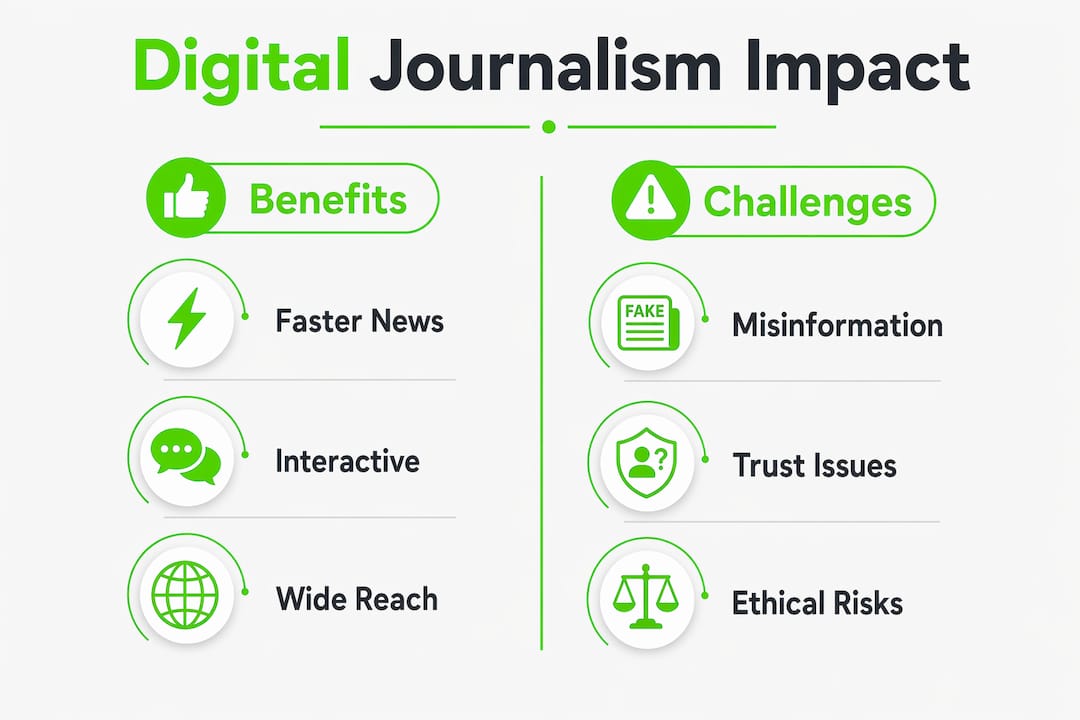
Digital journalism transforms how audiences receive and evaluate information by compressing the time between events and publication to minutes. That speed creates opportunity and risk in equal measure. When a story breaks on X (formerly Twitter) before a newsroom can verify it, the pressure to publish first often overrides the obligation to publish accurately. Rapid publishing and data analytics create both opportunities and serious risks for accuracy. This means verification workflows are no longer optional features of a newsroom. They are the product itself.
Trust levels in digital news are uneven and measurable. Trust in local digital news reaches 70% in the U.S., compared to just 56% for national news outlets. That 14-point gap reflects a simple reality: audiences trust sources they perceive as accountable and close to their lives. National outlets often feel distant and ideologically driven, while local digital newsrooms feel answerable to the same community they cover.
The challenges in digital journalism compound this trust problem in three specific ways:
- Misinformation spreads faster than corrections. A false claim shared on WhatsApp or Facebook reaches thousands before a fact-check is published.
- Information overload reduces critical reading. When readers encounter dozens of headlines per hour, they skim rather than evaluate. Shallow reading produces shallow trust.
- Polarization fragments audiences. Younger digital news consumers mix trusted outlets with social media and AI tools for verification, creating a flatter trust hierarchy where no single source holds authority.
The role of social media in news is particularly significant here. Platforms like Facebook, TikTok, and YouTube now function as primary news delivery systems for large portions of the population, yet none of them operate under traditional editorial standards. That gap between distribution power and editorial accountability is where misinformation finds its most fertile ground.
What ethical standards define trustworthy digital journalism?
Trustworthy digital journalism is built on visible governance, not just stated values. The Journalism Trust Initiative standard requires media outlets to disclose their mission, ownership structure, editorial guidelines, and accountability mechanisms. This is the clearest framework currently available for evaluating whether a digital outlet is genuinely committed to credibility or simply claiming it.
Digital media ethics, in practice, requires four operational commitments:
- Mission disclosure. Readers must know who funds the outlet, what its editorial purpose is, and whether commercial interests influence coverage decisions.
- Editorial guidelines. Written standards for sourcing, verification, and corrections must be publicly accessible, not buried in internal policy documents.
- Accountability mechanisms. Outlets need a functioning process for audience complaints, including a named editor or ombudsman responsible for responding.
- Operational transparency. Explaining sourcing, verification, and corrections builds credibility far more effectively than generic claims about fact-checking.
The distinction between stating transparency and showing it matters enormously. An outlet that publishes a correction prominently, explains why the original error occurred, and names the reporter responsible demonstrates institutional accountability. An outlet that quietly edits an article without notice does the opposite, even if it calls itself a fact-checking organization.
Pro Tip: If you want to evaluate whether a digital news outlet is trustworthy, look for a visible corrections policy, a named editorial contact, and a published ownership disclosure. If any of those three are missing, treat the outlet’s content with additional skepticism.
Self-regulation through bodies like the JTI and audience complaint systems creates external pressure that internal editorial standards alone cannot provide. For Nigerian readers and journalists, understanding how to follow news and avoid misinformation starts with applying exactly these criteria to every outlet you rely on.
How is artificial intelligence influencing digital journalism’s role?
Artificial intelligence is the single most disruptive force currently reshaping the importance of digital news production and distribution. UNESCO highlights AI’s dual role in disrupting information integrity while enabling content creation at scale. That duality is not a paradox. It is a management challenge that every newsroom now faces whether or not it has chosen to adopt AI tools.

The table below compares AI’s benefits and risks in digital journalism:
| Dimension | AI benefit | AI risk |
|---|---|---|
| Production speed | Automates routine reporting (earnings, sports scores) | Reduces time for verification and editorial review |
| Scale | Publishes localized versions of stories simultaneously | Amplifies synthetic misinformation at the same scale |
| Audience trust | Enables personalized news delivery | Perceived accuracy depends on ideological alignment, not objectivity |
| Editorial quality | Flags potential errors through AI tools | Shallow AI drafts require heavy human editing to meet standards |
The trust problem with AI-generated news is specific and measurable. A 2026 Nature study found that audiences perceive AI news as credible only when its accuracy matches their ideological preferences. This means AI-generated content does not automatically earn trust through neutrality. It earns trust when it confirms what readers already believe, which is precisely the opposite of what journalism is supposed to do.
Editorial oversight is the non-negotiable response to this risk. Clear editorial workflows are required to ensure that perceived neutrality aligns with factual accuracy. Newsrooms using AI tools like Google’s Genesis or AP’s automated reporting systems must assign human editors to review every AI-generated draft before publication. The AI handles volume. The journalist handles judgment.
Pro Tip: When reading AI-assisted news articles, check whether the outlet discloses that AI was used in production and whether a named journalist is credited as the editorial reviewer. Disclosure is the minimum standard for responsible AI journalism.
Trends in digital reporting increasingly involve AI, but the future of news reporting depends on whether newsrooms treat AI as a production tool with human oversight or as a replacement for the editorial process. The former strengthens journalism. The latter hollows it out.
What role does digital journalism play in democratic deliberation?
Digital journalism’s most underappreciated function is its capacity to support public reasoning, not just inform it. Deliberative journalism enhances democratic discourse by promoting reasoned public debate and setting meaningful agendas. This goes beyond the watchdog role of exposing corruption or the commercial role of attracting clicks. Deliberative journalism structures stories to help audiences think through complex issues, not just react to them.
The practical tools that support this function in digital environments include:
- Threaded comment systems that allow readers to respond to specific claims within an article, creating structured debate rather than chaotic reaction.
- Multimedia explainers that use video, infographics, and interactive data to make complex policy questions accessible to non-specialist audiences.
- Transparency about uncertainty. Deliberative newsrooms explain what is not yet known, rather than projecting false confidence to hold attention.
- Community engagement platforms that invite readers into the editorial process, including story selection and follow-up coverage decisions.
The contrast with click-optimization journalism is sharp. Outlets optimized for engagement metrics favor outrage, novelty, and conflict because those emotions drive shares. Deliberative journalism favors clarity, context, and structured argument because those qualities drive informed decision-making. The two approaches produce fundamentally different civic outcomes.
Digital communities that engage with deliberative journalism develop stronger civic reasoning skills. Naijatipsland has documented how digital communities shape social change in Nigeria, and the pattern is consistent: platforms that structure discussion around facts and accountability produce more constructive public debate than those that prioritize volume and speed. The role of social media in news can either support or undermine this function depending on how platforms design their engagement systems.
Key takeaways
Digital journalism’s credibility depends on visible governance, editorial oversight of AI tools, and a deliberate commitment to public reasoning over engagement metrics.
| Point | Details |
|---|---|
| Trust is local and measurable | Local digital news earns 70% trust vs. 56% for national outlets, driven by perceived accountability. |
| Transparency must be visible | Outlets must show editorial processes through corrections, sourcing disclosures, and named accountability contacts. |
| AI requires human oversight | AI tools accelerate production but require editorial review to prevent misinformation and maintain credibility. |
| Deliberative journalism builds civic capacity | Structuring stories to support public reasoning produces better democratic outcomes than click-driven reporting. |
| Ethical standards need external validation | Frameworks like the Journalism Trust Initiative provide measurable benchmarks beyond self-declared fact-checking. |
Naijatipsland’s take on digital journalism’s evolving responsibilities
The conversation about digital journalism often gets stuck on tools: which platform, which AI model, which distribution channel. That framing misses the point. The real challenge in 2026 is not technological. It is editorial.
Speed without verification is not journalism. It is rumor with a byline. Every newsroom, from global outlets to community platforms like Naijatipsland, faces the same pressure: publish fast or lose the audience. But the outlets that have built lasting credibility are the ones that chose accuracy over immediacy when those two values conflicted.
What strikes me most about the current moment is how much the audience’s role has changed. Readers are no longer passive recipients. They fact-check in real time, cross-reference across platforms, and call out errors publicly. That shift should make journalists more careful, not less. The accountability now runs in both directions.
AI will not replace good journalism. It will expose bad journalism faster. Outlets that rely on volume over verification will find AI accelerates their credibility collapse, not their growth. The newsrooms that will matter in five years are the ones investing in editorial judgment, transparent governance, and genuine community engagement today.
For Nigerian media professionals and informed readers, the opportunity is real. Understanding how traditional media shapes civic life alongside digital channels gives you a fuller picture of how public opinion forms and where journalism can intervene constructively.
— Naijatipsland
Stay informed and engage with digital journalism that matters
Understanding the role and impact of online journalism is the first step toward consuming news more critically and contributing to better public discourse.

Naijatipsland covers the current affairs, political developments, and community stories that shape Nigerian life every day. If you want to understand why current affairs matter in a country where digital news moves fast and misinformation spreads faster, this is where you start. You can also explore top current affairs topics impacting Nigeria right now, or learn how to submit your own news articles and participate in the conversation directly. Staying informed is not passive. It is a civic act.
FAQ
What is the role of digital journalism today?
Digital journalism creates, distributes, and contextualizes news through digital platforms, enabling real-time publishing, audience participation, and multimedia storytelling. Its core function is to inform public discourse while upholding editorial standards that distinguish verified reporting from misinformation.
How does social media affect trust in digital news?
Social media distributes news at scale but without editorial oversight, which increases exposure to misinformation. The 2025 Digital News Report finds younger audiences mix social media and AI tools with trusted outlets, creating fragmented trust rather than reliance on any single authoritative source.
What ethical standards should digital journalists follow?
The Journalism Trust Initiative requires outlets to disclose ownership, mission, editorial guidelines, and accountability mechanisms. Operational transparency, including published corrections and visible sourcing practices, is the measurable standard for ethical digital journalism.
How does AI change the future of news reporting?
AI accelerates content production and enables personalized delivery, but a 2026 Nature study shows audiences trust AI-generated news primarily when it aligns with their existing beliefs. Human editorial oversight remains the critical safeguard against AI-driven misinformation and shallow reporting.
Why does local digital news earn more trust than national news?
Local digital news earns 70% trust compared to 56% for national outlets in the U.S. because audiences perceive local outlets as more accountable, more responsive, and more directly connected to their lived experience.