First published 27 January 2026. Rewritten on 13 October 2026 from several news agencies’ reports. For what happened after early February, please check a current news source.
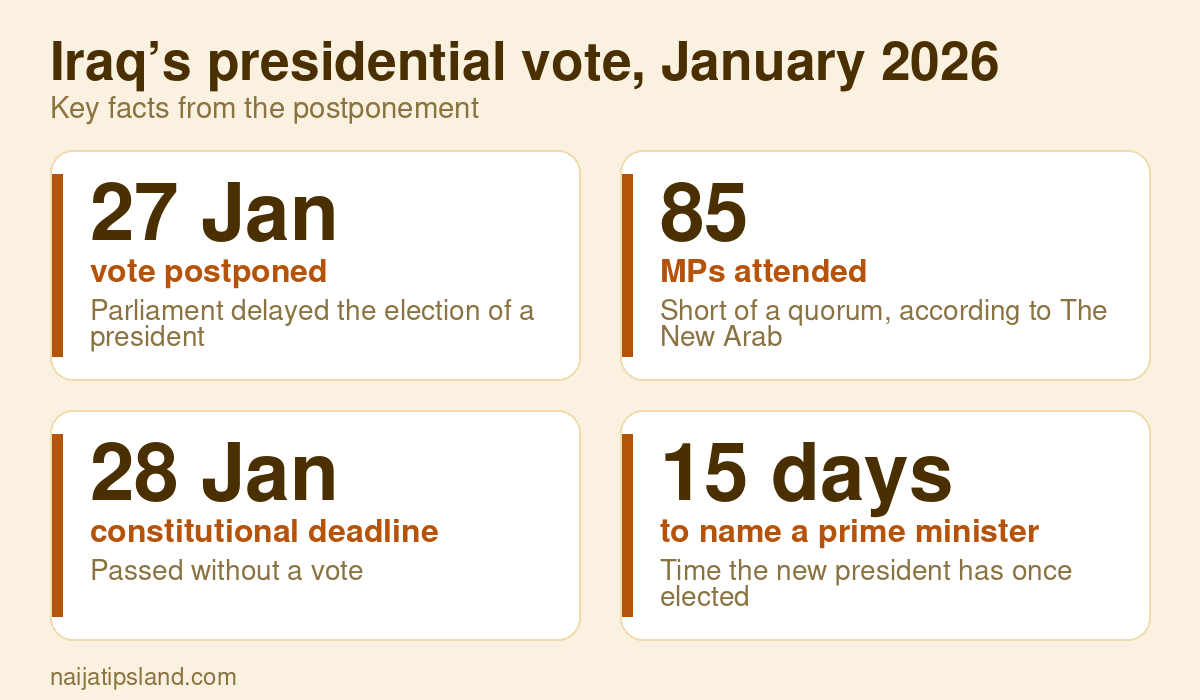
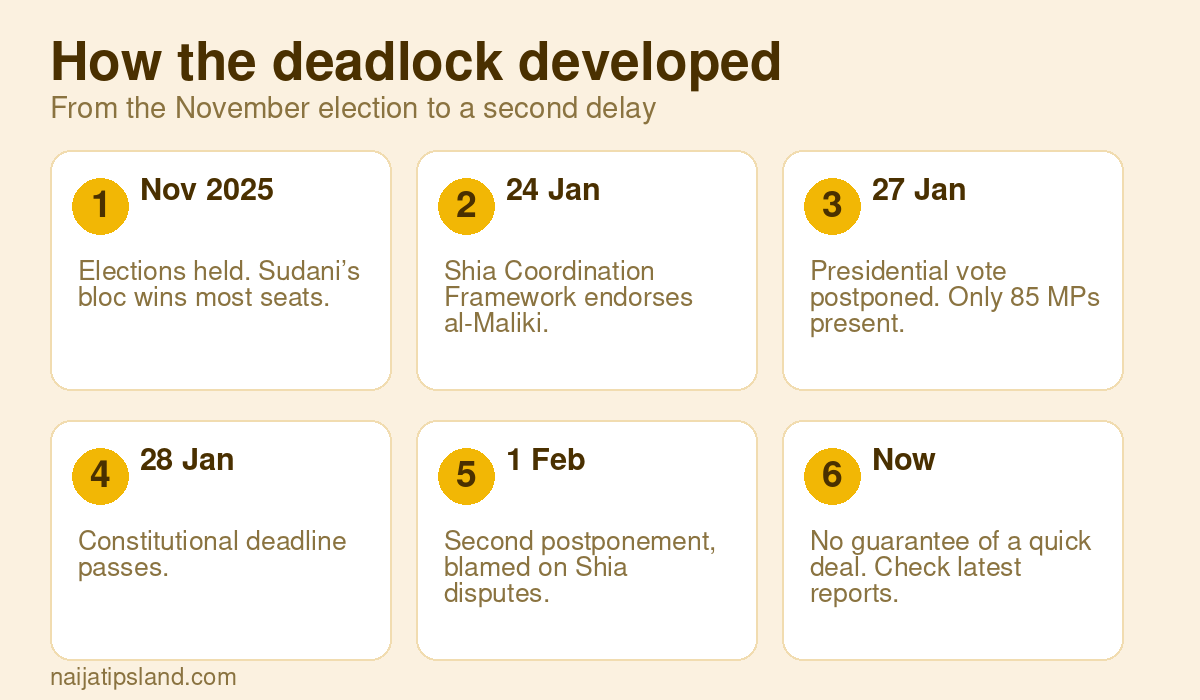
Iraq’s parliament was supposed to elect a new president on Tuesday 27 January. It did not. Lawmakers postponed the session after the two big Kurdish parties asked for more time to agree on a single candidate, and only 85 MPs turned up, according to The New Arab, which was not enough for the vote to go ahead. The constitutional deadline was the next day.
Why a mostly ceremonial job is causing such a fuss
Iraq shares its top posts on sectarian lines that date back to the aftermath of 2003: the prime minister is a Shia, the speaker of parliament a Sunni, and the presidency goes to a Kurd. The president has few real powers, but one of them matters a great deal: after the election, the president has 15 days to appoint the prime minister. Until there is a president, forming a government stalls.
The Kurdish split
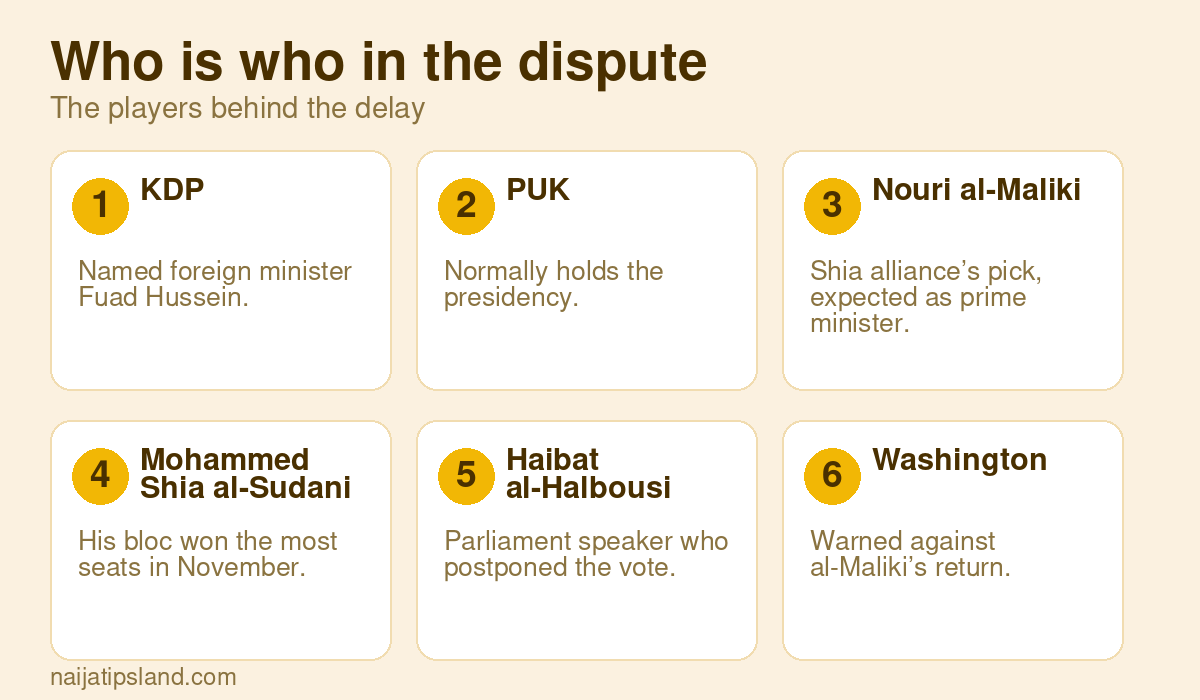
There is also an unwritten deal between the two big Kurdish parties. The Patriotic Union of Kurdistan (PUK) usually takes the national presidency, while the Kurdistan Democratic Party (KDP) takes the presidency and premiership of the Kurdistan Region. This time the KDP broke the pattern by nominating its own man, Foreign Minister Fuad Hussein. Whoever the Kurds finally put forward still needs the votes of the Shia and Sunni blocs, so the Kurdish quarrel was only part of the problem. Smaller candidates, including independent Shwan Dawdi and former MP Sardar Abdulla, were also in the race.
The prime minister question hanging over it all
After the November election, Prime Minister Mohammed Shia al-Sudani’s bloc won the most seats, but the Shia Coordination Framework, the alliance that holds a parliamentary majority, later backed former prime minister Nouri al-Maliki. Al-Maliki, 75, is Iraq’s only two-term premier since 2003. Washington warned against his return, pointing to his ties to Iran, a charge he rejects as interference. Iraq’s judiciary urged everyone to respect constitutional timelines.
That is why the delay was about more than the Kurds. When parliament failed to meet again on 1 February, Iraqi reports blamed disputes among Shia factions over the prime ministerial pick as much as the Kurdish rivalry.
What to watch
- Whether the KDP and the PUK agree on one candidate, or compete on the floor.
- Whether the Shia Coordination Framework holds together behind its prime ministerial choice.
- How Washington and Tehran, both with influence in Baghdad, react.
Iraq matters beyond its borders because it is a major oil producer, and instability there can move prices. If you want to understand how oil prices reach Nigerian households, see our guide on the role of oil in Nigeria.
Sources
- Al Jazeera: Iraq presidential vote delayed as Kurdish blocs struggle to pick candidate
- The New Arab: Iraqi parliament postpones presidential vote amid quorum failure
- Arab News: Election of new Iraqi president delayed by Kurds
- News On AIR: Iraq postpones presidential vote, delays government formation
- Peregraf: Second collapse of Iraq’s presidential session