First published 9 March 2026. Rewritten on 13 October 2026 from several news agencies’ reports.
Nine days into a war he started alongside Israel, Donald Trump told ABC News that whoever Iran picked to succeed Ayatollah Ali Khamenei would need Washington’s approval or would not last long. It was one of the bluntest things an American president has said about another country’s leadership in years, and it landed just hours before Tehran announced its choice.

What Trump said
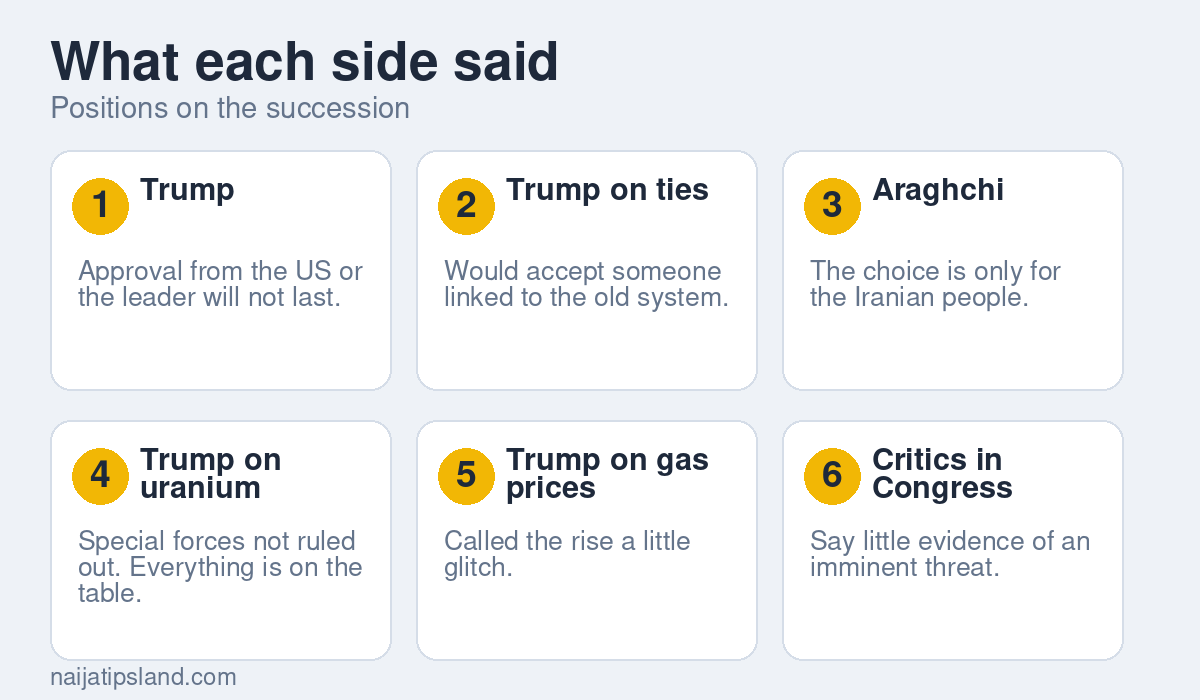
In the interview on Sunday 8 March, Trump said the new leader would have to get approval from the United States, and that without it he was “not going to last long”. Asked whether he could live with someone tied to the existing system, he said he would, if that person turned out to be a good leader. He explained his thinking as wanting to avoid having to return to Iran every few years, and said he did not want to see it get a nuclear weapon.
He also refused to rule out sending US special forces to seize Iran’s stock of enriched uranium, saying everything was on the table. He would not say how long the war would last, and brushed off rising petrol prices in America as a “little glitch”. Earlier, he had told the news site Axios that the reported frontrunner, Mojtaba Khamenei, was “a lightweight”.
Tehran’s answer
Iran’s foreign minister, Abbas Araghchi, had already said that picking the next leader was only the business of the Iranian people and that no foreign interference would be accepted. Hours after Trump’s interview, Iranian state media announced that the Assembly of Experts, the clerical body that chooses the supreme leader, had selected Mojtaba Khamenei, the 56-year-old son of the man killed in the opening strikes. Trump did not respond immediately to the announcement.

The wider picture that day
The remarks came as the toll mounted. Six American service members had been killed in a drone strike on a US base in Kuwait the previous Sunday, and Trump attended the return of their bodies on Saturday, according to AFP. Israel struck fuel dumps in and around Tehran, which we cover in our report on the first attack on Iran’s oil facilities, and hit a hotel in Beirut targeting suspected Iranian commanders. Critics, including most Democratic lawmakers, said the administration had offered little evidence that Iran posed an immediate threat.
Why it matters
A president saying he will vet another country’s leader is a break from decades of diplomatic custom, and it has practical consequences. It raises the odds of a longer confrontation, and it keeps oil markets on edge. For Nigeria, an oil producer that also buys fuel at world prices, higher crude can help revenue but hurts households at the pump. Read our guide on the role of oil in Nigeria, and for the unrest that preceded the war, see our report on the January protests in Iran.
Sources
- ABC News: Iran’s next supreme leader won’t last long without my approval, Trump says
- Al Jazeera: Trump vows control over Iran leader as death toll of US soldiers rises
- Anadolu Agency: Trump says Iran’s next supreme leader would need US approval
- Times of Israel: Trump says next Iranian supreme leader not going to last long
- ETV Bharat (AFP): Trump says new Iran leader won’t last long without his approval