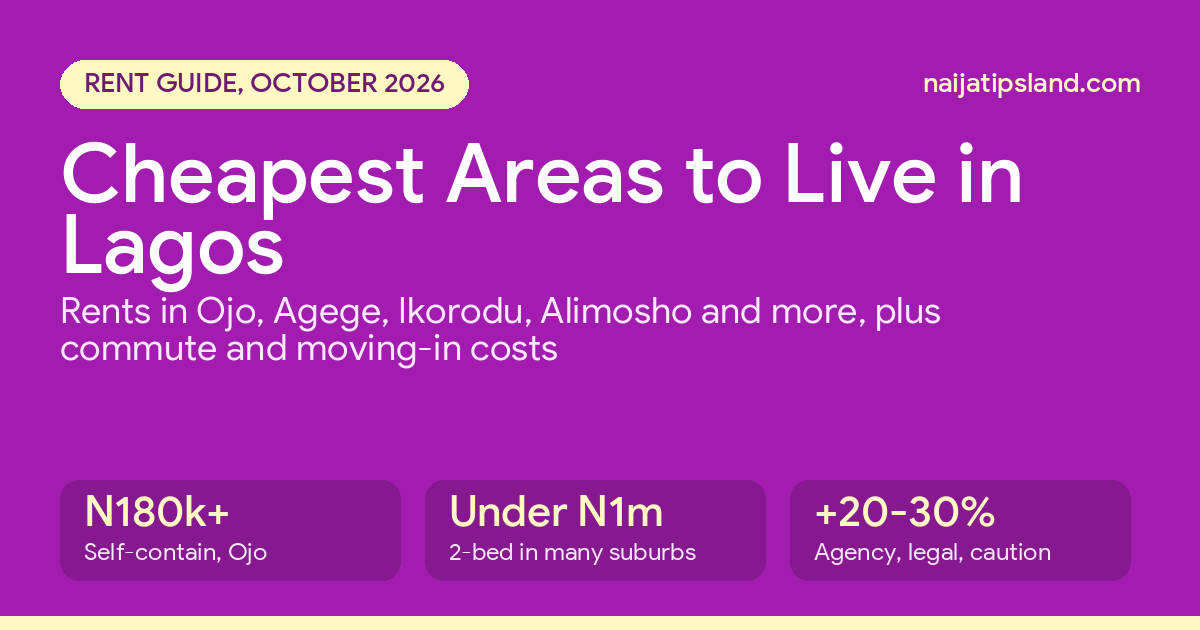
Where can you still find affordable rent in Lagos? Rents in Lagos have risen sharply since 2023, with many tenants facing renewal increases of 40% to 100%. In popular mainland areas like Yaba and Surulere, a two-bedroom flat now commonly costs ₦2 million to ₦4 million a year, and on the Island it can be several times that. But there are still areas where a self-contained apartment costs under ₦400,000 and a two-bedroom flat under ₦1 million a year.
This guide lists the cheapest areas to live in Lagos in 2026, with typical rents for a room, self-contain, mini flat and two-bedroom flat, what each area is like, the commute, and the hidden costs of moving in. If you are a landlord, see our guide to the mistakes first-time landlords make in Nigeria.
Last updated: 21 October 2026. Rents are typical annual asking rents from Nigerian property reports and listings published in 2026 (see Sources). Actual rents vary widely by street, building age and facilities, so always inspect before paying.
Cheapest areas in Lagos at a glance
| Area | Self-contain (per year) | Mini flat (per year) | 2-bedroom (per year) |
|---|---|---|---|
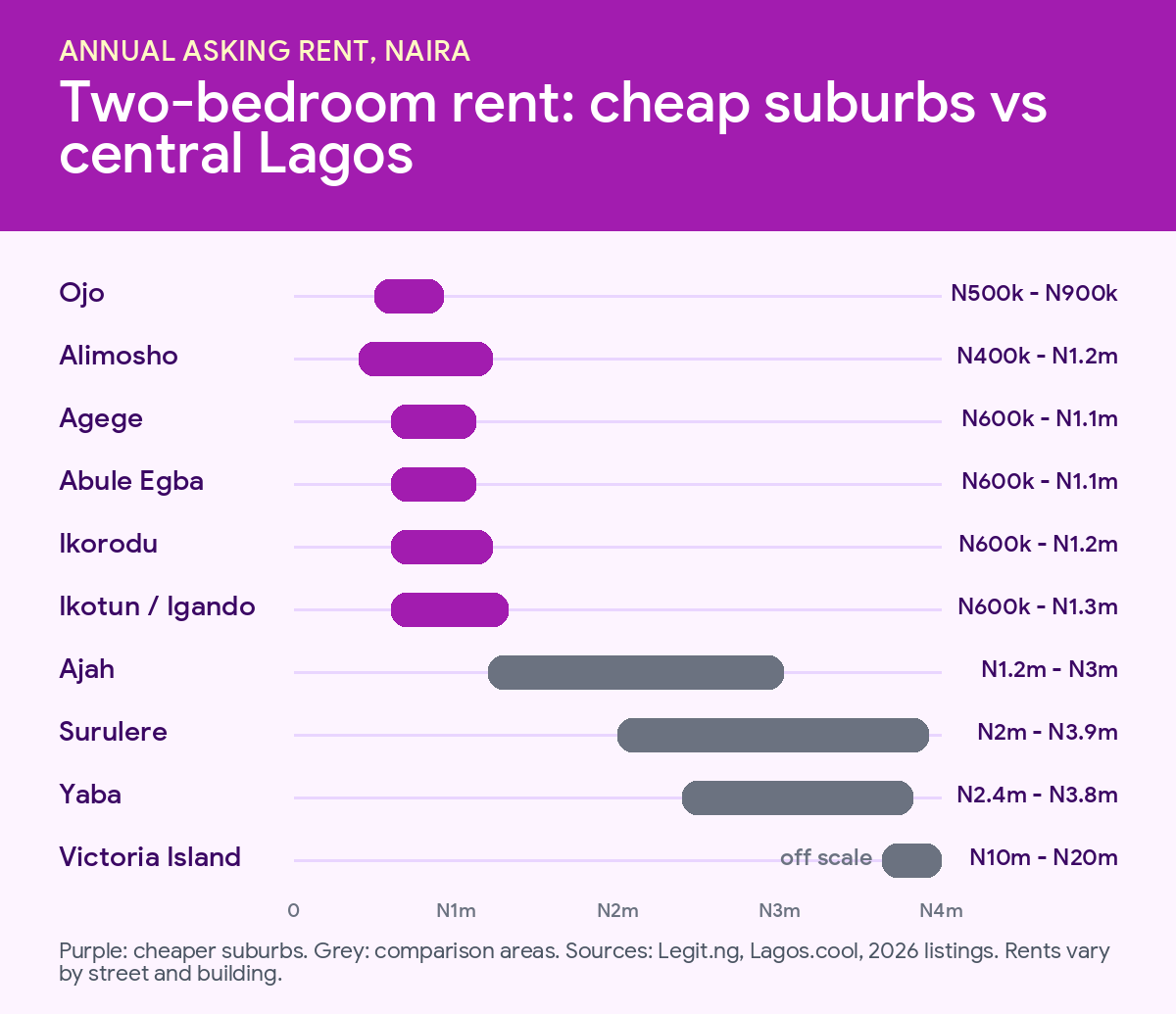
| Ojo | ₦180,000 to ₦350,000 | ₦300,000 to ₦600,000 | ₦500,000 to ₦900,000 |
| Agege | ₦200,000 to ₦400,000 | ₦350,000 to ₦700,000 | ₦600,000 to ₦1.1m |
| Abule Egba | ₦200,000 to ₦400,000 | ₦350,000 to ₦700,000 | ₦600,000 to ₦1.1m |
| Ikorodu | ₦250,000 to ₦450,000 | ₦400,000 to ₦700,000 | ₦600,000 to ₦1.2m |
| Ikotun and Igando | ₦250,000 to ₦450,000 | Varies | ₦600,000 to ₦1.3m |
| Alimosho (Egbeda, Iyana Ipaja, Ayobo) | From about ₦250,000 | Varies | ₦400,000 to ₦1.2m |
| Badagry | Among the lowest in Lagos | Lower than most areas | Lower than most areas |
| Ajah (cheapest on the Island side) | Higher than mainland suburbs | Higher than mainland suburbs | ₦1.2m to ₦3m |
For comparison, a two-bedroom flat costs about ₦2 million to ₦3.9 million a year in Surulere, ₦2.4 million to ₦3.8 million in Yaba, and ₦10 million to ₦20 million in Victoria Island, according to 2026 asking-rent data.
The 10 cheapest areas to live in Lagos
1. Ojo
Typical rent: self-contain ₦180,000 to ₦350,000; mini flat ₦300,000 to ₦600,000; 2-bedroom ₦500,000 to ₦900,000.
Ojo, on the Lagos-Badagry Expressway, is one of the cheapest places in Lagos to rent a flat. It is home to Lagos State University (LASU) and the Alaba International Market, so it suits students, traders and families on a budget. The Blue Line rail is being extended along the expressway towards Okokomaiko, which should make commuting to Mile 2 and Lagos Island much easier once complete. Traffic on the expressway and some poorly drained streets are the main downsides.
Best for: students, traders at Alaba and Trade Fair, and families on a budget.
2. Agege
Typical rent: self-contain ₦200,000 to ₦400,000; mini flat ₦350,000 to ₦700,000; 2-bedroom ₦600,000 to ₦1.1 million.
Agege is busy and crowded, but it has a major advantage: the Lagos Red Line rail, which runs from Agbado through Agege and Ikeja to Oyingbo. That makes it one of the cheapest areas with a fast, reliable commute to Ikeja and Yaba. It is close to Ikeja and the airport, and has busy markets. Expect older buildings and congested roads.
Best for: people working in Ikeja, Yaba or Ebute Metta who want to use the train.
3. Abule Egba
Typical rent: self-contain ₦200,000 to ₦400,000; mini flat ₦350,000 to ₦700,000; 2-bedroom ₦600,000 to ₦1.1 million.
Abule Egba sits on the Lagos-Abeokuta Expressway near the Ogun State border. It has improved since the expressway and the Abule Egba flyover were built, and BRT buses run towards Ikeja and Oshodi. The cheapest properties are often away from the main road, so factor in a walk or okada ride to transport. Nearby areas such as Ijaiye, Alagbado and Agbado are similarly priced and are close to Red Line stations.
Best for: commuters to Ikeja and Ogun State, and families who want more space.
4. Ikorodu
Typical rent: self-contain ₦250,000 to ₦450,000; mini flat ₦400,000 to ₦700,000; 2-bedroom ₦600,000 to ₦1.2 million.
Ikorodu is one of the biggest and fastest-growing parts of Lagos, with newer estates, more space and lower rents than most of the mainland. Its big drawback is the commute: the Ikorodu Road can add hours to a daily trip to Lagos Island. The BRT corridor and ferry services from Ikorodu to Lagos Island help, but plan your route carefully. Below ₦250,000, expect older buildings or less-developed areas.
Best for: families, remote workers and people who work locally.
5. Ikotun and Igando
Typical rent: self-contain ₦250,000 to ₦450,000; 2-bedroom ₦600,000 to ₦1.3 million.
Ikotun and Igando, in the Alimosho area, are popular with budget-conscious tenants. They are densely populated, with busy markets and good access to everyday services. Ikotun traffic is notorious, especially at the roundabout, so check your route to work before committing.
Best for: tenants who work in the Alimosho area or along the Lagos-Abeokuta and Lagos-Badagry corridors.
6. Alimosho: Egbeda, Iyana Ipaja and Ayobo
Typical rent: self-contain from about ₦250,000; 2-bedroom about ₦400,000 to ₦1.2 million.
Alimosho is the most populous local government area in Lagos and one of the most affordable. Egbeda and Iyana Ipaja have plenty of rental stock, and Ayobo, further out, often has newer houses at lower rents. Roads within some estates are poor, and areas close to canals can flood during the rainy season.
Best for: families looking for a two-bedroom flat for under ₦1 million.
7. Badagry
Typical rent: among the lowest in Lagos for rooms, self-contains and flats.
Badagry, near the border with Benin, offers some of the cheapest rents in Lagos State, a quieter lifestyle and a rich history. But it is a long way from central Lagos, so it suits people who work locally, work from home or don’t need to commute daily. The Blue Line extension and road upgrades along the Lagos-Badagry Expressway should improve access over time.
Best for: remote workers, retirees and people working in Badagry, Ojo or Seme.
8. Ejigbo and Isolo
Ejigbo and nearby Isolo are central mainland areas that are still relatively affordable, close to Oshodi, Ikeja and the Apapa-Oshodi Expressway. Rents are higher than in the outer suburbs, but you save on transport. Some streets in Ejigbo flood in heavy rain.
Best for: people working in Oshodi, Ikeja, Isolo or Ikotun who want a shorter commute.
9. Mushin and Oshodi
Mushin and Oshodi have some of the cheapest rooms and self-contains in central Lagos, often well under ₦300,000 a year, in older buildings. They are crowded and busy, but very central, with easy transport to almost anywhere. Inspect the building and street carefully, and ask neighbours about water, power and security.
Best for: single workers who want a central location at the lowest price.
10. Ajah and Sangotedo (cheapest on the Island side)
Typical rent: 2-bedroom about ₦1.2 million to ₦3 million.
If you work in Lekki, Victoria Island or Ikoyi, Ajah and Sangotedo are the most affordable places to live on the Island side, although still much more expensive than the mainland suburbs above. Further out, Lakowe, Awoyaya and Ibeju-Lekki are cheaper again, but rents there are rising fast, with Ibeju-Lekki asking rents up 46% in a year. The Lekki-Epe Expressway traffic and road works are the main drawback.
Best for: people working on the Island who can’t afford Lekki Phase 1 or VI.
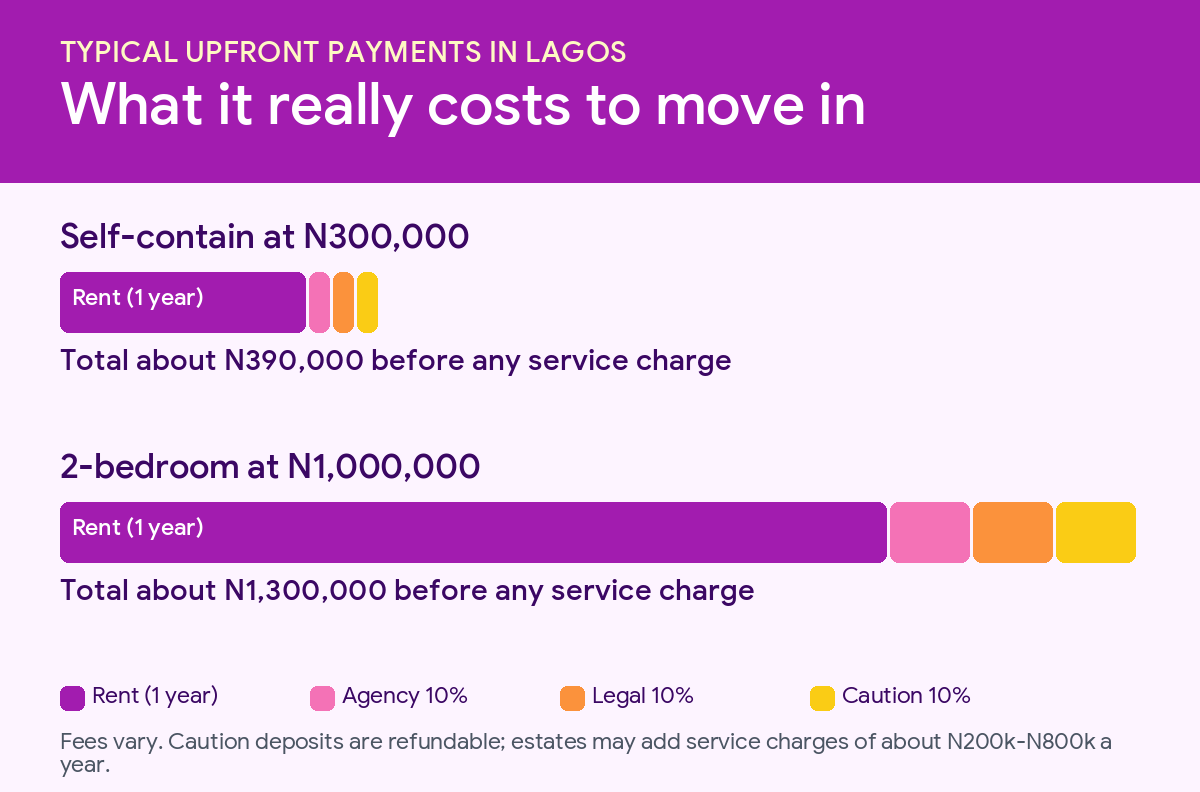
The real cost of moving in
The rent is only part of what you pay upfront. In Lagos, tenants usually pay a year’s rent in advance, plus:
- Agency fee: usually about 10% of the annual rent.
- Legal or agreement fee: usually about 10% of the annual rent.
- Caution (security) deposit: often 10% or more of the rent, refundable when you leave in good condition.
- Service charge: in estates and newer blocks, for security, waste, water and shared power. On the mainland this commonly runs from about ₦200,000 to ₦800,000 a year.
- Inspection fee: some agents charge to view properties. Agree on this before you go.
So a self-contain advertised at ₦300,000 a year can easily cost ₦400,000 or more to move into, and a ₦1 million two-bedroom flat ₦1.3 million or more.
What the law says
Under the Lagos State Tenancy Law 2011, a landlord cannot demand more than one year’s rent in advance from a new yearly tenant (or more than six months from a monthly tenant), and must give a receipt for rent paid. These limits do not apply in some high-end areas such as Ikoyi, Victoria Island, Ikeja GRA and Apapa. A new Lagos tenancy bill, which would tighten rules on agency fees and require estate agents to register with the state regulator (LASRERA), is before the Lagos State House of Assembly but had not become law at the time of writing.
How to find cheap rent in Lagos without getting scammed
- Look beyond the big listing sites. The cheapest rooms and self-contains are often advertised on “To let” signs, through local agents and by word of mouth. Walk around the area you want.
- Never pay before inspecting the property in person, and confirm that the person collecting money is the landlord or an authorised agent. Ask to see proof of ownership or the landlord’s authorisation.
- Be wary of very cheap online adverts. Fake rental listings on Instagram, WhatsApp and Facebook are common. See our guide to common WhatsApp scams in Nigeria.
- Visit during the rainy season or ask neighbours about flooding. Many affordable areas have streets that flood.
- Check water, power and security. Ask about the borehole, the electricity band and the estate’s security arrangements.
- Test the commute at rush hour. A cheap house that adds three hours of traffic a day may cost more in time and transport than it saves.
- Get everything in writing: a tenancy agreement and receipts for every payment.
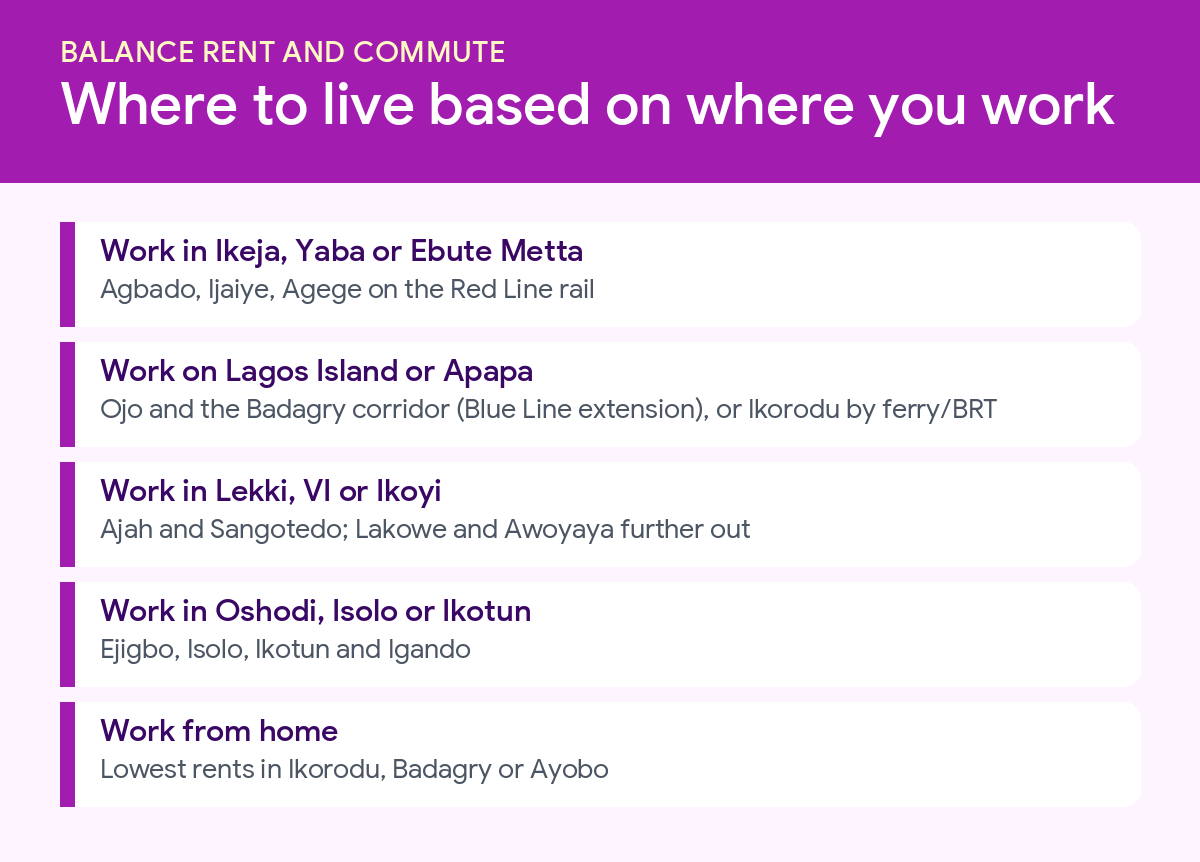
Is it worth living far out to save on rent?
It depends on where you work. A daily danfo or BRT commute in Lagos can cost ₦15,000 to ₦40,000 a month or more, and long journeys also cost time and energy. As a rule of thumb:
- If you work in Ikeja, Yaba or Ebute Metta, areas on the Red Line (Agbado, Ijaiye, Agege) offer the best balance of rent and commute.
- If you work on Lagos Island or Apapa, Ojo and the Lagos-Badagry corridor will improve as the Blue Line is extended. Ikorodu residents can use the ferry or BRT.
- If you work in Lekki or VI, Ajah and Sangotedo are the realistic budget options.
- If you work from home, you can take full advantage of the lowest rents in Ikorodu, Badagry or Ayobo. Just make sure the area has good mobile network coverage.
If you travel between cities, see our guide to Lagos to Abuja transport costs.
Thinking of building instead? See the cost of building a house in Nigeria in 2026.
Frequently asked questions
What is the cheapest area to live in Lagos?
Ojo, Badagry, Agege, Abule Egba and parts of Alimosho and Ikorodu have some of the lowest rents in Lagos, with self-contains from about ₦180,000 to ₦450,000 a year and two-bedroom flats from about ₦500,000 to ₦1.2 million.
How much is a self-contain in Lagos in 2026?
In the cheaper mainland suburbs, about ₦180,000 to ₦450,000 a year. In central mainland areas such as Yaba and Surulere it is usually much higher, and on the Island higher still.
Where can I get a two-bedroom flat for under ₦1 million in Lagos?
Ojo, Agege, Abule Egba, Ikorodu, Ikotun, Igando and parts of Alimosho such as Ayobo, depending on the street and the age of the building.
What is the cheapest area on the Island?
Ajah and Sangotedo, with two-bedroom flats from about ₦1.2 million a year. Lakowe, Awoyaya and Ibeju-Lekki are cheaper but further out.
How much should I budget to move into a Lagos flat?
Budget for one year’s rent plus about 20% to 30% extra for agency, legal and caution fees, and any service charge.
Sources
- Legit.ng (via AbokiFX): 5 neighbourhoods that offer budget-friendly homes (August 2026)
- Legit.ng: areas in Lagos with cheaper self-contained apartments (August 2026)
- BusinessDay: Lagos suburbs where renters can find affordable rents (March 2026)
- Lagos.cool: Lagos rent prices 2026, neighbourhood comparison
- Current Affairs Nigeria: cost of living in Lagos 2026
- Nigeria Housing Market: Lagos targets housing market abuses with new tenancy legislation