

TL;DR:
- Social trends in Nigeria and Africa rapidly influence culture, consumer behavior, and civic life.
- Understanding these shifts helps brands and individuals stay relevant and respond effectively to emerging narratives.
Social trends are defined as patterns of collective behavior and cultural shifts that reshape how societies think, communicate, and make decisions. The role of social trends in Nigeria and Africa has never been more direct or more consequential. Social media and video platforms now reach 54% of global consumers as their primary news source. That number tells you exactly how much power digital trends hold over public opinion, cultural identity, and purchasing behavior across the continent. Naijatipsland tracks these shifts daily, and the patterns are clear: understanding social trends is no longer optional for anyone who wants to stay culturally relevant in 2026.
What is the role of social trends in shaping cultural norms?
Social trends reshape cultural norms by accelerating the spread of new values, languages, and identities across communities. In Nigeria and across Africa, this process moves faster than in most regions because mobile internet adoption and social media engagement are growing simultaneously. What used to take a generation to shift culturally now takes months.
Digital communities create microcultures with their own norms, slang, and aesthetic codes. These microcultures do not stay contained. Viral moments push subcultural language and fashion into the mainstream, and Nigerian internet culture is one of the most visible examples of this globally. Afrobeats, Pidgin internet slang, and Nigerian fashion aesthetics have all traveled from niche online communities to international recognition through this exact mechanism.
Social media has transformed individuals from passive consumers into active cultural participants. That shift democratizes cultural production, meaning voices that were previously excluded from mainstream media now shape what is considered normal or aspirational. The risk, however, is real: the same openness that amplifies marginalized voices also accelerates misinformation and cultural polarization.
Key ways social trends influence cultural norms in Nigeria and Africa:
- Language evolution: Internet slang like “sapa,” “e go better,” and “no cap” moves from Twitter to everyday speech within weeks.
- Fashion cycles: Trend-driven styles spread through Instagram and TikTok, compressing fashion cycles from seasons to days.
- Social values: Conversations around gender roles, mental health, and civic responsibility gain or lose momentum based on trending discourse.
- Entertainment standards: What counts as quality content shifts rapidly as audiences follow trending formats and creators.
Pro Tip: Watch which subcultural trends cross over into mainstream Nigerian media. That crossover moment is when a micro-trend becomes a genuine cultural shift worth paying attention to.
What impact do social trends have on consumer behavior in Nigeria?
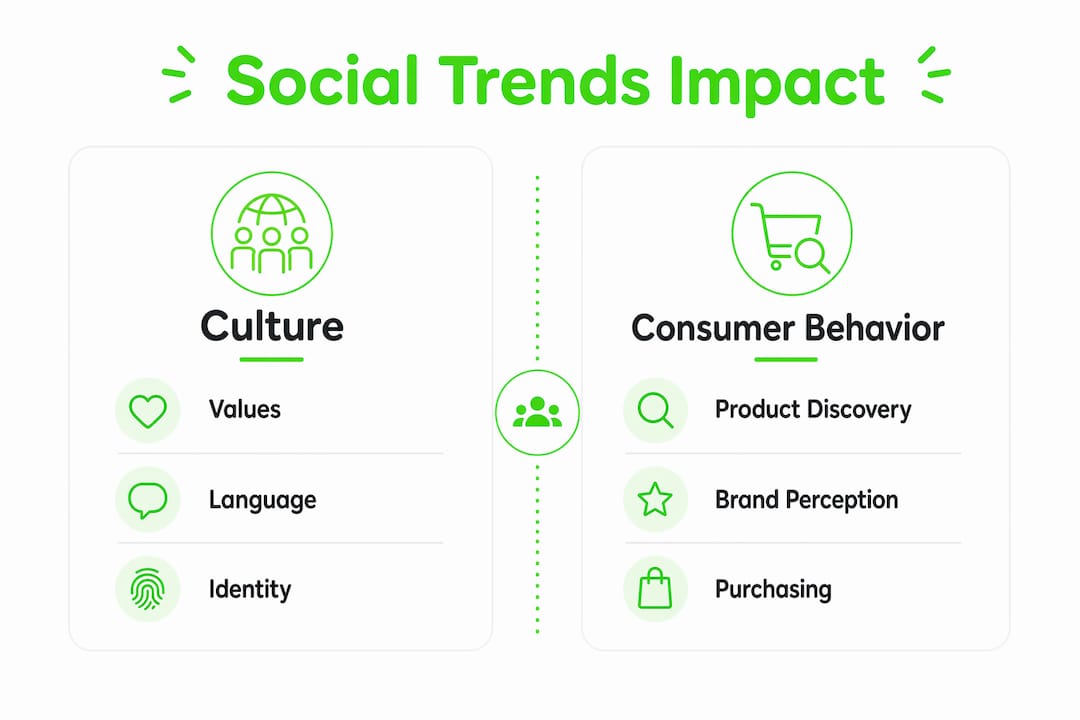
Social trends directly change how Nigerian consumers discover, evaluate, and buy products. The importance of social trends in purchasing decisions is measurable. 40% of consumers discover products through employee-generated content, and that figure rises to 61% among Gen Z. This means peer-validated discovery has replaced traditional advertising as the primary path to purchase for younger Nigerian consumers.
Brand perception is equally trend-sensitive. 84% of consumers say the speed at which a brand responds to crises on social media strongly affects how they view that brand. Nigerian audiences are particularly vocal on platforms like X (formerly Twitter), and a slow or tone-deaf response to a trending controversy can permanently damage brand trust.
| Consumer behavior marker | Traditional media influence | Social trend influence |
|---|---|---|
| Product discovery | TV and radio ads | Peer posts and influencer content |
| Brand trust signals | Corporate reputation | Real-time social media response |
| Purchase validation | Expert reviews | Community endorsement and comments |
| Trend adoption speed | Weeks to months | Hours to days |
| Crisis impact | Delayed public reaction | Immediate, viral backlash or support |
Trendjacking, the practice of brands inserting themselves into trending conversations, works only when it is authentic. Successful brand participation depends on a quality of fit, meaning brands should only engage with trends that align with their core voice and values. Nigerian brands that force themselves into unrelated trends consistently face public ridicule rather than engagement.
Pro Tip: Before joining a trending conversation, ask whether your brand would naturally be part of that discussion offline. If the answer is no, the online version will feel just as forced.
How do social media platforms influence the spread of social trends?
The platform you use determines how a trend spreads and how long it lasts. Social media is splitting into two distinct environments: public entertainment hubs like Instagram and TikTok, and private social spaces like WhatsApp. This split has direct consequences for how trends move through Nigerian digital culture.
Public entertainment platforms amplify trends through algorithmic reach and public engagement signals. WhatsApp, by contrast, spreads trends through trust networks, which makes them feel more personal and credible. A trend that starts on TikTok and migrates to WhatsApp group chats has crossed a significant threshold. It has moved from entertainment to genuine social conversation.
Micro-trends now last only 48–72 hours in many cases. Traditional weekly or monthly content planning cannot keep pace with that cycle. This is a structural challenge for Nigerian brands and content creators who rely on editorial calendars rather than real-time monitoring.
Signals that indicate a trend has staying power beyond the initial spike:
- Cross-platform spread: A trend appearing on TikTok, X, and WhatsApp simultaneously is more durable than one confined to a single app.
- Community adoption breadth: When multiple unrelated communities pick up the same trend, it signals cultural resonance rather than niche appeal.
- Journalist engagement: When Nigerian news outlets begin covering a trend, it has crossed into sustained public discourse.
- Week-over-week growth: A trend still growing after seven days is not a micro-trend. It is a cultural moment.
- Early brand uptake: When brands begin referencing a trend organically, it confirms mainstream relevance.
Hitting four of these five crossover indicators signals a trend worth strategic investment. That framework gives Nigerian marketers and content creators a concrete filter instead of guesswork.
What are the broader societal implications of social trends in Africa?
Social trends shape more than consumer choices. They influence civic life, community belonging, and identity construction across Nigeria and Africa. Platforms determine which issues gain public attention and which voices become authoritative. That is a form of political and social power, whether or not it is recognized as such.
The fragmentation of shared realities is one of the most significant consequences. When different communities consume entirely different trend ecosystems, they develop different assumptions about what is normal, what is true, and what matters. This fragmentation feeds echo chambers and polarization, which are visible in Nigerian political discourse on X and in the divergent narratives that emerge around elections, public health, and economic policy.
The societal implications cut in multiple directions:
- Civic mobilization: Trending hashtags have organized protests, fundraisers, and community responses to government actions across Nigeria and Africa.
- Misinformation spread: The same viral mechanics that amplify genuine movements also accelerate false narratives, particularly around health and politics.
- Cultural democratization: Groups historically excluded from mainstream Nigerian media now build audiences and shape cultural conversations directly.
- Privacy erosion: Trend participation often involves sharing personal data and location signals that users do not fully control.
- Attention economy distortion: Platforms reward emotional content over accurate content, which skews public discourse toward outrage and away from nuance.
Understanding why online trends matter for Nigerian youth is not just a cultural question. It is a civic one. The trends that dominate Nigerian social media in any given week shape what young Nigerians believe is possible, acceptable, and worth fighting for.
How can you identify and respond to social trends effectively?
Identifying a meaningful trend before it peaks is a skill, not luck. The difference between a viral spike and a sustained cultural shift is detectable if you know what to measure. Practitioners distinguish these two categories to allocate resources efficiently rather than chasing every trending topic.
Follow these steps to evaluate any emerging trend:
- Check cross-platform presence. A trend confined to one app is likely a micro-trend. Look for the same conversation appearing on X, Instagram, and WhatsApp within 24 hours.
- Measure week-over-week growth. A trend still accelerating after seven days has structural momentum. One that peaked on day two is already fading.
- Assess community breadth. Count how many distinct communities are participating. Broad adoption across unrelated groups signals cultural significance.
- Look for journalist and influencer crossover. When Nigerian journalists and mid-tier influencers begin referencing a trend, it has moved past early adopters.
- Evaluate your fit before acting. Ask whether your voice or brand belongs in this conversation. Forced participation damages credibility faster than silence.
Distinguishing fleeting viral spikes from slow-building cultural narratives is the core skill for anyone working with social trends in Nigeria. Brands and individuals who master this distinction spend less effort on noise and more on moments that actually move culture.
Pro Tip: Set up keyword alerts for trending Nigerian topics using free tools like Google Trends. Check them every morning. Patterns that appear across three consecutive days deserve your attention.
Key Takeaways
Social trends are the primary mechanism through which culture, consumer behavior, and civic life evolve in Nigeria and Africa, and understanding them is a practical skill, not just an academic one.
| Point | Details |
|---|---|
| Social media drives cultural change | Platforms accelerate the spread of new norms, languages, and values across Nigerian communities. |
| Consumer behavior is trend-dependent | 61% of Gen Z discover products through peer content, making trend awareness critical for brands. |
| Trend lifespan is shrinking | Micro-trends last 48–72 hours, requiring real-time monitoring rather than monthly planning. |
| Five crossover indicators predict durability | Cross-platform spread, community breadth, and journalist uptake signal trends worth investing in. |
| Societal impact goes beyond commerce | Social trends shape political discourse, civic mobilization, and shared realities across Africa. |
Naijatipsland’s take on social trends in Nigeria
The conversation around social trends in Nigeria often focuses on entertainment and marketing. That framing misses the deeper story. What I have observed through years of tracking Nigerian digital culture is that social trends are the primary way ordinary Nigerians negotiate power, identity, and belonging in a rapidly changing society.
The democratization argument is real. Voices that had no path into mainstream Nigerian media 10 years ago now build audiences of millions and shift national conversations. That is genuinely significant. The misinformation problem is equally real, and the two cannot be separated. The same open architecture that empowers new voices also removes the filters that once slowed the spread of harmful content.
What I find most underappreciated is the speed at which Nigerian internet culture exports itself globally. Afrobeats, Nollywood aesthetics, and Nigerian social media humor are not just local phenomena. They are active exports that shape global culture. That means understanding how social trends work in Nigeria is not just relevant for Nigerians. It is relevant for anyone trying to understand where global culture is heading.
The practical lesson is this: engage with social trends critically, not reactively. Know the difference between a moment and a movement. And always ask whose interests a trending narrative serves before you amplify it.
— Naijatipsland
Stay current with Nigerian culture on Naijatipsland
Naijatipsland covers the cultural and social shifts that matter most to Nigerian readers, from entertainment and politics to lifestyle and current affairs.
If you want to understand entertainment’s role in Nigerian culture and how it connects to the social trends shaping the country, Naijatipsland is where that conversation lives. The platform aggregates trending topics, community discussions, and current affairs coverage in one place, so you stay informed without having to monitor a dozen separate sources. For readers who want to go deeper on why entertainment updates matter for cultural awareness, Naijatipsland has you covered with fresh content updated daily.
FAQ
What are social trends?
Social trends are patterns of collective behavior and cultural change that spread across communities, often accelerated by social media. They influence language, values, consumer choices, and civic life.
How do social trends influence consumer behavior in Nigeria?
Social trends shape product discovery, brand perception, and purchasing decisions. Research shows 61% of Gen Z consumers discover products through peer-generated content, making trend awareness a core part of any brand strategy in Nigeria.
How long do social trends typically last?
Micro-trends often last only 48–72 hours, while sustained cultural shifts build over weeks. Cross-platform spread and week-over-week growth are the clearest signals that a trend has lasting power.
Why do social trends matter for Nigerian society beyond marketing?
Social trends influence political discourse, civic mobilization, and the construction of shared identity. Platforms determine which issues gain public attention, giving trending content direct influence over what Nigerians believe and prioritize.
How can you tell if a social trend is worth engaging with?
Check for four of five crossover indicators: cross-platform spread, community adoption breadth, journalist engagement, early brand uptake, and week-over-week growth. A trend hitting four of these signals is worth strategic attention.