


Last updated: 13 October 2026. This guide picks trends that the data supports. It does not predict precise growth rates. Funding figures differ between trackers because of how they count deals, so we name the source each time.
Five tech trends at a glance
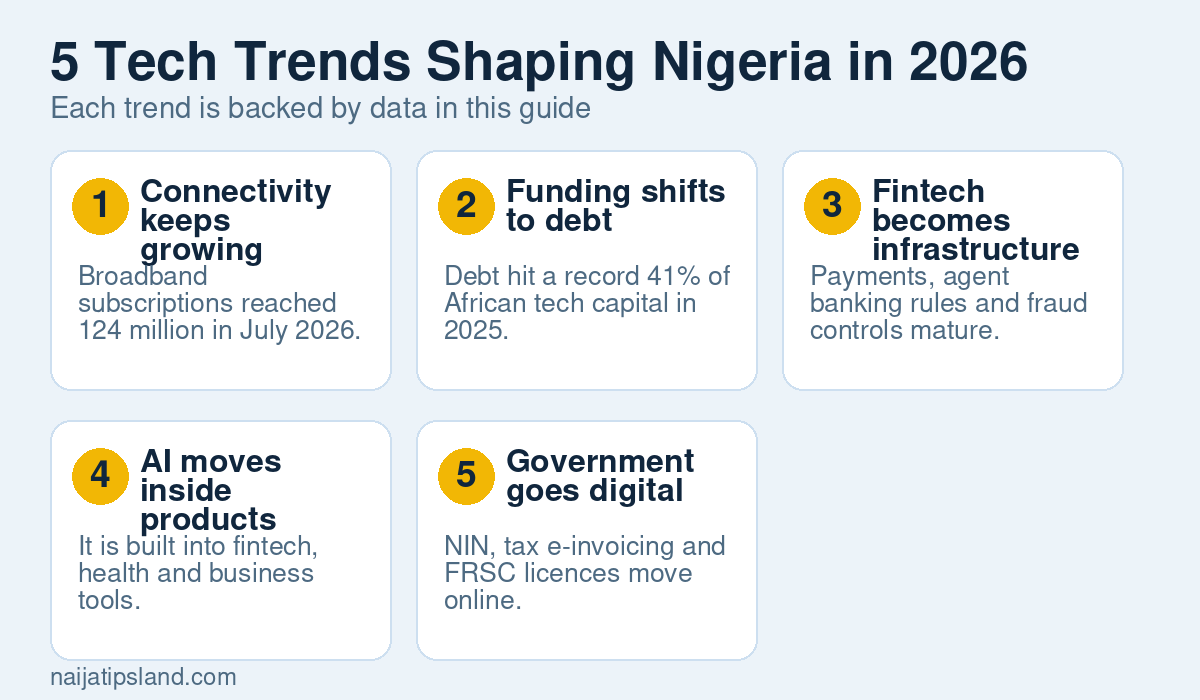
- 1. Connectivity keeps growing: broadband subscriptions reached 124 million in July 2026, with penetration at 57.40%.
- 2. Funding is recovering, and shifting to debt: African tech raised $4.1 billion in 2025, up 25%, with record debt of $1.64 billion.
- 3. Fintech is becoming infrastructure: payments, agent banking rules and fraud controls are maturing.
- 4. AI is moving inside products: it is being built into existing services, and it also powers new kinds of fraud and disinformation.
- 5. Government services are going digital: identity, tax and licences are moving online.
Every year brings lists of tech trends, but many are guesses dressed up as certainty. For this update we rebuilt the article around evidence you can check. An earlier version quoted several percentages without sources, which we have removed. Below are five trends that stand up against reports from the NCC, the NBS, Partech Africa and Nigerian regulators, with plain-language notes on what each means for Nigerians who work in or use technology.
How We Chose These Trends
We looked for developments that meet three tests. First, there must be solid data from an identifiable source. Second, the change must affect many Nigerians, not just a niche. Third, it must be likely to continue into 2027. We left out topics that rest mainly on hype or on single announcements.
Trend 1: Connectivity Keeps Growing, but Not Fast Enough for Everyone
Nigeria’s broadband penetration climbed from 50.58% in November 2025 to 57.40% in July 2026, and broadband subscriptions reached 124 million, according to NCC data. Data traffic is rising too, with the NCC reporting about 45,800 terabytes consumed daily in May 2026. The information and communication sector contributed 11.74% of real GDP in the second quarter of 2026, according to the NBS. That is the good news.
The challenge is that about 130 million Nigerians remain offline, according to DataReportal. Data costs, devices, power and skills hold many people back. What it means for you: if you build products or services, design for slow connections, small data budgets and low-cost phones, because that is still the reality for a large part of the market. Our guide on Nigeria’s digital economy has the full numbers.
Trend 2: Funding Recovers, but the Mix Is Changing
Partech Africa’s 2025 Africa Tech Venture Capital Report found that African tech startups raised $4.1 billion in 2025, a 25% rise from $3.25 billion in 2024 and the strongest level since 2022. But the composition matters:
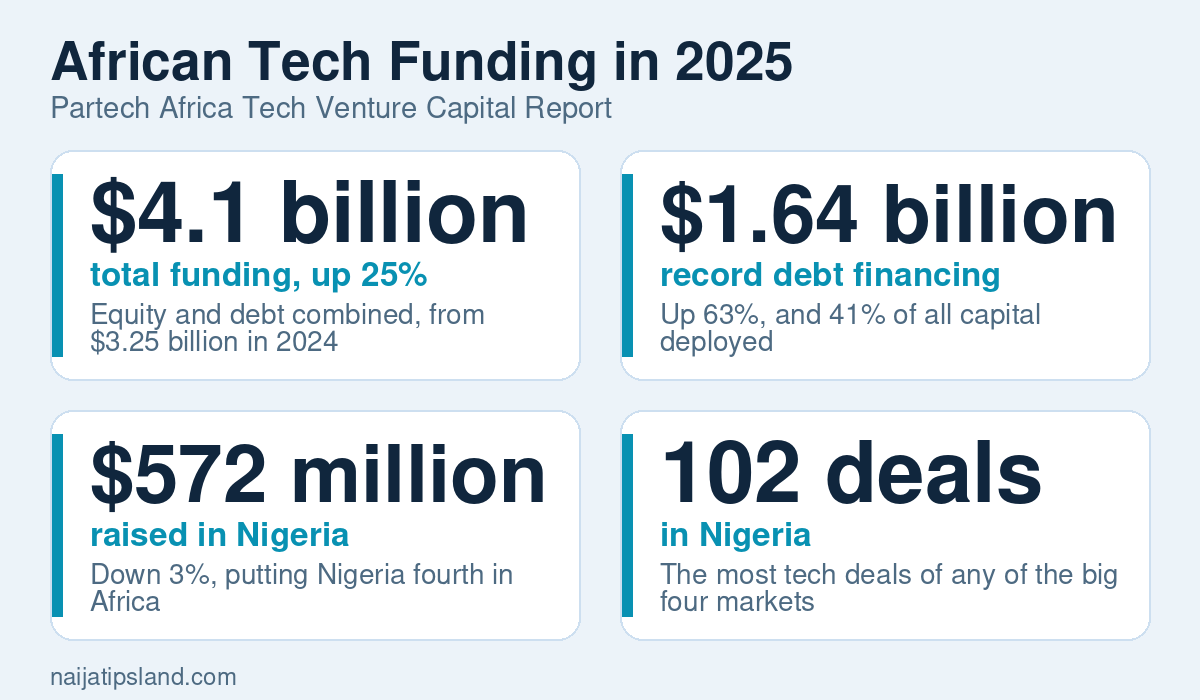
- Debt is now a big part of the picture. Startups raised a record $1.64 billion in debt in 2025, up 63%, and debt accounted for 41% of capital deployed, up from 17% in 2019.
- Nigeria is still active but no longer first. Kenya led with $1.04 billion, followed by South Africa at $715 million and Egypt at $604 million. Nigeria raised about $572 million, down about 3%, though it recorded 102 deals, the most among the big four markets.
- Early 2026 was softer for Nigeria. A report citing Nairametrics put Nigeria’s first-quarter 2026 funding at about $78.6 million, down 28% year on year.
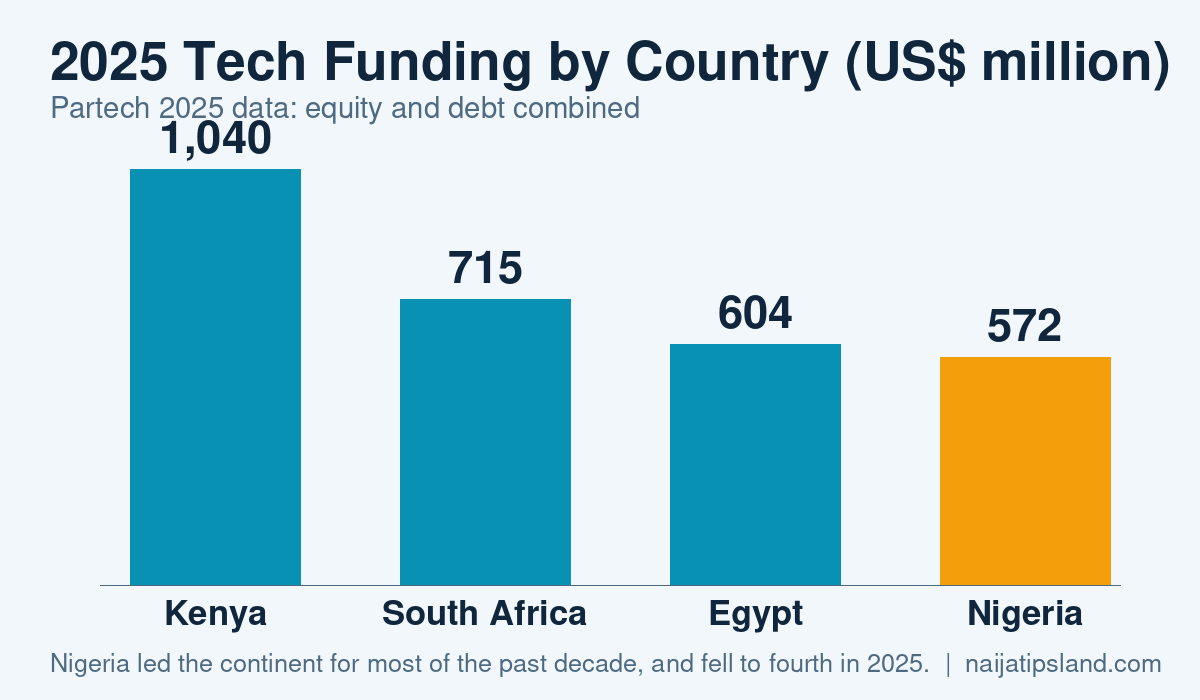
What it means for you: investors are favouring businesses with revenue, structure and the ability to repay, rather than growth at any cost. If you are a founder, focus on unit economics and cash flow. If you work at a startup, expect more emphasis on profitability.
Trend 3: Fintech Becomes Infrastructure
Fintech is still Africa’s largest funded sector, with about $1.49 billion in 2025 by one count, but its share of equity funding has fallen as money spreads to other areas such as cleantech. Partech reported fintech equity of $769 million, down 43%, and 32% of equity funding compared with 60% before. At the same time, the sector is maturing as a backbone for payments and commerce:
- The CBN’s October 2025 agent banking guidelines set transaction limits, geo-tagged POS terminals and required agents to work with one principal from April 2026. See our guide to POS agent fraud.
- Electronic payment fraud losses were reported at about ₦25.85 billion in 2025, down 51% from about ₦52.26 billion in 2024.
- Cash policies and payment rules continue to push more activity onto digital channels. Our guide to Nigeria’s cashless policy explains the background.
What it means for you: expect more rules, more verification steps and more reliance on digital payments. Use regulated providers and keep your accounts secure.
Trend 4: AI Moves Inside Products, With Risks
Artificial intelligence is spreading, but often under other labels. Analysts note that many startups using AI are classed as fintech, health or enterprise businesses in funding data, so headline figures can understate how widely AI is being used. Typical uses include fraud detection, customer support, credit scoring and productivity tools. The same technology also creates problems. Fact-checkers have documented AI-made fake newspaper covers and fabricated political quotes aimed at the 2027 elections, and scammers use AI to write convincing messages. See our guides on spotting fake news and WhatsApp scams.
What it means for you: learn to use AI tools well, check their output carefully and keep your own judgement. Skills that combine domain knowledge with AI literacy are likely to be valuable.
Trend 5: Government Services Go Digital
Public services are moving online, and several changes landed within the past year:
- Identity: NIMC launched its NINAuth authentication service, and the NIN is increasingly the key to other services.
- Tax: the Nigeria Revenue Service replaced FIRS, introduced a new platform called Rev360 and brought in e-invoicing for VAT-registered businesses. See our VAT guide.
- Transport: the FRSC launched contactless biometric capture for driver’s licences in October 2025. See our licence renewal guide.
What it means for you: keep your records accurate, because mismatches between your NIN and other documents can delay applications, and learn the official channels for each service so you are not at the mercy of agents.
How to Judge Any Tech Trend
- Is there data? Look for a named source and a date.
- Does it fit Nigeria? Check cost, power, connectivity and regulation.
- Who benefits? Be wary of claims made mainly by sellers.
- What are the risks? Consider security, privacy and fairness.
- What happens if it fails? Avoid betting everything on one technology.
Skills Worth Building
- Data analysis and spreadsheet skills.
- Cybersecurity basics, which matter to everyone.
- Product, design and customer support for digital services.
- Software development and cloud skills.
- AI literacy: using tools effectively and checking what they produce.
What These Trends Mean for Different Readers
- Students and graduates: build practical skills and a portfolio, because employers increasingly look for proof of what you can do.
- Job seekers: look for roles in fintech, telecoms, data, security and customer support, and learn the digital basics even for non-tech jobs.
- Founders: plan for slower funding cycles, show revenue early and consider the full range of financing, including debt.
- Small business owners: use digital payments and basic online marketing, keep records and stay compliant with tax and registration rules.
- Everyday users: enjoy the convenience, but protect your accounts, verify requests for money and use official channels for government services.
Reality Checks and Risks
- Hype cycles are real. New technologies are often oversold, so wait for evidence of results before you change your plans.
- Funding is concentrated. A few countries and sectors attract most capital, and one quarter’s numbers can swing sharply.
- Currency and costs matter. Exchange-rate movements affect imported hardware, cloud costs and dollar-denominated funding.
- Data differs by source. Trackers count rounds, grants, debt and regions differently, so compare like with like.
- Security cannot be an afterthought. More digital services mean more targets for criminals.
Quick Glossary
- Equity funding: money invested in exchange for a share of ownership in a company.
- Venture debt: a loan to a startup that must be repaid, usually with interest, rather than a share in the business.
- Seed and Series A: early funding rounds, with seed usually first.
- Broadband penetration: the share of people with a broadband subscription.
- Embedded finance: financial services built into non-financial products, such as payments inside a shopping or transport app.
Frequently Asked Questions
How much did African tech startups raise in 2025?
Partech reported $4.1 billion in equity and debt combined, up 25% from 2024. Other trackers report lower totals because they count different things.
Is Nigeria still Africa’s top startup market?
Nigeria led for most of the past decade, but in 2025 it ranked fourth by total funding at about $572 million, behind Kenya, South Africa and Egypt, while recording the most deals of the big four.
What is driving fintech now?
Payments infrastructure, regulation and fraud control are central. Funding has also moved toward other sectors, so fintech’s share of equity has fallen.
Is AI taking over tech jobs?
AI is changing how work is done, but the evidence we reviewed does not support precise predictions. Learn to work with AI tools and keep building skills they cannot easily replace.
Where can I check tech data for myself?
Use the NCC and NBS for connectivity and GDP, Partech and other trackers for funding, and regulator websites for rules.
Related Guides
- Nigeria’s digital economy in 2026
- How to avoid POS agent fraud in Nigeria
- VAT in Nigeria 2026
- How to buy Bitcoin and USDT in Nigeria
Sources
- Tech in Africa: African tech funding hits $4.1B in 2025
- Tech Labari: Partech Africa report shows Africa tech funding rose to $4.1 billion in 2025
- African Scalecraft: Startup investors in Africa, landscape and trends
- Mohac Africa: Global startup funding report 2026
- Techmoonshot: African startup funding 2026, the full picture so far
- Partech Africa: 2025 Africa Tech Venture Capital Report
- ThisDay: Broadband penetration maintains steady growth
- Leadership: ICT sector posts 9.62% growth (NBS data)
- NILDS: Electronic payment fraud trends in Nigeria’s banking sector, 2025 data
- Dubawa: 2027 election, how AI use is reshaping political disinformation