

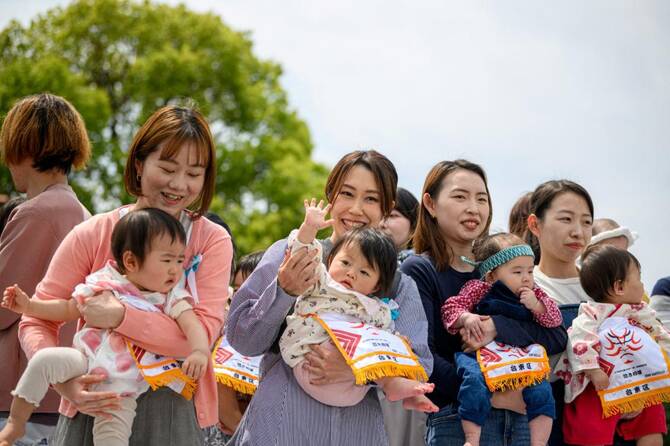
The number of babies born in Japan dropped for the 10th straight year in 2025, according to official data released on Thursday, adding to the growing population concerns facing Prime Minister Sanae Takaichi.
Preliminary figures from the health ministry showed that a total of 705,809 babies were born in 2025. This represents a 2.1 per cent decrease compared to the number recorded in 2024.
The data covers all births linked to Japan, including babies born to Japanese nationals within the country, foreign nationals who gave birth in Japan, and children born to Japanese citizens overseas.
Meanwhile, 505,656 couples got married in 2025, up 1.1 per cent, while the number of divorces fell 3.7 per cent to 182,969 cases.
There were 1,605,654 deaths, down 13,030 or 0.8 per cent from 2024.
The internal affairs ministry estimated Japan’s overall population as of February at 122.86 million people, down 0.47 per cent, or 580,000, from a year ago.
The world’s fourth-biggest economy has one of the world’s lowest birth rates and a falling and ageing population.
This is leading to a host of problems, including labour shortages, a ballooning social security bill and fewer working people paying tax.
That in turn is adding to Japan’s huge debts. It already has the highest debt ratio among major economies.
Figures last year showed that the number of people aged 100 or older was almost 100,000, with close to 90 per cent of them women.
The shrinking population is also gutting rural communities. The number of abandoned homes in Japan is now around four million.
Over 40 per cent of municipalities risk extinction, according to a recent study.
Successive Japanese leaders — including Takaichi, the country’s first woman premier — have promised to increase births but with limited success.
Tokyo’s city government developed its own dating app which requires users to submit documentation proving they are single and to sign a letter stating they are willing to get married.
“The declining birth rate and shrinking population are a quiet state of emergency that will gradually erode our country’s vitality,” Takaichi said in parliament last week.
Takaichi’s ruling Liberal Democratic Party (LDP) won a two-thirds majority in February 8 snap elections.
Increasing immigration would help reverse Japan’s falling population and the associated problems in the labour market.
But under pressure from the “Japanese first” Sanseito party, the right-wing Takaichi has vowed tougher measures on immigration.
The government said Thursday it is striving to build a stronger economy to reduce the economic burden of childcare for working families.
“I believe there were some successes. Unfortunately, however, we have not managed to reverse this trend (of falling births),” Deputy Chief Cabinet Secretary Masanao Ozaki told reporters.
“I believe (an important factor) is to achieve a strong economy,” Ozaki said