
Tokenized stock trading has moved into billion-dollar territory, with weekly spot volume reaching nearly $3 billion as Robinhood Chain, BNB Chain and Solana capture most of the activity across blockchain-based equities.
Grayscale Investments said tokenized-equity trading reached new highs in August, with weekly spot volume peaking near $3 billion early in the month. The three leading networks accounted for the majority of trading volume during the latest week covered by its research, highlighting a rapid expansion of markets that allow investors to trade economic exposure to traditional stocks on public blockchains.
The growth is not limited to turnover. A Token Terminal dashboard puts the tokenized-stocks market capitalization at about $3 billion, while the much larger tokenized-funds category stands at $34.3 billion. The comparison shows how quickly tokenized equities are developing while also underscoring how much smaller they remain than the broader market for blockchain-based funds.
Tokenized Stock Trading Expands Across Three Major Chains
Robinhood Chain has quickly become an important part of the market after launching its public mainnet July 1. The Ethereum-compatible Layer 2 was built using Arbitrum technology and designed specifically for financial services and tokenized real-world assets.
Robinhood says eligible users in more than 120 countries can access Stock Tokens through Robinhood Wallet, with availability depending on jurisdiction. The system supports 24-hour trading and allows eligible users to interact with decentralized exchanges and potentially deploy the assets into lending or collateral applications.
BNB Chain and Solana are competing for the same market. Grayscale identified the three networks as the leading chains for tokenized equity trading by volume, while decentralized protocols including Uniswap, PancakeSwap and Raydium provide trading infrastructure.
The result is an increasingly multi-chain market rather than one dominated by a single blockchain.
On-chain Use of Tokenized Stocks Tops $110 Million
Trading is growing faster than the use of tokenized equities in decentralized finance, but that gap has started to narrow.
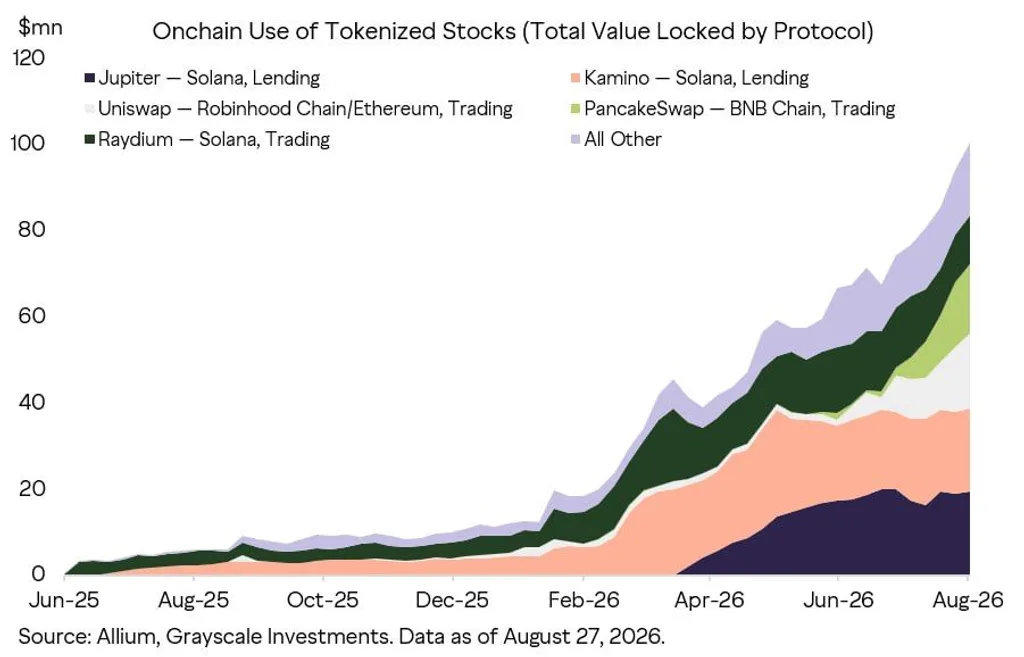
Tokenized Stocks Onchain TVL by Protocol. Source: Grayscale (@Grayscale) on X
Grayscale’s data show total value locked in protocols using tokenized stocks rising above $110 million after spending much of 2025 below $10 million. Solana-based Kamino helped drive the initial increase, while Jupiter later became another significant source of lending activity. Trading venues on Solana, BNB Chain and Robinhood Chain added to the expansion.
Only about 5% of the broader tokenized-equity market is currently deployed in onchain financial applications, according to Grayscale’s research. That means most activity is still centered on buying and selling rather than using tokenized shares for lending, borrowing or collateral.
Tokenized Stocks Reach a $3 Billion Market
Token Terminal’s dashboard places tokenized-stock market capitalization at roughly $3 billion. By comparison, tokenized funds have reached $34.3 billion, led by products including sUSDS, BlackRock’s BUIDL and USYC.

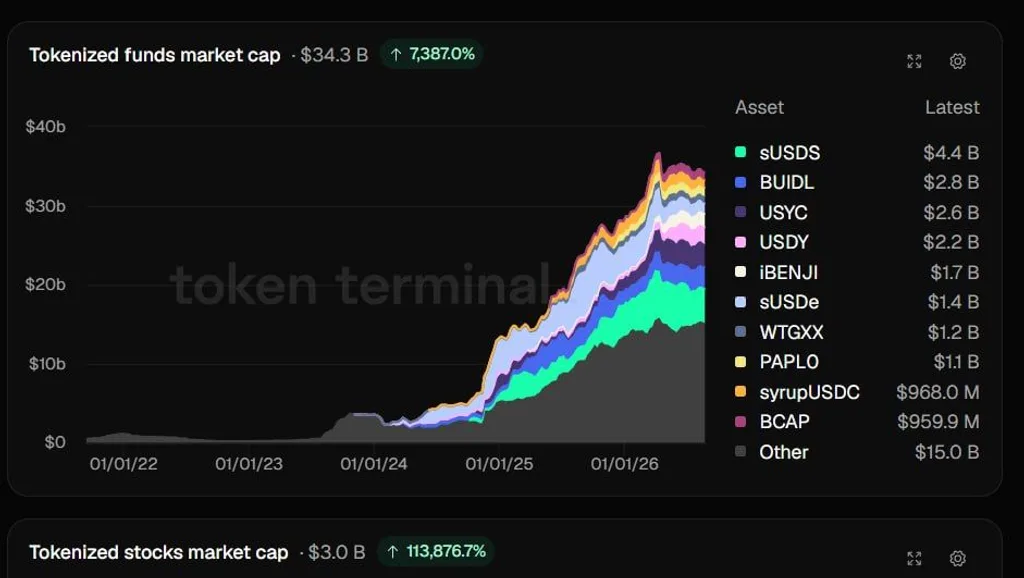
Tokenized Stocks Market Capitalization. Source: Token Terminal
The distinction between trading volume and market capitalization is important. The roughly $3 billion weekly figure cited by Grayscale measures how much tokenized equity changes hands, while Token Terminal’s $3 billion figure measures the value of tokenized stocks represented in the market.
Tokenized equities also do not always carry the same legal rights as directly owned shares. Structures vary by issuer. Robinhood, for example, says its current Stock Tokens are tokenized debt securities providing economic exposure to underlying securities but do not give holders legal or beneficial ownership of the underlying shares. They are not available to U.S. persons.
That leaves the next phase of growth dependent on more than trading demand. If tokenized stocks become widely usable as collateral and lending assets, the market could move from primarily providing round-the-clock equity exposure toward becoming a deeper part of decentralized finance.