
Ramadan: Haske Foundation Launches Welfare Drive, Distributes 80,000 Bags Of Rice In Adamawa

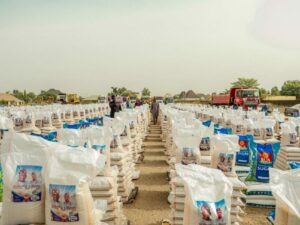
The Abdurrahman Bashir Haske Foundation has commenced a large-scale Ramadan humanitarian intervention in Adamawa State, rolling out food supplies, cash assistance and mobility support valued at ₦220 million to thousands of residents across the state’s 21 local government areas.
The outreach, flagged off in Yola, includes the distribution of 80,000 bags of rice and other grains, alongside cash donations and transportation support aimed at easing economic hardship for vulnerable households during the holy month of Ramadan.
According to the foundation, the intervention is expected to benefit between 40,000 and 80,000 residents, particularly low-income families facing rising living costs.
The food component of the programme comprises 30,000 bags of 50kg rice, 20,000 bags of 25kg rice, and 30,000 bags of other grains, carefully allocated to ensure equitable distribution across all local government areas.
Organisers said the structure of the distribution was designed to reach underserved communities and ensure that assistance extends beyond urban centres to rural and semi-urban populations.
Beyond food relief, the foundation also disbursed ₦220 million in cash donations, in addition to 10 vehicles and 50 motorcycles allocated to selected beneficiaries.
The mobility support, according to coordinators, is intended to improve economic participation by enabling small-scale traders, community workers and rural residents overcome transportation challenges that often limit income opportunities.
Founder Abdurrahman Bashir Haske described the initiative as part of a long-standing tradition of giving rather than a seasonal charity effort.
“Coming back to our community, we wish we could do 100 times more than what we are doing today,” he said during the flag-off ceremony.
He added that the foundation remains committed to sustained community support, especially during festive periods when financial pressures on families typically increase.
“We do this every festive season to celebrate with our loved ones and to see how we can support families,” he noted, explaining that the intervention is aimed at reducing hardship at the household level.
The foundation’s coordinator described the Ramadan programme as both timely and necessary, noting that many residents observing the fast are simultaneously grappling with economic challenges.
Beneficiaries expressed appreciation for the assistance, describing it as arriving at a critical moment.
“For many families, we are very excited about this great gesture. This is the right and crucial time, when almost all families are struggling,” one recipient said.
Another beneficiary noted that the outreach successfully targets households that depend heavily on communal and philanthropic support systems.
Unlike short-term charity drives, the programme’s statewide coverage and inclusion of transportation assets aim to tackle both food insecurity and economic mobility, particularly in communities where access to livelihood opportunities remains limited.
For thousands of families across Adamawa State, the Ramadan intervention offers immediate relief — reinforcing the role of structured philanthropy in supporting vulnerable populations during periods of economic difficulty.