
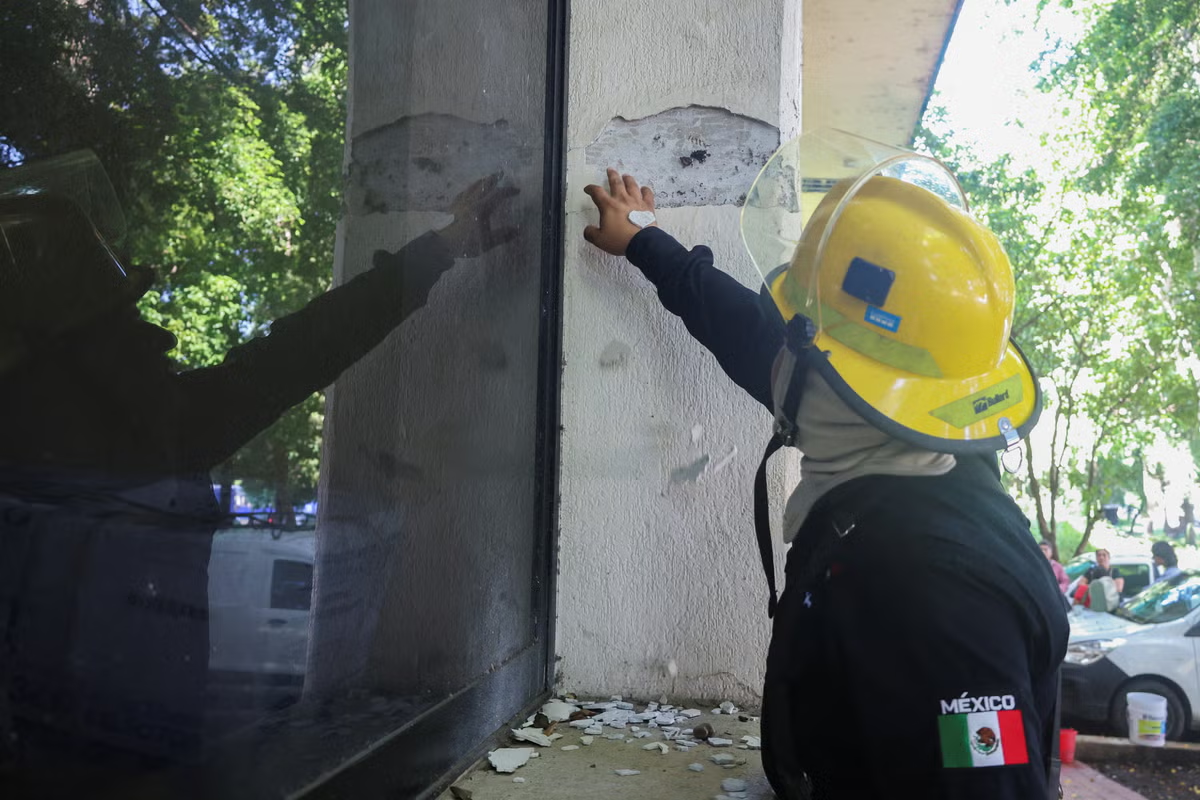
A powerful 7.3 magnitude earthquake struck Mexico’s southern Pacific coast on Friday, near the Guatemalan border, sending tremors across a vast region from Mexico City to El Salvador.
While authorities have reported no severe damage or fatalities in any affected country, two individuals sustained injuries in southern Mexico.
The U.S. Geological Survey (USGS) identified the quake’s epicenter 30 miles southwest of Aquiles Serdan, off the coast of Chiapas, at a depth of nine miles. This significant seismic event was preceded by a smaller tremor further out at sea and followed by at least 10 aftershocks ranging from magnitude 4.9 to 6.
Residents in Tapachula, a major city on Mexico’s southern border, described the initial shaking as mild before it gradually intensified.
“We were upstairs on the second floor when it started shaking; we thought it would pass, but then it got stronger, so we all went downstairs and evacuated in an orderly manner to the front courtyard,” Alejandra Mendoza, an administrative employee at a public hospital in the city, explained to The Associated Press.
Demetrio Martínez, head of the city’s Civil Protection agency said that a Haitian migrant woman in her 30s suffered a nervous breakdown and jumped from a height of about four meters (13 feet) from an apartment building. She was taken to a hospital with fractures, but her life is not in danger, the official added. He said that there was another minor injury from a broken window at a nearby business.
In Guatemala City, the earthquake frightened residents because of how long it lasted. Many people poured into the streets in the middle of rush hour as the workday was beginning and several buildings were evacuated.
Guatemala’s National Coordinator for Disaster Reduction (CONRED) reported no immediate damage. Social media users posted videos of some landslides, especially on roads heading west.
The Ministry of Education suspended in-person classes in the departments of San Marcos, Quetzaltenango, Suchitepéquez and Retalhuleu, near the quake’s epicenter.
In the Mexican capital, where buildings in certain areas creaked and shook, the earthquake alert did not sound because, the government said, “the energy radiated by the earthquake during the first few seconds did not exceed the activation thresholds.”
Mexican President Claudia Sheinbaum said that preliminary reports showed no damage. The navy recommended staying away from beaches for six hours because of tsunami risk.
The Meteorological Service of Chiapas alerted that there could be tsunami waves up to 1 meter (3.3 feet) off the coast of Mexico and Guatemala.
In the town of Suchiate, located along the river that separates Mexico from Guatemala, coastal areas are being monitored for tsunami risk, according to Mayor Elmer Vázquez Gallardo.
In San Salvador, the earthquake was also felt strongly, but no deaths or damage were reported, although the Ministry of Environment reported another earthquake of lesser intensity off the coast of the department of Usulután, in the eastern part of the country.
The region is prone to earthquakes, many that can be deadly. Earlier this year, a strong earthquake rattled southern and central Mexico, killing two. Hundreds in Mexico City were killed in a 7.1 magnitude earthquake in 2017.