
Beneath the pomp and pageantry surrounding Chinese President Xi Jinping’s state visit to the U.S. on Sept. 24, Washington and Beijing remain locked in a far deeper strategic rivalry.
During the visit, Xi and U.S. President Donald Trump announced a broad package of eight diplomatic deliverables spanning trade, investment, technology, security, diplomacy and people-to-people ties.
The package reaffirmed a “constructive relationship of strategic stability,” which they earlier announced during Trump’s reverse visit to China in May.
The framework is built on respect, fairness and reciprocity, offering a principle for managing their increasingly complex relationship.
Taken together, the deliverables suggest an attempt not to eliminate China-U.S. competition, but to establish mechanisms through which that competition can be managed and prevented from escalating uncontrollably.
The latest understandings may have eased immediate tensions, but the underlying trade and strategic competition between the world’s two largest economies has not disappeared.
Some analysts regard the latest trade truce as a useful interim step towards a more durable arrangement, while others see it primarily as a temporary pause rather than a fundamental resolution.
China’s Ministry of Foreign Affairs said the two countries, as major powers, bear a historic responsibility for advancing human development and progress.
“President Xi said he was ready to work with President Trump to steer the giant ship of China-U.S. relationship on a steady course toward the future,” the ministry said.
The concept of constructive strategic stability reflects the realities of a relationship in which cooperation remains possible, competition persists and differences require mechanisms for management.
Its significance, therefore, may lie less in the creation of a formal strategic pact than in establishing sufficient predictability to prevent rivalry from developing into uncontrolled confrontation.
The economic and trade stakes dimension is arguably the most consequential component of the framework.
For businesses, investors and supply-chain operators, strategic stability matters less as diplomatic terminology than as a potential reduction in the risk of sudden tariff increases, export restrictions and retaliatory measures.
Washington and Beijing endorsed mechanisms intended to institutionalise trade consultations, including a bilateral Board of Trade and other channels for addressing commercial disputes.
The two sides also agreed to arrangements involving 30 billion dollars in reciprocal tariff reductions covering non-sensitive goods, according to the White House account of the summit.
The measures cover selected U.S. exports, including agricultural products, seafood, timber, cosmetics and medical devices, while Chinese exports include consumer goods such as appliances and toys.
China is also expected to import at least 10 million metric tonnes of U.S. coal in both 2027 and 2028, according to the announced arrangements.
The broader significance is institutional. Rather than relying exclusively on presidential intervention, Washington and Beijing are seeking government-to-government mechanisms capable of managing recurring trade and investment disputes.
The two countries also established a Board of Investment to provide a structured channel for discussing investment opportunities and addressing investment-related impediments.
These mechanisms assume greater importance because trade and investment disputes increasingly overlap with national-security concerns, supply-chain vulnerabilities and restrictions involving strategically important technologies and resources.
Analysts Emily Kilcrease and Geoffrey Gertz, however, have argued that strategic stability could involve significant concessions by Washington.
They contend that U.S. efforts to pressure China through tariffs and export controls encountered strong Chinese retaliation, including restrictions on rare-earth exports, exposing the vulnerabilities of global advanced-technology supply chains.
The analysts argue that Washington should distinguish strategic stability from stability “at any cost”, maintaining its broader economic and security objectives while managing competition.
Their assessment underscores the central dilemma that strategic stability may reduce economic disruption, but it does not eliminate the structural competition that produced many of the tensions in the first place.
“The two-month extension isn’t a bridge to a grand bargain. “It’s a temporary sandbag holding back a structural flood,” said Beijing-based Einar Tangen, a senior fellow at the Centre for International Governance Innovation.
The framework also extends into artificial intelligence, an area where technological competition is increasingly intertwined with national security.
China and the U.S. agreed to establish an AI-related dialogue to exchange views on the risks and benefits of the technology, with another exchange scheduled for November 2026.
They also agreed to establish a bilateral communication channel for AI incidents, recognising that technological failures or unforeseen AI-related events could acquire international-security consequences.
Such communication could become increasingly important as the two countries compete for technological leadership while imposing restrictions and counter-restrictions on advanced technologies.
Chan Ho-Him, an analyst, said China and the U.S. were competing for AI dominance while simultaneously confronting shared concerns over safety.
“The hopes for finding common ground on concerns around global AI safety are clouded by competition between the two countries,” he said.
Chris McGuire of the Council on Foreign Relations, a specialist in China and emerging technologies, similarly pointed to growing pressure on Washington and Beijing to negotiate arrangements addressing AI safety.
However, he argued that a comprehensive AI agreement was unlikely in the immediate term.
Military-to-military communication also constitutes another important pillar of the framework.
Beijing said the two countries’ militaries had agreed to conclude a memorandum of understanding on crisis communication and prevention as soon as possible.
The proposed mechanism addresses a longstanding challenge in great-power competition that military encounters can generate rapidly escalating situations even when neither government intends a broader confrontation.
Crisis communication cannot resolve fundamental disagreements over security or regional strategy, but it can provide commanders and policymakers with additional channels for clarification during potentially dangerous incidents.
The agenda discussed by Xi and Trump also extended beyond bilateral economic relations to international security and global commerce.
The two leaders agreed that Iran should honour its commitment not to develop nuclear weapons.
They also agreed that no country or institution should be allowed to impose tolls on international waterways, linking the bilateral relationship to wider concerns over maritime security and the free flow of global commerce.
Such understandings demonstrate how the China-U.S. relationship increasingly carries consequences beyond bilateral affairs, particularly when the two powers address conflicts affecting energy supplies, shipping and international markets.
The leaders’ references to their countries’ World War II cooperation introduced another dimension, with historical memory being used to highlight periods when Washington and Beijing worked together against a common threat.
That history does not remove contemporary disagreements, but it provides diplomatic space for presenting cooperation as compatible with national interests rather than as a retreat from strategic competition.
Kilcrease and Gertz, however, identified Taiwan and Iran as particularly difficult tests for the emerging framework.
“For China, strategic stability is contingent upon America’s non-interference on Taiwan,” they argued, while warning that a conflict over the issue could have devastating consequences for the global economy.
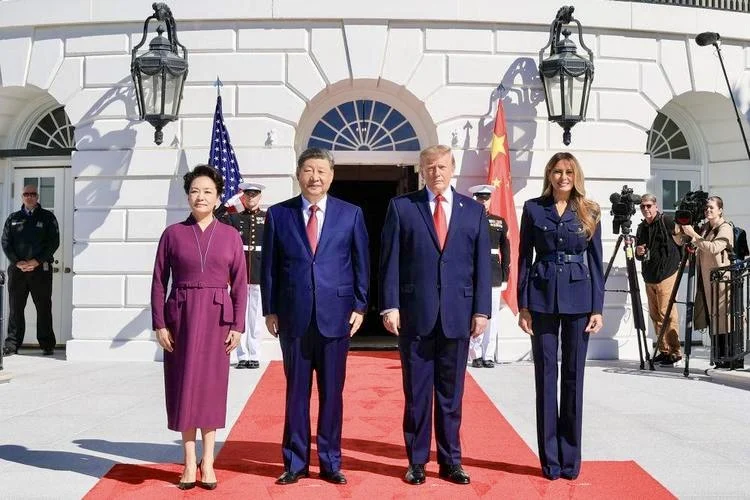
Xi (first left), and Trump, (first right), with their spouses during the former’s visit.
They also pointed to Iran as another test, given China’s role in Iran’s oil trade and the potential consequences of U.S. sanctions for global energy markets. China alone imports about 90 per cent of Iran’s oil.
Counter-narcotics cooperation provides a more operational example of how Washington and Beijing can compartmentalise disagreements while pursuing shared objectives.
Chinese and U.S. law-enforcement agencies have cooperated on cases involving new psychoactive substances and precursor chemicals, according to the Chinese account.
The White House separately highlighted Chinese action against precursor chemicals and said U.S. officials were seeking further measures to prevent their diversion into illicit drug production.
Such cooperation illustrates the possibility of pursuing practical areas of common interest even while broader strategic disagreements persist.
The APEC and G20 commitments extend that approach into multilateral diplomacy. Both countries agreed to support each other as hosts, while Xi and Trump intend to attend each other’s meetings.
Such engagement could provide repeated opportunities for direct communication while connecting bilateral negotiations to wider debates on global economic governance and international cooperation.
Even the arrival of two Chinese giant pandas at Zoo Atlanta carries diplomatic symbolism, placing cultural exchange alongside much harder questions involving trade, security and technology.
For Africa, the implications are potentially significant.
If China-U.S. tensions become more manageable, African economies could benefit from greater global trade stability, investment flows and demand.
A less volatile relationship between the world’s two largest economies could also create opportunities for African countries to attract investment, diversify exports and participate in evolving global supply chains.
The opportunity will, however, depend on whether African economies can move beyond the role of raw-material suppliers and use changing trade patterns to advance industrialisation, value addition, technology transfer and manufacturing capacity.
For developing economies, therefore, the greatest potential benefit of China-U.S. strategic stability may not be preferential treatment from either power, but a more predictable international economic environment in which they can pursue their own development priorities.
Ultimately, the significance of the framework will depend on implementation rather than summit symbolism.
Its real test will be whether trade mechanisms, investment consultations, AI communication, military safeguards and areas of international cooperation can make strategic competition more predictable and crises more manageable.
The framework does not end economic competition between China and the United States. Rather, it seeks to place that competition within channels that can reduce the risk of recurring trade and strategic shocks.
If Washington and Beijing can institutionalise tariff negotiations, protect legitimate trade and investment, and prevent disputes over technology and critical minerals from repeatedly becoming wider economic crises, the effects could extend well beyond the two countries.
For Africa and other developing economies, greater predictability in the global trading system could create opportunities for investment, export diversification and participation in reconfigured supply chains.
Ultimately, the eight deliverables from the two world leaders’ summit represent less a settlement of China-U.S. rivalry than an emerging framework for managing it.
Whether “constructive strategic stability” becomes an enduring feature of the relationship will depend on the ability of both powers to translate summit commitments into sustained, verifiable and institutionalised cooperation.(NANFeatures)
***If used, please credit the writer and the News Agency of Nigeria. (NAN)
Edited by Isaac Aregbesola