Submit Post
Date: February 17, 2026 10:32 pm. Number of posts: 1,784. Number of users: 3,145.

What Is Nigerian Democracy and Why It Matters

Every Nigerian student trying to make sense of home from a classroom abroad soon discovers that democracy in Nigeria is anything but simple. The idea of ‘governance by the people’ sounds clear in textbooks, yet the reality is shaped by political parties chasing their own interests and deep-rooted communal traditions colliding with Western ideals. By examining these contested definitions of democracy and common misconceptions, you gain essential context to decode why Nigerian politics often feels both chaotic and deeply familiar.

Table of Contents

Key Takeaways

PointDetails
Nigerian Democracy is ComplexDemocracy in Nigeria is influenced by tribal and ideological divisions, leading to partisan politics that often distort representation.
Dissent is EssentialPolitical dissent should be seen as a strength rather than a failure, fostering healthy debate and accountability in governance.
Electoral Process is FracturedDespite a comprehensive legal framework for elections, practice is marred by corruption, violence, and lack of trust in institutions.
Current Challenges PersistNigeria faces interconnected issues of corruption and insecurity, but reform efforts are underway, driven by engaged citizenry and social media advocacy.

Defining Nigerian Democracy and Misconceptions

Nigerian democracy sounds straightforward on the surface: the people choose their leaders through free elections and have a say in governance. But the reality is far messier. Democracy fundamentally means rule by the people, a concept rooted in the Greek term demokratia. In Nigeria’s context, this should mean exercising power through representation and participation. Yet many Nigerians encounter a version of democracy that feels fractured and partisan.

The core problem? Political parties prioritize partisan agendas over genuine democratic principles. Different political actors perceive democracy through their own tribal, religious, or ideological lenses rather than embracing it as a shared system. This creates a situation where democracy becomes contested territory, with each faction claiming their interpretation is the authentic one.

One major misconception is that dissent signals democratic failure. Actually, disagreement and debate are vital components of a functioning democracy. Political dissent, when channeled constructively, strengthens democratic engagement rather than weakening it. This follows global democratic practices where healthy contestation keeps institutions accountable.

Another critical tension exists between what Nigerians inherited from Western liberal democracy and what their communities traditionally valued. Western individualism clashes with Nigeria’s communal traditions, creating friction in how democracy actually operates. Free and fair elections mean little if they ignore ethnic or religious unity. Equitable opportunities sound ideal until they bump against deep-rooted communal hierarchies.

Here’s a summary comparing Western liberal democracy with Nigerian communal traditions:

AspectWestern Liberal DemocracyNigerian Communal Traditions
Decision-makingIndividual choice emphasizedCommunity leaders guide consensus
Social structureEqual rights for all citizensHierarchies based on lineage/group
Political valuesRights and freedoms centralCollective harmony prioritized
DissentOpen debate encouragedDisagreement may threaten unity

Many Nigerians mistakenly believe democracy is simply voting every four years. They miss that real democracy requires functioning institutions, media literacy, and inter-ethnic dialogue. Without these elements, elections alone cannot sustain democratic governance. Your generation of students studying political science abroad has the advantage of seeing this more clearly than those still caught in daily Nigerian politics.

Pro tip: When discussing Nigerian democracy with peers abroad, explain the specific tensions between Western liberal ideals and communal practices rather than treating Nigerian democracy as simply broken or underdeveloped.

Historical Evolution and Key Milestones

Nigeria’s journey to democracy didn’t start in 1999, though many treat that year as a fresh beginning. The country had attempted democratic governance multiple times since independence in 1960, only to watch military strongmen dismantle elected governments. These interrupted attempts taught Nigerians painful lessons about how fragile democracy can be without strong institutions.

The 1999 transition from military to civilian rule marked the beginning of the Fourth Republic, Nigeria’s longest continuous stretch of democratic governance. When Olusegun Obasanjo was inaugurated as the elected president that year, it symbolized an official break from decades of military dictatorship. This wasn’t just a political event; it felt revolutionary to Nigerians who had lived under gun rule for so long.

Nigerian leaders at 1999 handover ceremony

But transition doesn’t equal consolidation. Over the next two decades, Nigeria experienced power alternation between dominant political parties while struggling to actually cement democratic norms. Some progress appeared real. Multiple elections happened. Power transfers occurred without armed conflict. Yet deeper problems persisted.

Electoral irregularities, party factionalism, and governance failures revealed the fragility beneath the surface. The Boko Haram insurgency that emerged in the 2000s created security crises that threatened democratic stability itself. How can democracy function when extremist violence dominates headlines and citizen safety collapses? This remains Nigeria’s central democratic challenge.

Your generation studying abroad sees this oscillation clearly. Nigeria has oscillated between democratic growth and regression rather than following a straight upward trajectory. That’s not failure in disguise. It’s reality. Understanding these cycles matters because they shape current Nigerian politics and explain why your classmates back home remain skeptical about democratic institutions.

Pro tip: When writing academic papers on Nigerian democracy, anchor your arguments to specific transition years and electoral cycles rather than treating “since 1999” as one monolithic period.

Core Structure: Federal System and Institutions

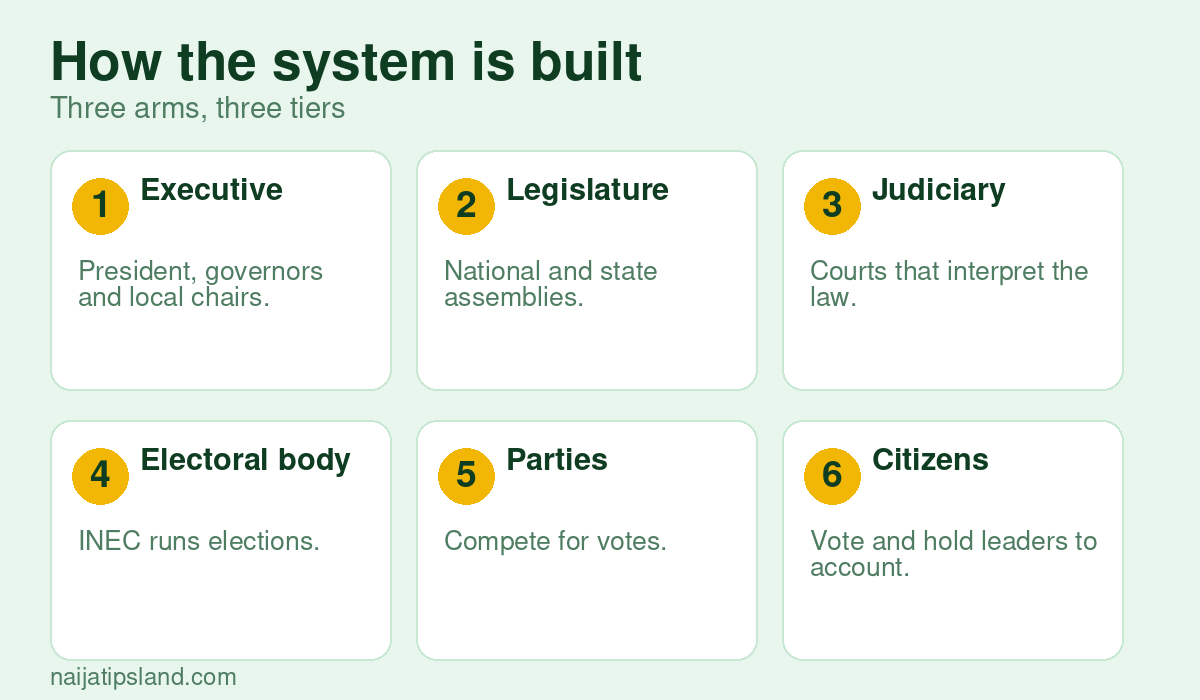
Nigeria’s democratic framework rests on a presidential system where power theoretically flows through three branches: executive, legislature, and judiciary. The design sounds solid on paper. Each branch checks the others. No single entity dominates. Yet reality in Nigeria reveals how easily theory breaks down when political actors refuse to respect constitutional limits.

Infographic explaining Nigeria’s democracy structure

The country operates as a federal republic, meaning power divides between a central government and individual states. This structure inherited colonial legacies but was adapted for Nigeria’s complex ethnic and religious landscape. The idea was sound: let regions govern themselves on local matters while the federal government handles national concerns. In practice, tensions between centralization and regional autonomy constantly threaten this balance.

Your understanding of Nigerian politics requires grasping this federal tension. The president wields enormous power from Abuja, yet state governors control significant resources and influence. When the federal government pushes agendas that states resist, gridlock follows. When governors overstep into federal matters, constitutional crises emerge. Neither scenario strengthens democracy.

Institutional challenges have undermined separated powers and accountability through political compromises that favor ruling elites over constitutional principles. The legislature sometimes rubber-stamps executive decisions instead of genuinely investigating them. The judiciary occasionally bends to political pressure rather than applying law impartially. These aren’t bugs. They’re symptoms of weak institutions vulnerable to manipulation.

The National Assembly, comprising the Senate and House of Representatives, represents Nigeria’s legislative power. Yet it struggles with corruption, poor attendance, and members who prioritize personal gain over constituent service. State legislatures mirror these problems at regional levels. Without functional legislatures that truly represent people, democracy becomes hollow.

Meanwhile, the judiciary theoretically provides the final check. But court cases drag for years. Political pressure influences rulings. Judges fear threats. A branch meant to protect constitutional rights often appears powerless against executive overreach.

Below is a summary of key Nigerian democratic institutions and their actual performance challenges:

InstitutionIntended RoleCommon Performance Issues
ExecutiveLead and enforce lawsOverreach, centralization of power
LegislatureCreate and review legislationCorruption, lack of accountability
JudiciaryInterpret constitution, resolve disputesDelays, political interference
INECOrganize elections, ensure fairnessCapacity limits, manipulation risk
State GovernmentsGovern local affairsResource battles, autonomy conflict

Pro tip: When analyzing Nigerian governance in essays, distinguish between constitutional design and actual institutional performance rather than assuming the system works as written.

Nigeria’s elections operate within a legal framework designed to protect democratic principles. The Constitution of Nigeria outlines the rules for who can run for office, how voters register, and what happens when disputes arise. The Electoral Act provides more detailed procedures for candidate qualification, polling operations, and ballot counting. On paper, these legal foundations appear comprehensive and fair.

The Independent National Electoral Commission (INEC) carries the massive responsibility of implementing these laws. INEC manages voter registration, candidate vetting, election administration, and results tallying across Nigeria’s 36 states and federal capital territory. This is an enormous task in a country with over 100 million eligible voters. Yet electoral integrity remains compromised by persistent irregularities and institutional weaknesses that INEC struggles to overcome.

The electoral process itself follows several stages. Voters register with INEC, candidates submit their qualifications for verification, campaigns occur, voting takes place at polling stations, ballots get counted, and results move through a verification process. Legal mechanisms exist to address grievances and election disputes through electoral tribunals. This structure should work.

But real elections in Nigeria look different. Voter suppression happens. Election observers face intimidation. Ballot stuffing occurs. Violence erupts at polling stations. Results get manipulated before reaching INEC headquarters. Some observers simply don’t show up to monitor proceedings. These violations happen despite clear legal prohibitions against them.

The gap between legal frameworks and actual practice frustrates Nigerian voters. You’ll hear classmates say their relatives couldn’t vote because they weren’t on the register, even though they registered months earlier. Others describe armed thugs preventing people from reaching polling stations. Still others claim votes were counted differently than what they witnessed. None of these problems stem from unclear laws. They stem from actors ignoring laws with minimal consequences.

Reforms targeting transparency, voter education, and institutional capacity strengthening have been proposed repeatedly. Yet without enforcement mechanisms that actually punish violators, legal frameworks remain largely symbolic. Understanding this gap between law and practice is crucial for grasping why Nigerians feel skeptical about electoral democracy.

Pro tip: When researching Nigerian elections for academic work, examine INEC reports alongside independent observer reports to understand where legal provisions are honored and where violations occur systematically.

Contemporary Challenges and Reforms

Nigeria’s democracy faces a constellation of interconnected problems that undermine governance at every level. Corruption drains resources meant for schools, hospitals, and roads. Insecurity from Boko Haram, banditry, and communal conflicts makes holding peaceful elections nearly impossible in some regions. Institutional inefficiency means government agencies move at a crawl while citizens wait for basic services. These aren’t separate issues. They reinforce each other.

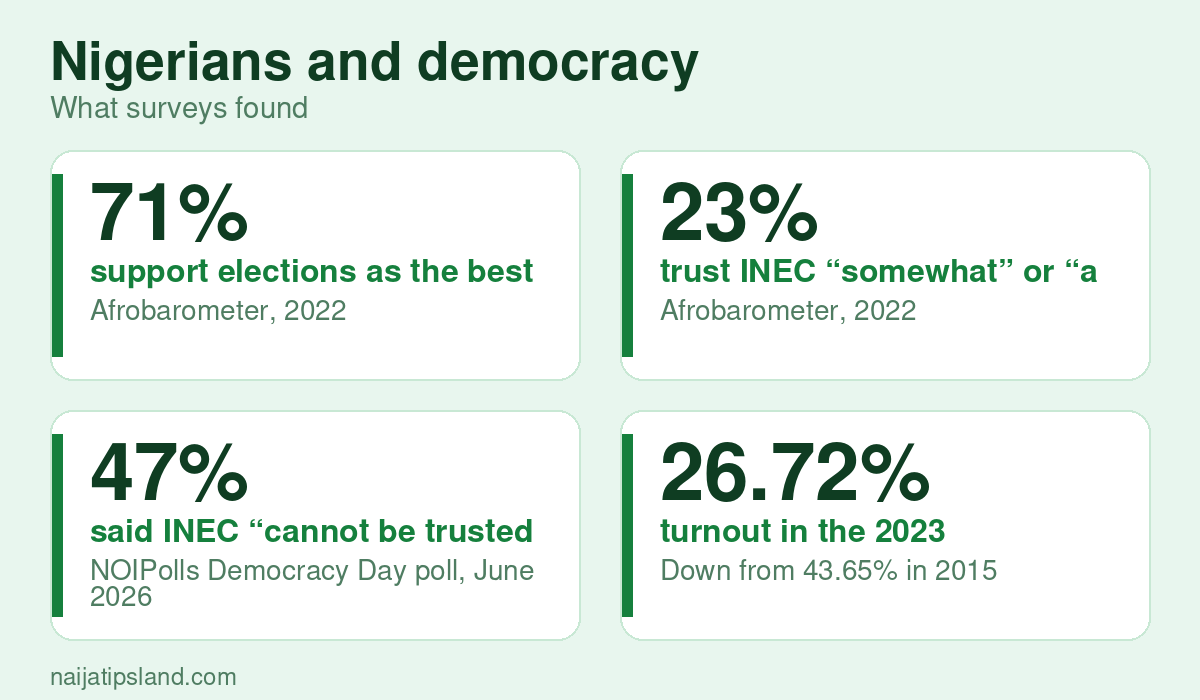
Electoral malpractice and judicial inefficiency compound governance weaknesses that discourage democratic participation. When voters see elections stolen and courts take years to rule on cases, trust evaporates. Low voter turnout becomes rational behavior. Why vote if your ballot won’t count? Why support institutions that don’t deliver?

Yet challenges alone don’t tell the complete story. Reform efforts are underway. Anti-corruption agencies pursue high-profile cases. Electoral reforms attempt to strengthen INEC’s capacity. Social investment programs target poverty reduction. These initiatives show genuine intent to improve governance, though results remain mixed and progress slow.

Public distrust remains high despite constitutional amendments and electoral improvements. Nigerians have seen promised reforms fail before. Constitutional amendments sound impressive until implementation reveals they were toothless. Electoral administration improvements matter little if political violence prevents voting. Citizens demand tangible benefits, not procedural promises.

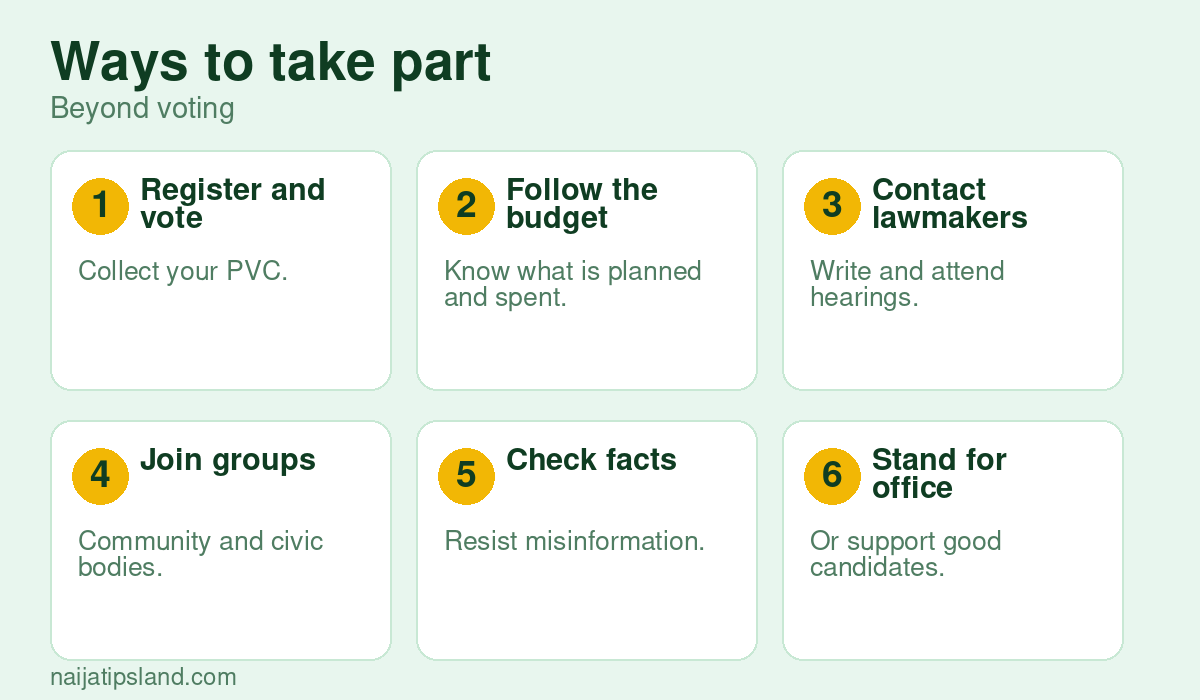
Yet hope exists in unexpected places. Younger Nigerians increasingly hold leaders accountable through social media and civic organizing. Judicial independence has strengthened in recent years, with courts occasionally ruling against executive interests. Civil society organizations monitor elections and challenge results in court. These forces move slowly and face obstacles, but they represent genuine democratic resistance.

Strengthening institutions requires time, resources, and political will. Promoting inclusiveness means giving voice to marginalized groups. Equitable resource distribution demands leaders prioritize collective welfare over personal enrichment. None of this happens overnight. But incremental transformation is possible when citizens actively demand it.

Pro tip: In your academic arguments about Nigerian reforms, distinguish between announced policies and actual implementation, using specific examples of how reforms succeeded or failed rather than assuming policy announcements equal real change.

Engage Deeply with Nigerian Democracy and Stay Informed with Naijatipsland

Understanding the complex realities of Nigerian democracy means recognizing its challenges like institutional weaknesses, electoral flaws, and communal tensions that affect governance and citizen trust. You deserve a platform that not only keeps you updated but also connects you with lively discussions on these critical issues. Naijatipsland.com provides a vibrant community and timely news that dives into the heart of Nigerian politics and society, helping you stay informed and engaged.

https://naijatipsland.com

Join thousands of Nigerians and global students who are passionate about exploring democracy beyond the surface. Visit Naijatipsland.com today to submit your posts, participate in discussions, and access up-to-date political commentary and news. Don’t just watch from the sidelines stay active in conversations that matter by signing up and getting involved now. Experience the pulse of Nigerian current affairs and be part of the change.

Frequently Asked Questions

What does democracy mean in the context of Nigerian governance?

Democracy in Nigeria means rule by the people through free elections, representation, and participation in governance. However, it often faces challenges due to the dominance of partisan agendas and ethnic divisions.

Why is dissent important in a democracy?

Dissent is crucial as it reflects healthy debate and engagement in democratic processes. Constructive political dissent helps to hold institutions accountable and fosters a vibrant political discourse.

What are the main challenges facing Nigerian democracy today?

Current challenges include corruption, insecurity from extremist violence, electoral malpractice, and institutional inefficiencies that undermine trust in democratic processes and participation.

How can reforms improve the democratic process in Nigeria?

Reforms can enhance electoral integrity, strengthen institutions, and promote inclusiveness. However, real change depends on effective implementation and political will to address underlying issues and ensure that all citizens can participate in governance.

We will be happy to hear your thoughts

      Leave a reply

      Nigeria's Fast-Growing Online Forum for News & Discussions
      Logo
      1