


TL;DR:
- Effective news tips in Nigeria must include clear facts, evidence, and proper targeting of outlets.
- Submitting tips involves identifying the right media, using proper contact channels, and following up systematically.
- Citizen-generated stories play a crucial role in filling media gaps and promoting civic engagement.
You just witnessed something important. Maybe it’s a government official acting improperly, a community flooding that no major outlet has covered, or a local business story that could affect thousands of people. You know it matters. But you have no idea how to get it to the right people. That gap between knowing something and getting it published is where most Nigerian citizen journalists get stuck. This guide breaks down exactly how to submit a news tip in Nigeria, from what you need to prepare, to which platforms accept tips, to how you verify that your story actually made it to publication.
Table of Contents
- What you need before submitting a news tip
- How to submit your news tip: step-by-step process
- Common mistakes to avoid when submitting news tips
- How to verify if your news tip is published
- Why every Nigerian’s voice matters in the media
- Connect your news tips to real impact
- Frequently asked questions
Key Takeaways
| Point | Details |
|---|---|
| Prepare relevant details | Gather all essential info—who, what, where, when, why, and supporting evidence—before you submit. |
| Use the right submission method | Send your tip via direct channels, online forms, or reliable press release aggregators for better results. |
| Avoid common errors | Double-check your submission for clarity and completeness to increase chances for publication. |
| Track publication status | Follow up and verify whether your story gets picked up by searching news channels and contacting editors. |
| Your voice shapes news | Every Nigerian’s tip can bring attention to important events or issues and drive community change. |
What you need before submitting a news tip
Now that you know why your tip matters, let’s explore what you’ll need before reaching out.
Not every piece of information qualifies as a news tip. Editors receive dozens of messages every day, and they quickly sort through what deserves attention and what doesn’t. A newsworthy tip typically meets a few key criteria: it affects a significant number of people, it involves public interest or public figures, it reveals something previously unknown, or it documents an event that has happened or is about to happen.
Before you send anything, make sure your tip answers these core questions:
- Who is involved? (Names, titles, organizations)
- What happened or is happening?
- Where did it occur or is it occurring?
- When did it happen or when will it happen?
- Why does it matter to the public?
These five elements are the backbone of every credible news report. If you cannot answer all five clearly, your tip will likely be set aside.
Beyond the basic facts, you also need supporting evidence. Raw claims without documentation are difficult for editors to act on. Here’s what supporting evidence can look like:
- Clear photographs or short videos of the incident
- Official documents, receipts, or contracts
- Screenshots of communications (WhatsApp messages, emails)
- Contact information for at least one witness or source
- Your own contact details for follow-up
Writing news articles well starts with organizing your information before you ever type a single word to an editor. Think of your tip like a short pitch. You want to capture the most important fact in your first sentence and let the details follow.
Major outlets accept tips via press release distributors and direct contacts, so the format you choose depends on how organized your information already is.
| Type of evidence | Why it helps editors |
|---|---|
| Photos/videos | Visual proof reduces doubt immediately |
| Documents | Adds legal or official weight to claims |
| Witness contacts | Allows independent verification |
| Your contact info | Enables editorial follow-up |
| Timeline of events | Provides context and sequence |
Pro Tip: Write a three to five sentence summary of your tip before you make contact. If you can’t summarize it clearly in five sentences, keep refining until you can. Editors appreciate brevity and clarity above almost everything else.
How to submit your news tip: step-by-step process
With your information ready, here’s how to actually submit your news tip.

There are three main ways to get your story to Nigerian media: direct submission to a news outlet, online tip forms, and press release distribution services. Each method works differently and suits different types of stories.
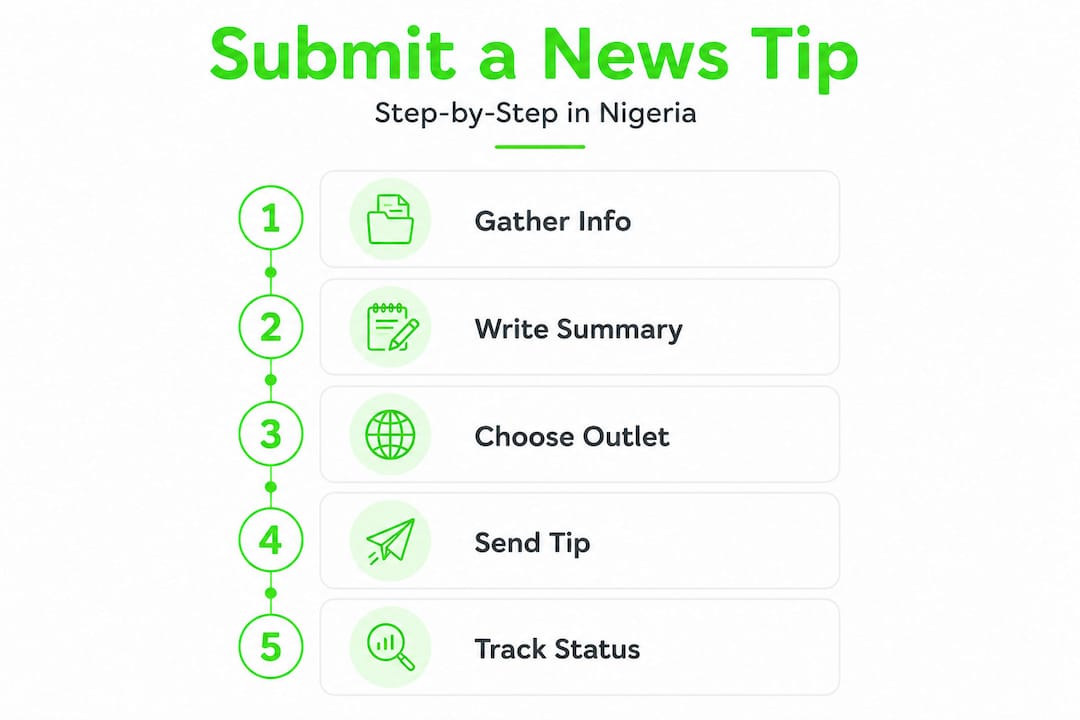
Here’s a step-by-step process to follow:
Identify the right outlet. Not every publication covers every topic. Political stories go to outlets like Punch, Vanguard, or Premium Times. Entertainment tips may suit The Pulse or Bellanaija. Local community stories might fit regional newspapers better than national ones.
Find the correct contact. Visit the outlet’s official website and look for a “Contact Us” or “Submit a Tip” page. Sending your tip to a general inbox instead of the right editor significantly reduces your chances of being noticed.
Draft your submission email. Use a clear subject line such as: “News Tip: [Topic] in [Location].” Paste your five-sentence summary in the body, attach your supporting evidence, and include your phone number for follow-up.
Submit via online forms if available. Many outlets like Premium Times have online submission forms on their websites. These forms route your tip to the correct desk automatically, which saves time on both ends.
Consider a press release distributor. If your tip involves a formal announcement, a business story, or something that needs wide coverage quickly, a distribution service may serve you better. Pressdia enables guaranteed placement on top Nigerian news sites via their packages, which means your story reaches multiple outlets simultaneously without you contacting each one separately.
Send your submission and note the time and date. Keep a record of exactly when you submitted, to whom, and via which method.
Follow up within five to seven business days if you have not received a response.
Here’s a comparison of your two main submission approaches:
| Method | Best for | Speed | Cost | Coverage |
|---|---|---|---|---|
| Direct email to editor | Local/breaking news | Medium | Free | Single outlet |
| Online tip form | General news | Fast | Free | Single outlet |
| Press release distributor | Business/announcements | Fast | Paid | Multiple outlets |
The ways to stay updated on Nigerian media also help you understand which outlets cover which beats, so you’re not sending a political tip to a lifestyle editor.
Learning tips for getting featured in news from industries with high competition shows how universal the principles of clear communication and strong evidence really are. The same logic applies here.
Pro Tip: After sending your submission, create a simple tracking log. Use a notes app or spreadsheet to record outlet name, editor contact, date submitted, and response status. This makes follow-up systematic rather than guesswork.
Common mistakes to avoid when submitting news tips
After you’ve sent your tip, avoiding simple errors can significantly boost your chances.
Many citizens submit tips that never see publication, not because the story lacks value, but because the submission itself falls short. Understanding the most common mistakes helps you steer clear of them before it’s too late.
Here are the most frequent errors and what to do instead:
Sending incomplete information. A tip without clear answers to who, what, where, when, and why gives the editor nothing to work with. Always complete your five-point summary before sending.
No evidence or documentation. An unverified claim puts the outlet at legal risk. Photos, videos, and documents make your tip publishable. Without them, editors are unlikely to move forward.
Contacting the wrong person. Sending a corruption story to an entertainment editor wastes everyone’s time. Research which desk handles your story type before making contact.
Using informal language or slang. Your tip represents both the story and your credibility. Write clearly, use proper grammar, and avoid using language that makes you appear unreliable.
Never following up. Newsrooms are busy. A single tip can get buried under dozens of other submissions. A polite follow-up after five to seven business days is not just acceptable, it’s expected.
Sharing sensitive sources carelessly. If your tip involves a whistleblower or a private individual, protect their identity. Only share source details with editors who explicitly need them and only after establishing trust.
“The most powerful news stories are clear, evidence-backed, and submitted to the right person. One well-prepared tip from a citizen journalist can start a national conversation.”
For guaranteed multi-site placement, avoid errors and use verified press services that handle formatting, distribution, and outlet relationships on your behalf.
News forums in Nigeria show how community sharing platforms have grown alongside traditional media, giving citizens more options than ever. Understanding both channels helps you decide where your tip fits best.
Promoting digital news tips effectively also means understanding that strong, shareable content travels further when paired with the right distribution strategy.
How to verify if your news tip is published
Once you’ve submitted your news tip, it’s important to check if and where it’s been published.
Verification is a step many first-time tip submitters forget entirely. But knowing whether your story ran, and where, helps you understand what worked and builds your confidence for future submissions.
Here’s how to track and confirm your tip:
Search Google for your story. Use specific keywords from your tip (such as the location, names involved, or the event) and scan results over the days following your submission.
Monitor the outlet directly. Visit the website of the outlet you submitted to and check their latest stories. Filter by topic or region if the outlet allows it.
Use press release tracking tools. If you submitted via a distribution service, press release services often include tracking tools to monitor outlet placements. Log into your account and check placement reports.
Email the editor for confirmation. If you submitted by email and noticed a story that looks like yours appeared without credit or without contact, it’s appropriate to send a polite email asking about the status of your tip.
Check social media. Many Nigerian outlets share new stories on Twitter (now X), Facebook, and Instagram. A quick search of the outlet’s social pages can show you if your story was published and how it was shared.
What should you do if your tip is not published? Don’t take it personally. Not every story gets picked up. It could be timing, editor priorities, or a lack of evidence. Review your submission, strengthen the evidence, and consider submitting to a different outlet or a community forum where your story may gain initial traction before reaching a major outlet.
Staying updated on news helps you understand which types of stories are getting published right now and why. Editors follow news cycles, and knowing what’s trending increases your chances of having a timely tip accepted.
Pro Tip: Save every confirmation email, submission receipt, or auto-reply you receive from news outlets. Keep these in a dedicated folder in your email. If your tip is published later and your name is left out, you have documented proof of your original submission.
Why every Nigerian’s voice matters in the media
Understanding the final step, let’s take a broader look at why your contribution is so vital.
We believe something that mainstream media conversations often overlook: the most impactful stories in Nigerian journalism rarely start in a newsroom. They start with a woman in Kano who noticed her street’s drainage system has been deliberately blocked. They start with a trader in Lagos who kept records of how his market was sold off to private developers. They start with a student in Enugu who filmed what happened during registration at her school.
Citizen tips fill the gaps that mainstream coverage misses. Professional journalists operate under tight deadlines, limited resources, and editorial priorities shaped by ownership and advertising. That means some stories, particularly at the local and community level, simply don’t get told unless someone like you decides to tell them.
Your news tip is an act of civic engagement. When you document and report what you see, you hold institutions accountable. You create a public record. You give your community a voice that might otherwise go unheard. This is not a small thing.
Discussing current affairs empowers Nigerian youth by creating awareness, developing critical thinking, and encouraging young people to see themselves as participants in governance rather than passive observers. Every tip you share is a small but real step in that direction.
We also believe that understanding what current affairs means and why it matters gives citizens a deeper sense of responsibility toward their communities. When you realize that public information shapes public opinion, you understand why your firsthand account carries genuine power.
The encouragement here is straightforward. Keep sharing. Keep documenting. If one tip doesn’t get picked up, refine it and try again. The media landscape in Nigeria is changing, and citizen-driven reporting is a major part of that change.
Connect your news tips to real impact
Ready to keep making a difference? Here’s how to stay connected and see your impact grow.
Submitting one tip is a great start, but staying engaged is how real change happens over time. Naijatipsland.com makes it easy to stay connected to the stories that matter most in Nigeria and to keep contributing your own perspective to the conversation.
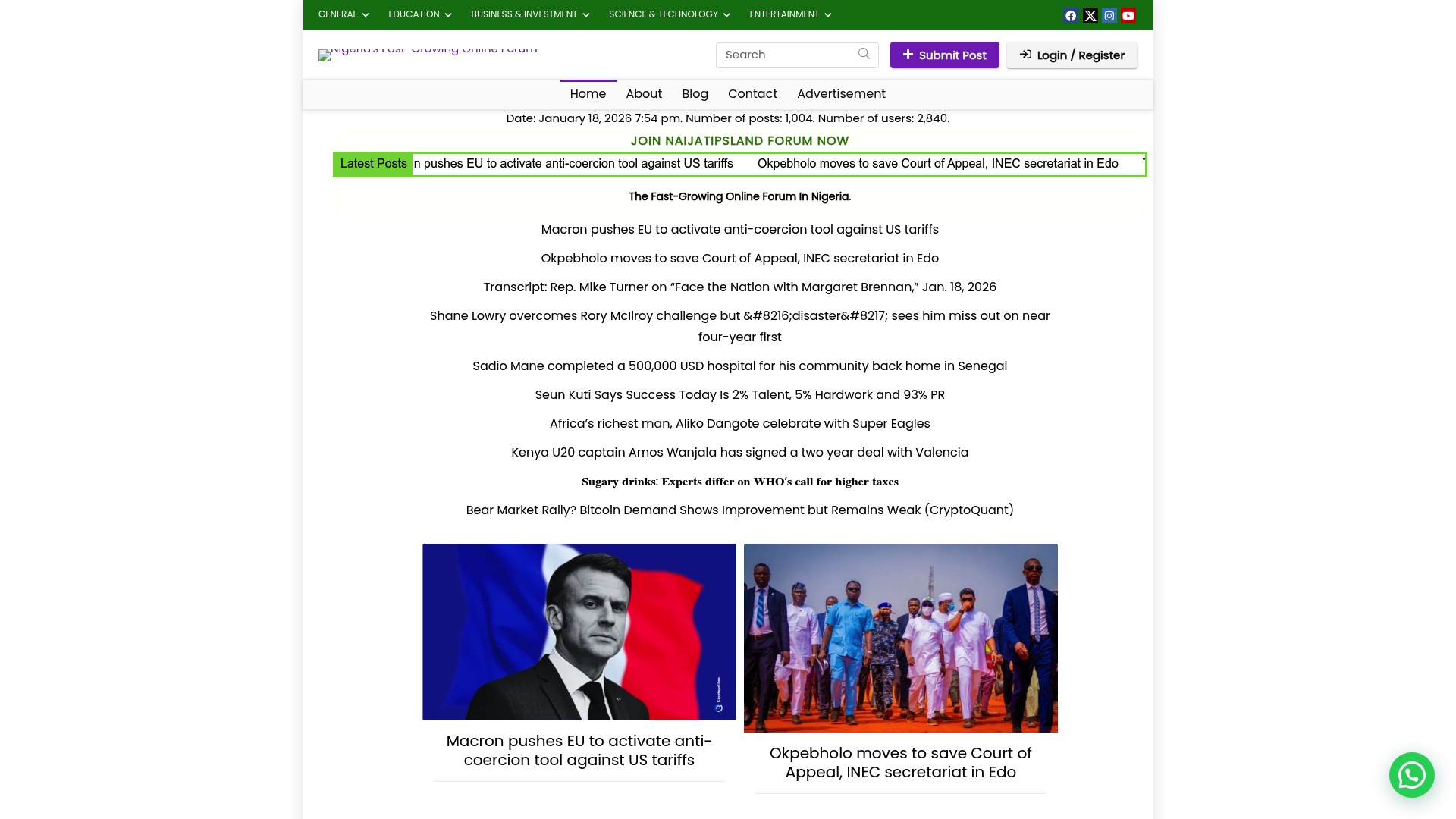
Whether you want to track how Nigerian stories evolve, join discussions on breaking news, or simply stay informed, our platform gives you the tools to do it all in one place. You can explore staying informed and engaged across entertainment and current affairs, or browse the top current affairs topics shaping Nigeria in 2026. Register today, submit your stories, and join thousands of Nigerians already using Naijatipsland.com to stay informed and connected.
Frequently asked questions
Which major Nigerian newspapers accept news tips directly?
Major Nigerian outlets like Punch, Vanguard, Premium Times, and Guardian all accept news tips, especially via authorized distribution services and their official contact channels.
What details should I include in my news tip?
Always include who, what, where, when, and why, along with any photos, videos, or official documents that support your claim and make the story verifiable.
How long does it take for a news tip to get published?
Most news outlets respond within a few days if your tip is newsworthy and well-documented, though major investigations may take longer depending on the outlet’s editorial process.
Are paid press release services effective for Nigerian news tips?
Yes, services like Pressdia offer guaranteed multi-site distribution on major Nigerian news platforms for a fee, making them a reliable option for tips that need wide or fast coverage.