

Every week in Nigeria, something shifts. A new policy drops, an oil deal closes, or a global program opens its doors to young graduates. If you are not paying attention, you miss the context that shapes your career choices, your business decisions, and even your daily conversations. In 2026, the pace of change across Nigeria and Africa is faster than ever, and staying informed is no longer optional for young adults and professionals who want to stay relevant. This article breaks down the biggest current affairs topics you need to know right now, with facts, figures, and clear context.
Table of Contents
- How we selected the top current affairs topics
- Landmark reforms in Nigeria’s oil and energy sector
- Nigeria’s 2026 federal budget and economic outlook
- Nigeria as Africa’s trade and investment hub
- Youth skills initiatives and rising opportunities
- Stay connected and informed with Naijatipsland
- Frequently asked questions
Key Takeaways
| Point | Details |
|---|---|
| Energy sector drives change | Major oil reforms and investments in 2026 are expected to fuel Nigeria’s economic recovery and global standing. |
| Economic policies impact daily life | The 2026 budget, with its focus on growth and security, directly affects job markets, inflation, and social infrastructure. |
| Regional leadership rising | With hosting IATF 2027 and embracing AfCFTA, Nigeria is positioned as a continental trade and innovation center. |
| Youth programs offer real benefits | International skills initiatives and improved well-being statistics create more opportunities for Nigerian youth in 2026. |
How we selected the top current affairs topics
With so much happening, let’s first clarify what makes a current affairs topic stand out in Nigeria this year. Not every trending story deserves equal attention. We used a clear set of criteria to filter the noise and focus on what truly matters.
Here is what guided our selection:
- National impact: Does the topic affect the economy, governance, or daily life for millions of Nigerians?
- Youth relevance: Is it especially important for Nigerians under 40, students, or urban professionals?
- Economic significance: Does it influence jobs, income, investment, or business opportunities?
- Policy effect: Has it triggered new laws, executive orders, or government programs?
- Headline frequency: Is it consistently appearing in major Nigerian and African news outlets?
Topics that scored high across all five areas made this list. Items that are only viral for a day or two did not.
Pro Tip: Use these same criteria the next time you scroll through your newsfeed. Ask yourself whether a story has lasting policy effects or just short-term buzz. That habit alone will sharpen your awareness significantly.
Landmark reforms in Nigeria’s oil and energy sector
Using those criteria, the oil and energy sector stands out due to its deep influence on Nigeria’s economy and governance. Two major developments in 2026 have reshaped the conversation entirely.
First, the OPL 245 dispute resolution is a landmark moment. This oil block case dragged on for 15 to 30 years, and its resolution under President Tinubu now clears the path for developing a deepwater asset that could add up to 150,000 barrels per day to Nigeria’s output. That is not a small number. To understand the broader role of oil in Nigeria, you need to appreciate how a single block like OPL 245 can shift national revenue projections.
Second, a new Executive Order now mandates direct oil revenue remittance straight into public funds, cutting out the middlemen that previously allowed leakages. You can read more about how these oil revenue reforms are being implemented at the federal level.
Beyond those two moves, the $20 billion Bonga Southwest Aparo project represents one of the largest single energy investments Nigeria has attracted in years. That kind of capital signals real confidence from international partners.
Not everyone agrees on the pace or fairness of these reforms, though. Some opposition figures argue the benefits are not reaching ordinary Nigerians fast enough. You can explore contrasting views on OPL 245 to get a fuller picture.
“Nigeria’s oil reforms are a litmus test for transparency and global investor confidence.”
Key highlights from this sector:
- OPL 245 resolution ends decades of legal deadlock
- Executive Order boosts revenue transparency
- Bonga Southwest Aparo project brings $20 billion in new investment
- Production capacity could rise by 150,000 barrels per day
Nigeria’s 2026 federal budget and economic outlook
Reforms aren’t limited to oil. They’re shaping the national budget and the economic outlook for 2026 in ways that touch every Nigerian household.
The N58.47 trillion budget passed its second reading in the House of Representatives, with a strong focus on capital expenditure, security, and infrastructure. This is one of the largest budgets in Nigeria’s history.
| Budget item | Detail |
|---|---|
| Total budget size | N58.18 to N58.47 trillion |
| GDP growth projection | 3.98% to 4.5% |
| Inflation forecast | 14.45% |
| Key priorities | Infrastructure, security, capital projects |
| Tax reform scope | Consolidates over 60 existing taxes |
The tax overhaul is particularly significant. Consolidating over 60 taxes into a simpler system is designed to reduce the burden on businesses and improve compliance. If you run a small business, you should check out how tax reform affects SMEs and what steps you can take now.
The GDP growth projection of 3.98% to 4.5% is encouraging, but the 14.45% inflation forecast means prices will still feel high for most Nigerians. Real wages need to grow faster than inflation for ordinary people to feel the benefit. Nigeria is also pursuing national economic growth strategies that could improve trade efficiency significantly.
Politically, pre-2027 election pressures are already influencing how economic reforms are being packaged and communicated. Expect more policy announcements as the election cycle heats up.
Key budget takeaways:
- Infrastructure and security get the biggest allocations
- Tax simplification targets business efficiency
- Inflation remains a real concern despite growth projections
- Political dynamics will shape how reforms are rolled out
Nigeria as Africa’s trade and investment hub
Looking beyond the national budget, Nigeria’s regional and international moves are changing its place in Africa and beyond. Two developments stand out clearly.

Nigeria has signed a hosting agreement for the Intra-African Trade Fair (IATF) 2027, targeting $50 billion in new trade deals. IATF is the flagship event under the African Continental Free Trade Area (AfCFTA), which is a continental agreement designed to reduce trade barriers and boost commerce across 54 African countries. Hosting this event positions Nigeria as the center of African business activity going into 2027.
Nigeria is also positioning as a regional superpower, with youth entrepreneurship and fintech identified as key growth sectors. International partners are taking notice.
| Country | Key trade move in 2026 |
|---|---|
| Nigeria | Hosting IATF 2027, targeting $50bn in deals |
| South Africa | Deepening BRICS trade ties |
| Kenya | Expanding East African digital trade corridors |
| Ethiopia | Growing manufacturing export base |
For young Nigerian professionals and entrepreneurs, this regional momentum creates real opportunities. Trade fairs, investment forums, and digital platforms are opening doors that did not exist five years ago. Journalists and communicators covering these shifts can find relevant context through urban reporting projects in Lagos that document how these macro trends play out at the street level.
Key points on Nigeria’s trade position:
- IATF 2027 hosting targets $50 billion in new deals
- AfCFTA creates a market of over 1.4 billion people
- Youth and fintech sectors are priority investment areas
- Nigeria’s influence benefits local graduates and entrepreneurs directly
Youth skills initiatives and rising opportunities
Empowering the next generation is another current trending focus this year, with international and local forces at work. If you are a recent graduate or early-career professional, this section is directly relevant to you.
The SAP Young Professionals Program 2026 is one of the most talked-about initiatives targeting Nigerian graduates in tech and business. SAP, a global enterprise software company, runs this program to place young Africans into meaningful roles within the digital economy. Spots are competitive, but the career impact is significant.
Beyond tech, a new study shows that young Nigerians demonstrate higher mental health resilience compared to their peers in the United States. That finding challenges common narratives about youth well-being in developing economies and points to a generation that is adaptive, resourceful, and ready to compete globally.
The demand for practical and creative job skills is also growing fast. Employers in 2026 are prioritizing candidates who can combine digital literacy with communication, problem-solving, and entrepreneurial thinking.
Pro Tip: Do not wait for opportunities to find you. Actively search for global programs like SAP’s initiative and local government schemes. Many of these programs have rolling applications and low awareness, which means less competition for those who look early.
Key youth opportunity highlights:
- SAP Young Professionals Program targets Nigerian tech and business graduates
- Young Nigerians show stronger mental health resilience than US peers
- Creative and digital skills are in high demand from employers
- Local and international programs offer more pathways than ever before
Stay connected and informed with Naijatipsland
Keeping up with all of these developments on your own can feel like a full-time job. That is exactly why Naijatipsland.com exists.
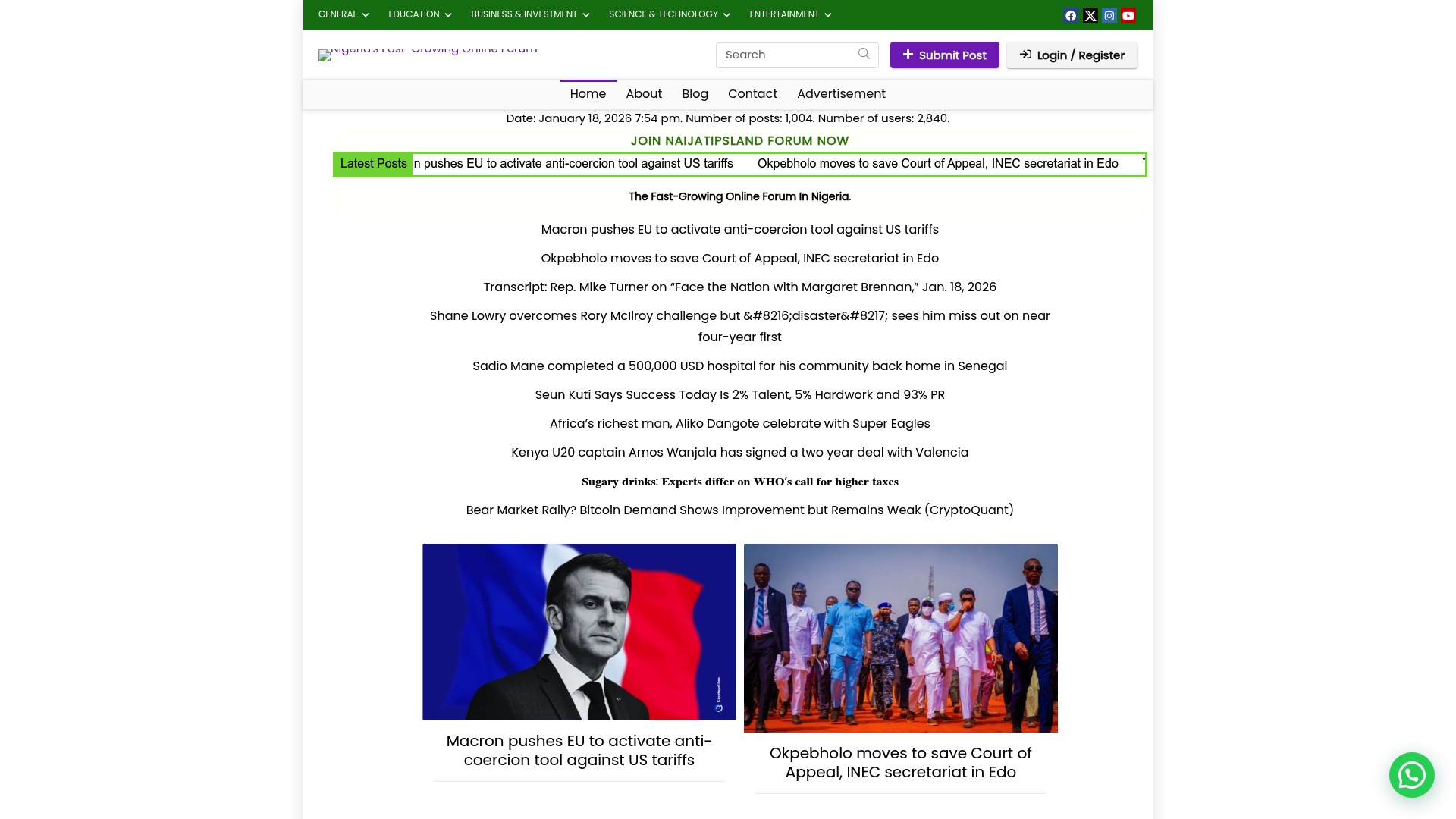
Naijatipsland is your go-to community platform for breaking Nigerian news, current affairs analysis, and trending topics across politics, economics, entertainment, and more. Whether you want to read the latest on oil sector reforms, join a discussion about the 2026 budget, or find out which youth programs are accepting applications, you will find it all in one place. Register today, submit your own posts, and become part of a growing community of informed Nigerians who are not just watching events unfold but actively discussing and shaping the conversation. Your voice matters here.
Frequently asked questions
Why is the OPL 245 dispute significant in 2026?
Resolving the OPL 245 dispute ends 15 to 30 years of litigation and unblocks a deepwater asset that could add 150,000 barrels per day to Nigeria’s oil output, signaling fresh investor confidence.
How will the 2026 budget affect ordinary Nigerians?
The N58.47 trillion budget prioritizes capital projects and security to drive economic growth, but a projected 14.45% inflation rate means the cost of living will remain a real challenge for most households.
What new opportunities exist for young Nigerian professionals in 2026?
Programs like the SAP Young Professionals initiative and growing investment in digital and creative sectors are creating more career pathways for graduates than at any point in recent years.
What is AfCFTA and how does it impact Nigeria?
AfCFTA stands for African Continental Free Trade Area, a trade agreement covering 54 African nations. Nigeria’s role as IATF 2027 host cements its position as a regional trade leader under this framework.