


Every Nigerian student and young professional knows the feeling when global crude prices make headlines, instantly affecting salaries, fuel costs, and hopes for career growth. Oil remains the engine behind Nigeria’s economic story, from shifting away from agriculture in the 1960s to becoming Africa’s largest oil and gas producer. With the Dangote Refinery starting operations in 2024 and the Nigerian National Petroleum Corporation reporting a bold 28% rise in net profit, the impact of oil touches everything—from government budgets to daily life and job opportunities.
Table of Contents
- What Oil Means For Nigeria’s Economy
- Types Of Nigerian Oil And Major Producers
- Government Policies And Legal Framework
- Challenges Facing Oil Production And Revenue
- Diversification, Sustainability, And Future Outlook
Key Takeaways
| Point | Details |
|---|---|
| Oil is Central to Nigeria’s Economy | Oil accounts for about 9% of GDP and generates over 90% of government revenue, affecting public spending and investment. |
| The Refinery Revolution is Transformative | The Dangote Refinery enhances local fuel production and job creation, reducing dependency on imported fuel. |
| The Petroleum Industry Act (PIA) Imperatives | The PIA aims to enhance transparency and community investment, redefining the operational landscape for oil companies. |
| Diversification is Essential for Sustainability | Economic stability relies on diversifying beyond oil, focusing on agriculture, technology, and renewable energy sectors. |
What Oil Means for Nigeria’s Economy
Oil is the backbone of Nigeria’s economy. It has shaped your country’s development since the 1960s, when agriculture gave way to petroleum as the primary revenue source. Today, Nigeria remains Africa’s largest oil and gas producer, accounting for roughly 9% of national GDP while driving government budgets and foreign exchange earnings.
The numbers tell a compelling story. In 2024, the Nigerian National Petroleum Corporation (NNPC) reported a 28% rise in net profit due to increased crude production. This isn’t just accounting—it translates to real money flowing into healthcare, infrastructure, and education budgets across the country.
Why Oil Dominates Your Country’s Finances
Nigeria’s reliance on oil is staggering. When oil prices rise, government revenues swell. When prices drop, budgets tighten immediately. Your unemployment, education investments, and infrastructure development all move with global crude prices.
Consider this reality:
- Oil exports generate over 90% of government revenue
- Petroleum sector employs hundreds of thousands directly
- Oil fuels government spending on salaries, roads, and public services
- Currency strength depends heavily on crude export earnings
- International loans and credit ratings rest on oil production forecasts
Without oil revenues, Nigeria’s government would struggle to fund basic services that millions depend on daily.
The Refinery Revolution Changing the Game
Historically, Nigeria exported raw crude while importing refined fuel at high cost—money flowing out instead of staying in. The Dangote Refinery began operations in 2024, fundamentally shifting this dynamic by processing crude locally and reducing fuel imports.
This single development matters because:
- Refined fuel is produced domestically, keeping more value in Nigeria
- Imported fuel bills shrink, improving foreign exchange position
- Local jobs emerge in refining, petrochemicals, and distribution
- Government no longer subsidizes expensive imported gasoline
For young professionals like yourself, this means potential employment in downstream operations, logistics, and energy infrastructure that didn’t exist before.
What This Means for Your Future
Oil’s dominance creates both opportunity and vulnerability. The sector offers well-paid careers in engineering, finance, and operations. Yet the economy’s oil dependency means your financial stability partly depends on forces beyond Nigeria’s control—Middle Eastern production, global demand, geopolitical tensions.
Understanding oil’s role helps you grasp why government policies, currency fluctuations, and employment opportunities shift so dramatically. The fuel shortages, inflation, and naira movements you experience connect directly to petroleum sector performance.
Recent economic reforms have begun producing positive results as Nigeria adapts to changing global energy markets, but oil remains central to any economic forecast.
Pro tip: Track crude oil prices monthly on international markets—this single metric predicts government revenue, currency stability, and job market shifts before official announcements arrive.
Types of Nigerian Oil and Major Producers
Nigeria produces two main crude oil types, each with distinct characteristics that affect refining processes and global market value. Understanding these types helps explain why different fields command different prices and why certain buyers prefer Nigerian crude over alternatives.
Light and Heavy Crude: What’s the Difference?
Light crude from Nigeria’s Niger Delta has an API gravity around 36 degrees, making it easier to refine into gasoline and diesel. Heavy crude, by contrast, measures 20-25 API gravity and requires more complex processing to extract valuable products.
Both types share a key advantage:
- Paraffinic base composition (easier to process)
- Low sulfur content (cleaner burning, less refinery cost)
- High demand from international refineries
- Consistent quality across production zones
The difference matters because light crude fetches higher prices on global markets. When Nigeria’s production mix shifts toward heavier grades, government revenues decline even if total barrels pumped stay constant.
Here’s a concise overview comparing Nigeria’s light and heavy crude oil characteristics:
| Attribute | Light Crude | Heavy Crude |
|---|---|---|
| API Gravity | ~36 degrees | 20-25 degrees |
| Ease of Refining | Simple processing | Complex processing |
| Market Value | Commands premium | Lower global price |
| Typical Use | Gasoline, diesel | Industrial fuels |
| Sulfur Content | Low | Low |
| Environmental Impact | Cleaner burning | Cleaner burning |
Light crude commands premium prices because refineries spend less processing it into fuel products.
Who Controls Nigeria’s Oil Production
Three categories of operators shape Nigeria’s petroleum landscape. International oil companies like Shell, ExxonMobil, and Chevron have operated here for decades through joint ventures. The Nigerian National Petroleum Corporation (NNPC) is the state-owned company holding assets across exploration, production, refining, and marketing.

NNPC’s role has expanded significantly since its establishment, transitioning from a regulatory body to an active operator managing major production facilities and refinery projects.
Current major players include:
- Shell Petroleum Development Company (SPDC)
- ExxonMobil Nigeria
- Chevron Nigeria Limited
- Nigerian National Petroleum Corporation (NNPC)
- Independent operators in deepwater and onshore fields
How They Work Together
International oil companies don’t operate independently. They partner with NNPC through joint ventures and production-sharing contracts that define profit splits, operational control, and investment obligations. This model gives Nigeria state ownership while leveraging international expertise and capital.
Young professionals enter this ecosystem through technical roles at operating companies, downstream refineries, or NNPC management divisions. The sector offers engineering positions, project management, and finance roles across exploration, production, and marketing.
For professionals tracking industry shifts, recognize that Nigeria’s export strategy continues evolving as companies balance crude sales against refined fuel production. This transition creates new career pathways in processing and distribution.
Pro tip: Monitor which company operates each major field—Shell dominates onshore, ExxonMobil leads deepwater, and NNPC’s production share keeps growing, signaling where employment opportunities will expand.
Government Policies and Legal Framework
Nigeria’s oil sector operates under rules that have shifted dramatically in recent years. The legal framework determines how companies operate, how much profit the government keeps, and what obligations companies face to communities and the environment. These policies directly affect your employment opportunities, investment potential, and Nigeria’s long-term economic stability.
The Petroleum Industry Act: A Major Shift
In 2021, Nigeria passed the Petroleum Industry Act (PIA), fundamentally restructuring how the oil sector functions. This law created two specialized regulators—one for upstream exploration and production, another for midstream and downstream operations. It also commercialized the Nigerian National Petroleum Corporation, transforming it from a state agency into a profit-driven company competing with private operators.
The PIA targets multiple objectives:
- Improved governance and transparency
- Host community development requirements
- Better business environment for operators
- Clearer regulatory authority and enforcement
- Enhanced fiscal terms for government revenue
The PIA represents Nigeria’s biggest regulatory overhaul in decades, aiming to attract investment while ensuring communities benefit from oil wealth.
What Changed for Communities and Investors
The Act introduced mandatory spending on host communities. Oil operators must now invest in education, healthcare, and infrastructure in areas where they extract crude. This shift means money stays closer to where drilling occurs rather than flowing solely to national coffers.
For investors and companies, the PIA clarified rules around licensing, contract terms, and operational standards. International oil companies know exactly what to expect, reducing uncertainty that previously deterred investment.
Key provisions include:
- Three percent of operating expenditure goes to host communities
- Gas utilization targets to prevent flaring
- Local content requirements for hiring and procurement
- Environmental management standards and penalties
- Transparent bidding processes for new licenses
Energy Transition and Climate Policy
Beyond oil-specific rules, Nigeria’s broader energy transition policies integrate renewable development with fossil fuel management. The Climate Change Act 2021 established carbon budget frameworks, while the national Energy Transition Plan targets emissions reduction and renewable energy scaling.
This creates career opportunities in solar, wind, and hydropower sectors alongside traditional oil jobs. Young professionals now navigate an energy landscape shifting away from oil dependency.
The government emphasizes transparency and stakeholder engagement, meaning civil society, communities, and private sector input shapes policy implementation. Your voice in these discussions matters more than ever.
Pro tip: Study the PIA’s local content requirements if pursuing oil sector careers—companies actively hire Nigerian engineers, managers, and specialists to meet these mandates, making qualifications and certifications your competitive advantage.
Challenges Facing Oil Production and Revenue
Nigeria’s oil sector faces threats that directly impact government budgets, employment, and economic growth. These aren’t abstract problems—they’re real obstacles that reduce the money flowing into your country’s treasury and create instability across all sectors.
Infrastructure and Security Crises
Aging pipelines, refineries, and production facilities plague Nigeria’s oil operations. Pipeline vandalism and crude oil theft cost the government billions annually in lost revenue and recovery expenses. Thieves tap pipelines, siphoning crude for illegal sale while damaging infrastructure that takes months to repair.
Security concerns compound these problems. Insecurity in Niger Delta oil-producing regions disrupts operations, forces facility shutdowns, and deters investment. When production stops due to attacks or instability, government revenues plummet within weeks.
The damage spans multiple areas:
- Pipeline ruptures from deliberate sabotage
- Theft reducing actual crude reaching export terminals
- Production shutdowns during security incidents
- Maintenance delays due to safety risks
- Capital fleeing toward more stable regions
When one major field goes offline due to insecurity, Nigeria loses millions daily in export revenue.
Governance and Competitiveness Problems
Governance issues including entrenched interests undermine the sector’s efficiency. Corruption, bureaucratic delays, and unclear regulations discourage international companies from expanding operations. Several major oil firms have exited Nigeria entirely, taking expertise and investment elsewhere.
Nigeria’s declining global competitiveness worsens this trend. Other African nations with stable governance and modern infrastructure attract investment that previously went to Nigeria. Angola, for example, has increased production while Nigeria stagnates.
Key governance challenges include:
- Lack of transparency in contract awards
- Unstable regulatory implementation
- Unclear investment protection frameworks
- Political interference in operational decisions
- Insufficient accountability for mismanagement
Impact on Your Wallet and Career
These challenges directly affect you. Lower government revenues mean reduced spending on education, healthcare, and infrastructure. Companies operating in Nigeria can’t expand if security remains questionable, limiting job creation and wage growth.
Fluctuating production also destabilizes the naira. Currency weakness makes imports expensive, driving inflation that eats your purchasing power. Young professionals often find fewer opportunities when companies operate at reduced capacity.
Addressing these obstacles requires sustained political will, investment in infrastructure, and genuine security improvements. Until then, expect continued volatility affecting employment prospects and economic conditions across Nigeria.
Below is a summary of major Nigerian oil sector challenges and their direct impacts:
| Challenge | Cause | Impact on Economy | Impact on Nigerians |
|---|---|---|---|
| Infrastructure decay | Aging pipelines/refineries | Lower production, revenue | Fewer jobs, higher prices |
| Security threats | Regional instability | Disrupts exports | Service interruptions |
| Governance weaknesses | Corruption, delays | Deters investment | Reduced public services |
| Global market competition | Other African producers | Loss of investment | Limited career prospects |
Pro tip: Track production loss announcements monthly—they precede currency fluctuations and inflation by weeks, giving you advance warning to adjust spending and investment decisions before broader economic impacts hit.
Diversification, Sustainability, and Future Outlook
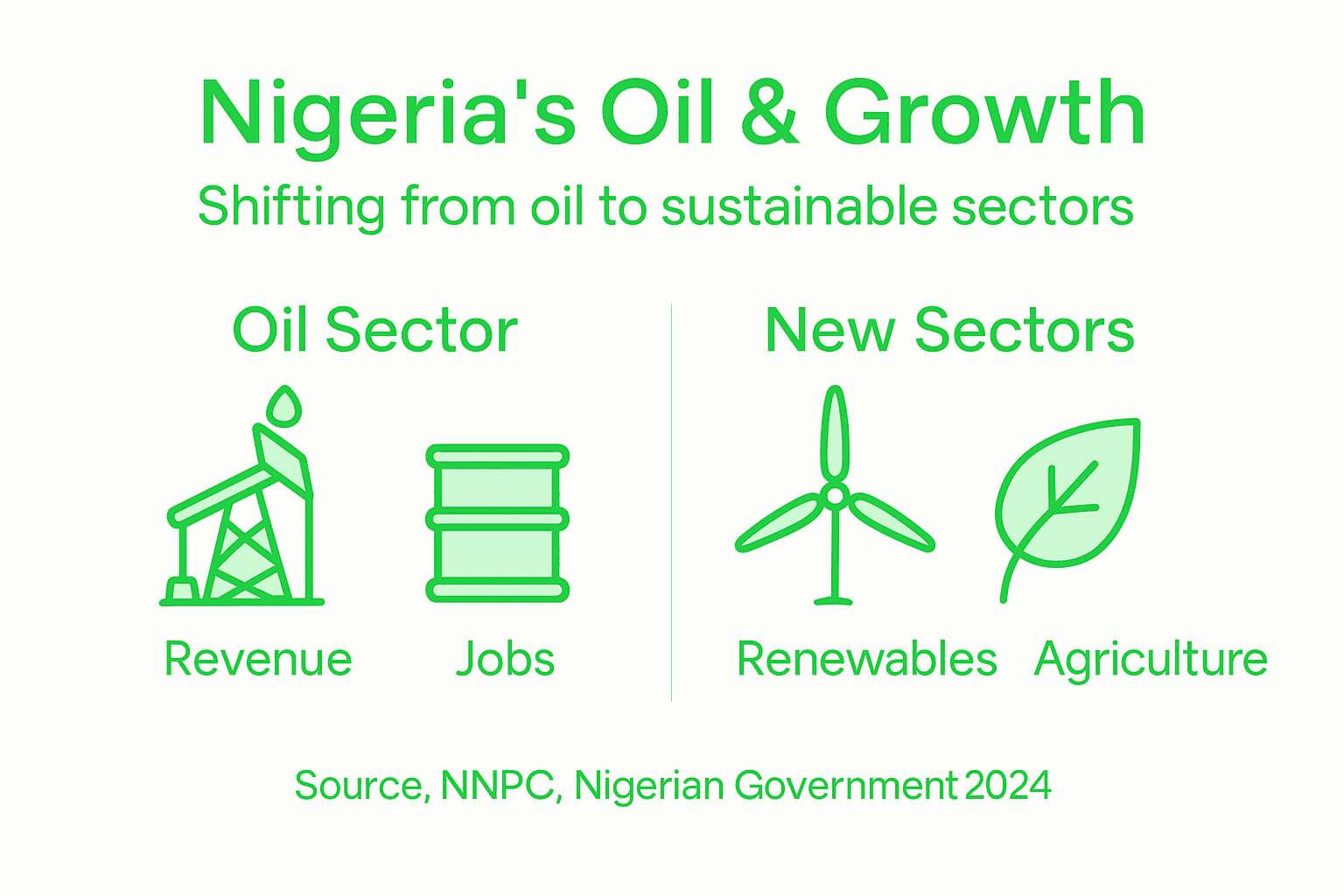
Nigeria cannot depend on oil forever. Global demand for crude will eventually decline as the world shifts toward renewable energy. Your country’s economic survival depends on building strength in other sectors while managing the transition responsibly.
Why Diversification Matters Now
Oil dependency creates what economists call the “resource curse.” When one commodity dominates revenues, the economy becomes fragile. Price drops cause immediate crises. Other sectors get neglected. Skilled workers migrate seeking stability elsewhere.
Economic diversification beyond oil revenues requires tackling political instability and governance reforms. Agriculture, manufacturing, technology, and services must grow to replace oil’s contribution to GDP.
Critical diversification areas include:
- Agriculture processing and export
- Technology and digital services
- Manufacturing and light industry
- Tourism and hospitality
- Professional services and finance
Without diversification, Nigeria risks economic collapse when global oil demand falls—a certainty, not a possibility.
The Energy Transition Strategy
Nigeria’s government has committed to transitioning away from fossil fuel dependency. The Energy Transition Plan emphasizes renewables, energy access, and emissions reduction under the Climate Change Act 2021. This isn’t just environmental responsibility—it’s economic necessity.
Solar and wind projects are expanding across Nigeria. Battery storage technology improves annually. Hydropower capacity remains underutilized. These sectors create jobs in installation, maintenance, and grid management.
For young professionals, this transition opens doors:
- Solar technician and engineer roles
- Renewable energy project management
- Energy efficiency auditing
- Grid modernization specialists
- Climate finance and carbon credit positions
Achieving Just Transition
Moving away from oil affects millions—oil workers, communities, government budgets. A “just transition” means retraining workers, supporting affected communities, and ensuring new opportunities replace lost jobs.
Nigeria’s commitment to this transition signals long-term economic restructuring. Expect government investment flowing toward renewable projects, agricultural modernization, and technology infrastructure over the next decade.
This reshaping creates uncertainty but also opportunity. Companies and professionals who adapt early gain competitive advantages. Those stuck in declining oil-dependent roles face displacement.
The stakes are clear: diversify or decline. Every sector strengthened outside oil improves Nigeria’s resilience and your personal economic stability.
Pro tip: Develop skills in emerging sectors now—renewable energy, agricultural technology, and digital services hire aggressively as Nigeria transitions, and early expertise commands premium compensation as demand accelerates.
Understand Nigeria’s Oil Challenges and Join the Conversation
Nigeria’s heavy reliance on oil revenues creates real challenges that affect your daily life from employment opportunities to inflation and infrastructure development. With issues like pipeline security, governance struggles, and the push for diversification reshaping the landscape, staying informed and engaged has never been more important. This is your chance to explore the latest discussions on Nigeria’s economic future and how oil policy impacts growth right now.
Dive deeper into these critical topics and connect with thousands of Nigerians sharing insights and solutions at Naijatipsland.com. Whether you want to understand government reforms, oil market dynamics, or the energy transition, our platform lets you submit posts, participate in debates, and stay ahead of news shaping your country’s trajectory. Start making informed decisions today by joining a community focused on Nigeria’s growth and your career prospects.
Frequently Asked Questions
What is the significance of oil in Nigeria’s economy?
Oil is crucial to Nigeria’s economy, accounting for roughly 9% of the national GDP and generating over 90% of government revenue. It drives budgets, foreign exchange earnings, and influences sectors like healthcare and infrastructure.
How does Nigeria’s reliance on oil affect employment opportunities?
Nigeria’s heavy dependence on oil creates job opportunities in various sectors like engineering, finance, and operations. However, this dependency also makes employment stability sensitive to fluctuations in global oil prices and geopolitical factors.
What changes were brought by the Petroleum Industry Act (PIA) for oil production?
The PIA, passed in 2021, restructured the oil sector by introducing specialized regulators, commercializing the Nigerian National Petroleum Corporation, and implementing mandatory community development investments, which aims to enhance transparency and attract investment.
How are the challenges facing Nigeria’s oil production impacting the economy?
Challenges like aging infrastructure, security issues, and governance problems lead to reduced production and revenue losses. These directly affect public services, job creation, and the overall economic stability of the country.
Recommended
- From Crude To Complexity: Why Nigeria’s Export Story Must Change / Naijatipsland
- Ojulari Concedes NNPC Can’t Run Refineries Profitably / Naijatipsland
- Energy Security: NNPCL, Dangote Forge Alliance / Naijatipsland
- Slovakia Threatens To Cut Electricity To Ukraine Over Russian Oil Spat | Oil And Gas News / Naijatipsland