

Malaria remains one of the deadliest and most underestimated diseases in Nigeria. According to the World Health Organization, Nigeria accounts for the highest number of malaria cases and deaths globally. Despite this alarming reality, many Nigerians continue to ignore early malaria symptoms, dismissing them as stress, weather changes, hunger, or “ordinary body pain.”
This habit of ignoring malaria warning signs has serious consequences. What begins as mild discomfort can escalate into severe malaria, organ failure, pregnancy complications, or death—especially in children, pregnant women, and people with weakened immunity.
This article explores malaria symptoms Nigerians commonly ignore, why these symptoms are dangerous, and what to do when they appear. If you live in Nigeria, this information could save your life or the life of someone you love.
Why Malaria Is Often Ignored in Nigeria
Several factors contribute to why Nigerians downplay malaria symptoms:
Malaria is extremely common and perceived as “normal”
Self-medication is widespread
Poor access to diagnostic testing in rural areas
Confusion between malaria and typhoid symptoms
Cultural belief that malaria only starts with fever
Unfortunately, malaria does not always begin with a high fever. In many cases, early malaria symptoms are subtle, misleading, and easy to ignore.
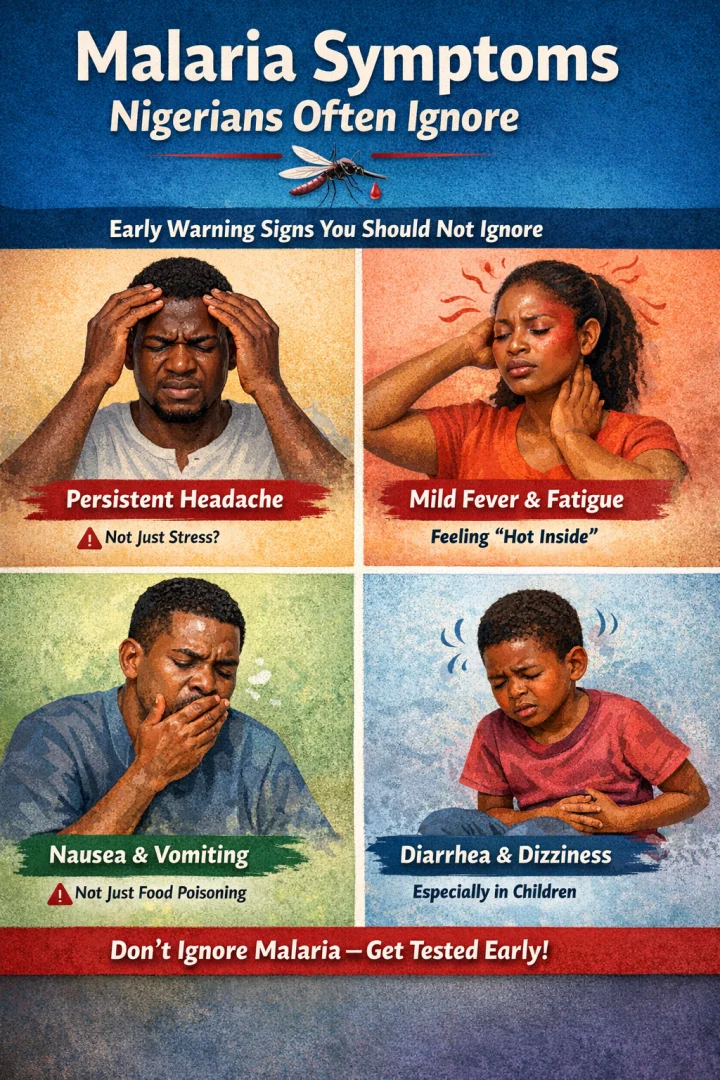
1. Persistent Headache
Among all malaria symptoms Nigerians ignore, persistent headache is the most common and the most dangerous. Many people experience headaches almost daily due to stress, heat, long working hours, dehydration, or poor sleep. Because of this, headaches are rarely taken seriously—especially when there is no high fever.
In Nigeria, it is common to hear statements like:
“It’s just stress”
“I stayed too long in the sun”
“Once I rest, it will go”
“Paracetamol will settle it”
Unfortunately, malaria-related headaches behave differently from ordinary stress headaches.
Why Malaria Causes Persistent Headache
Malaria parasites invade red blood cells and multiply rapidly. As the infection progresses:
Red blood cells are destroyed
Oxygen delivery to the brain reduces
Inflammatory chemicals are released into the bloodstream
This combination puts pressure on the brain, leading to a deep, persistent headache that often feels:
Throbbing or pounding
Heavy behind the eyes
Worse in the morning or at night
Resistant to common painkillers
Unlike tension headaches, malaria headaches do not fully go away with rest or hydration.

How Nigerians Commonly Misinterpret Malaria Headaches
Many Nigerians delay testing because they misinterpret the headache as:
Heat headache (especially during dry season)
Stress or work fatigue
Hunger or low blood sugar
Eye strain from phone or computer use
High blood pressure
This delay allows the malaria parasite load to increase, making treatment more difficult and recovery slower.
Warning Signs That a Headache May Be Malaria-Related
A headache should never be ignored if it comes with any of the following:
Body weakness or unusual fatigue
Mild fever or feeling “hot inside”
Body or joint pain
Loss of appetite
Nausea or dizziness
Chills or night sweats
Even if the fever is mild or absent, persistent headache + weakness is a strong indicator of malaria in Nigeria.
Persistent Headache in Children and Teenagers
In children and teenagers, malaria headaches may present as:
Frequent crying or irritability
Complaints of head pain without fever
Poor concentration in school
Sleeping excessively
Refusing food
Parents often assume the child is pretending, tired, or avoiding school. This delay is dangerous, as children can progress to severe malaria much faster than adults.
When a Persistent Headache Becomes Life-Threatening
If malaria is left untreated, persistent headache can progress to cerebral malaria, a medical emergency that affects the brain.
Signs include:
Severe headache that worsens rapidly
Confusion or disorientation
Seizures
Loss of consciousness
Cerebral malaria has a high fatality rate and is one of the leading causes of malaria-related deaths in Nigeria.
Why Painkillers Mask the Danger
Many Nigerians rely heavily on:
Paracetamol
Ibuprofen
Combination analgesics
While these drugs may temporarily reduce pain, they do not treat malaria. This false relief often convinces people they are improving, while the parasites continue multiplying.
Painkillers delay diagnosis, increase complications, and raise the risk of severe malaria.
What to Do If You Have a Persistent Headache in Nigeria
If a headache lasts more than 24 hours, especially with weakness or fever:
Get a malaria test immediately (RDT or microscopy)
Avoid treating without confirmation
Do not rely solely on painkillers
Complete the full malaria treatment if positive
Seek medical care if symptoms worsen
Early testing is cheaper, faster, and safer than treating complications.
2. Mild Fever or Feeling “Hot Inside”
One of the biggest reasons malaria is misdiagnosed or ignored in Nigeria is the belief that malaria must start with a very high fever. In reality, many malaria cases—especially in adults—begin with mild fever or a strange sensation Nigerians describe as “feeling hot inside.”
This symptom is often brushed off as:
Weather heat
Stress or sun exposure
Menstrual changes
Fatigue from work
Poor ventilation
Because the body temperature may not be extremely high, many Nigerians assume malaria is impossible and delay testing.
What “Feeling Hot Inside” Really Means
“Feeling hot inside” is not a medical myth. It is how early malaria fever presents in people who live in malaria-endemic areas like Nigeria.
Over time, repeated exposure to malaria parasites causes the body to:
Develop partial immunity
Produce less dramatic fever spikes
Show subtle temperature increases instead
As a result, malaria fever may feel:
Internal rather than external
Worse at night or early morning
Accompanied by sweating but no chills
Inconsistent or on-and-off
This is why many Nigerians say:
“My body is hot but thermometer is not showing much.”
Why Malaria Fever Is Often Mild in Adults
Adults in Nigeria often experience low-grade malaria fever because:
The immune system partially suppresses parasite activity
Fever spikes occur in cycles
Antimalarial drug misuse alters symptom patterns
However, mild fever does not mean mild malaria. The parasite load may still be high and dangerous.
Common Mistakes Nigerians Make With Mild Fever
Many people delay treatment because they:
Wait for fever to become severe
Use paracetamol repeatedly
Drink cold water and rest
Assume it will resolve naturally
This delay gives malaria parasites time to multiply, increasing the risk of:
Severe anemia
Persistent weakness
Organ complications
Mild Fever in Women and Pregnant Women
In women—especially during pregnancy—malaria fever is often mistaken for:
Hormonal changes
Stress
Pregnancy-related discomfort
This is extremely dangerous.
Malaria in pregnancy can cause:
Miscarriage
Stillbirth
Low birth weight
Maternal anemia
Any pregnant woman in Nigeria who feels unusually hot, weak, or feverish should be tested immediately.
Mild Fever in Children
Children may not always show high fever. Instead, malaria may present as:
Warm body without clear fever
Irritability
Refusal to eat
Excessive sleepiness
Night sweating
Parents often wait for fever to rise before visiting the hospital, but children can deteriorate rapidly.
When Mild Fever Is a Red Flag
Mild fever should raise concern if it is combined with:
Persistent headache
Body pain or weakness
Loss of appetite
Dizziness
Chills or night sweats
Even if the fever comes and goes, testing is essential.
Why Thermometers Can Be Misleading
Many Nigerians rely solely on thermometers to confirm malaria. This is risky because:
Fever may spike and fall quickly
Measurements depend on time of day
Antipyretics suppress temperature temporarily
A normal reading does not rule out malaria.
How Malaria Fever Progresses If Ignored
If untreated, mild malaria fever can:
Become severe within 24–72 hours
Lead to high parasite density
Cause organ damage
Result in hospitalization
Early treatment is cheaper, faster, and more effective.
What Nigerians Should Do Instead
If you feel hot inside or notice mild fever:
Test immediately using a rapid diagnostic test (RDT)
Avoid repeated paracetamol without diagnosis
Do not wait for severe fever
Complete prescribed malaria treatment if positive
Seek medical care if symptoms persist

Malaria symptoms Nigerians often ignore-mild-fever
3. General Body Weakness and Fatigue
In Nigeria, feeling weak or tired is often considered a normal part of daily life. Long work hours, economic stress, poor sleep, heat, and traffic are commonly blamed whenever someone feels exhausted. As a result, general body weakness and fatigue are among the most ignored malaria symptoms in Nigeria.
Many Nigerians say:
“I’m just tired”
“I worked too much”
“It’s hunger”
“I need rest”
While these explanations may sometimes be true, persistent or unusual weakness is one of the clearest early signs of malaria.
Why Malaria Causes Severe Weakness and Fatigue
Malaria parasites attack and destroy red blood cells. These cells are responsible for carrying oxygen throughout the body. When they are reduced:
Oxygen supply to muscles drops
Energy production decreases
The body struggles to function normally
This process leads to malaria-induced anemia, which causes deep, overwhelming fatigue that rest alone cannot fix.
Unlike normal tiredness, malaria fatigue:
Comes suddenly
Feels heavy and draining
Persists even after sleeping
Worsens over time if untreated
How Malaria-Related Weakness Feels Different
Many people fail to recognize malaria fatigue because it does not always come with fever. However, malaria weakness often feels like:
Heavy limbs
Difficulty standing or walking for long
Shortness of breath after minor activity
Feeling drained after waking up
Lack of motivation or energy
If your strength drops suddenly without clear reason, malaria should be suspected.
Why Nigerians Commonly Ignore This Symptom
Several factors make Nigerians dismiss body weakness:
Fatigue is culturally normalized
Economic pressure forces people to keep working
Self-medication masks symptoms temporarily
Malaria is seen as “not serious” at first
Unfortunately, pushing through malaria-related weakness can worsen the illness and delay recovery.
General Body Weakness in Women
Women, especially working mothers and traders, often attribute weakness to:
Stress
Menstrual cycles
Hormonal changes
This leads many women to ignore malaria until it becomes severe.
In pregnancy, malaria-related fatigue is especially dangerous. It can cause:
Severe anemia
Dizziness and fainting
Poor oxygen supply to the baby
Any pregnant woman experiencing unusual weakness should be tested immediately.
General Body Weakness in Children
Children may not complain of weakness clearly. Instead, signs include:
Refusing to play
Sleeping more than usual
Difficulty standing or walking
Weak crying or lethargy
Parents often assume the child is tired or lazy, delaying treatment. In children, malaria progresses faster and can become fatal within days.
When Weakness Signals Severe Malaria
Body weakness becomes dangerous when accompanied by:
Dizziness or fainting
Pale skin or lips
Rapid heartbeat
Shortness of breath
Confusion or drowsiness
These signs indicate severe anemia or organ involvement and require urgent medical care.
Why Rest Alone Is Not Enough
Many Nigerians believe that rest, food, and vitamins will restore strength. While nutrition is important, malaria parasites continue damaging red blood cells until treated.
No amount of rest can reverse malaria-related fatigue without proper antimalarial medication.
The Link Between Recurrent Malaria and Chronic Fatigue
People who experience repeated malaria infections may suffer from:
Long-term weakness
Poor productivity
Frequent illness
Reduced quality of life
This is common in Nigeria and often goes untreated, leading to chronic health problems.
What Nigerians Should Do When Weakness Appears
If you feel unusually weak or fatigued:
Get tested for malaria immediately
Avoid treating fatigue with only painkillers or energy drinks
Do not wait for fever to appear
Complete your malaria treatment if positive
Follow up if weakness persists after treatment
Early treatment prevents complications and speeds up recovery.
4. Loss of Appetite
Loss of appetite is one of the quietest yet most consistent early symptoms of malaria, but in Nigeria it is rarely associated with the disease. Many Nigerians only connect malaria with fever, chills, and body pain, so when appetite disappears, they assume something else is wrong.
Common assumptions include:
Stress or emotional issues
Digestive problems
Ulcer or gastritis
Pregnancy-related nausea
“Food just didn’t go down well”
As a result, malaria testing is often delayed, allowing the infection to worsen.
Why Malaria Causes Loss of Appetite
Malaria triggers an inflammatory response in the body. As the immune system fights the parasite:
Digestive activity slows down
Hunger signals from the brain are suppressed
The body prioritizes survival over digestion
This leads to:
Reduced desire to eat
Early fullness after small meals
Nausea at the thought or smell of food
Loss of appetite is often one of the first signs that the body is fighting infection.
How Loss of Appetite Appears in Nigerians With Malaria
Malaria-related appetite loss often presents as:
Skipping meals unintentionally
Eating very small portions
Feeling full quickly
Disinterest in favorite foods
Mild nausea without vomiting
Because these symptoms are not dramatic, many Nigerians ignore them—especially if they are still able to work.
Why Nigerians Commonly Dismiss Appetite Loss
Several cultural and lifestyle factors contribute:
Busy schedules reduce regular eating
Appetite loss is normalized during stress
People wait for fever before acting
Malaria is self-treated only when symptoms worsen
Unfortunately, appetite loss rarely occurs alone. It is usually accompanied by weakness, headache, or mild fever—early malaria warning signs.
Loss of Appetite in Children
In children, loss of appetite is often the earliest malaria symptom, even before fever.
Warning signs include:
Refusing food or breast milk
Eating far less than usual
Crying when offered food
Weight loss if prolonged
Parents often assume teething or stubbornness, delaying diagnosis. In children, malaria can become severe quickly.
Loss of Appetite in Pregnant Women
Pregnant women frequently confuse malaria-related appetite loss with:
Morning sickness
Hormonal changes
This is dangerous.
Malaria in pregnancy can:
Worsen anemia
Affect fetal growth
Increase risk of miscarriage or stillbirth
Any appetite loss combined with weakness or fever in pregnancy should be investigated immediately.
The Danger of Ignoring Appetite Loss
When appetite loss is ignored:
Nutritional intake drops
Weakness and fatigue worsen
Immune response weakens
Recovery becomes slower
Malaria patients who eat poorly during infection often experience longer illness duration and higher complication risk.
Why Appetite Does Not Return Without Treatment
Many Nigerians expect appetite to return on its own. However:
Malaria parasites continue to multiply
Inflammation persists
Digestive function remains suppressed
Appetite usually returns only after effective antimalarial treatment begins.
When Loss of Appetite Becomes a Red Flag
Loss of appetite should not be ignored if it lasts more than 24 hours and occurs with:
Persistent headache
Body weakness or fatigue
Mild fever or “hot inside” feeling
Nausea or vomiting
These combinations strongly suggest malaria.
What Nigerians Should Do
If appetite suddenly reduces:
Test for malaria immediately
Avoid assuming ulcer or stress
Do not self-medicate blindly
Maintain hydration even if food intake drops
Complete malaria treatment if positive
Early diagnosis prevents complications and speeds recovery.
5. Nausea and Vomiting
Nausea and vomiting are among the most misunderstood malaria symptoms in Nigeria. When these symptoms appear, many Nigerians immediately assume food poisoning, ulcer, typhoid fever, or stomach infection—rarely malaria.
Common statements include:
“Something I ate upset my stomach”
“It’s ulcer”
“It will pass”
“Maybe it’s typhoid”
Because of this misinterpretation, malaria testing is often delayed, allowing the disease to progress.
Why Malaria Causes Nausea and Vomiting
Malaria affects more than just the blood. As parasites multiply:
Toxins are released into the bloodstream
The liver becomes inflamed
Digestive function is disrupted
These changes irritate the stomach and intestines, leading to:
Persistent nausea
Vomiting after meals
Sensitivity to smells or food
Loss of appetite
In some cases, vomiting occurs before fever becomes obvious, making diagnosis even more difficult.
How Malaria-Related Vomiting Feels Different
Vomiting caused by malaria often:
Occurs repeatedly
Is not clearly linked to a specific meal
Comes with weakness or dizziness
Persists despite avoiding food
Occurs alongside mild fever or headache
Unlike food poisoning, which usually resolves within a day, malaria-related vomiting tends to worsen without treatment.
Why Nigerians Confuse Malaria With Food Poisoning or Typhoid
This confusion happens because:
Symptoms overlap significantly
Typhoid is overdiagnosed in Nigeria
Many people self-medicate without testing
Diagnostic facilities may be limited
However, treating typhoid or ulcer while malaria remains untreated puts the patient at serious risk.
Nausea and Vomiting in Children
In children, malaria-related vomiting is especially dangerous.
Warning signs include:
Repeated vomiting
Refusal to eat or drink
Rapid dehydration
Weakness or lethargy
Parents often treat with home remedies, but children can deteriorate rapidly without proper treatment.
Nausea and Vomiting in Pregnant Women
Pregnant women may mistake malaria vomiting for:
Morning sickness
Pregnancy-related nausea
This is extremely risky.
Malaria during pregnancy increases the risk of:
Severe anemia
Miscarriage
Low birth weight
Maternal complications
Vomiting that worsens or persists during pregnancy should always prompt malaria testing.
Why Vomiting Makes Malaria More Dangerous
Vomiting increases malaria risk by:
Preventing oral antimalarial drugs from staying down
Causing dehydration
Leading to electrolyte imbalance
When patients cannot keep medication or fluids down, hospital treatment with injections or IV fluids may be required.
When Vomiting Signals Severe Malaria
Seek urgent care if vomiting is accompanied by:
Severe weakness
Confusion
Persistent high fever
Blood in vomit
Inability to drink fluids
These signs may indicate severe malaria or organ involvement.
What Nigerians Should Do When Nausea or Vomiting Occurs
Test for malaria immediately
Avoid assuming food poisoning
Do not self-medicate repeatedly
Maintain hydration
Seek medical care if vomiting persists
Early diagnosis prevents complications and improves outcomes.

6. Chills and Shivering Without Cold Weather
In a hot, tropical country like Nigeria, chills and shivering should never be considered normal. Yet many Nigerians ignore this symptom, especially when it happens without rain, cold weather, or air conditioning.
People often say:
“I don’t know why I’m shivering”
“Maybe it’s stress”
“I suddenly felt cold”
“It will pass”
Unfortunately, chills and shivering are one of the most classic malaria symptoms, and ignoring them can allow the disease to progress rapidly.
Why Malaria Causes Chills and Shivering
Malaria parasites live and multiply inside red blood cells. At specific intervals, these infected cells burst, releasing parasites and toxins into the bloodstream. When this happens:
The body’s temperature regulation becomes unstable
The immune system triggers a strong inflammatory response
Blood vessels constrict suddenly
This causes the body to feel intensely cold, even in hot weather, leading to:
Shivering
Teeth chattering
Goosebumps
Uncontrollable shaking
This stage often occurs before or during fever spikes.
Why Shivering Happens Even When It’s Hot
Many Nigerians are confused by malaria chills because:
The weather is hot
Other people around are comfortable
The environment does not feel cold
However, malaria chills are internal, not environmental. They are caused by rapid changes in body temperature, not external cold.
This is why someone can be sweating and shivering at the same time.
How Nigerians Commonly Misinterpret Malaria Chills
Chills are often mistaken for:
Reaction to rain
Sudden tiredness
Low blood sugar
Stress or anxiety
“Just feeling cold for no reason”
Because chills may come and go, many people wait until symptoms worsen before seeking help.
Chills Without Fever: Why This Is Still Malaria
One dangerous misconception is that chills must always come with high fever. In reality:
Fever may be mild or delayed
Fever may spike at night
Painkillers may suppress temperature
A person can experience intense chills before fever becomes obvious, especially in early malaria.
Chills in Children
In children, malaria-related chills may appear as:
Shaking while feeling warm to touch
Crying and clinging
Sudden restlessness
Refusing to be put down
Parents may assume the child is reacting to cold air or fear, delaying treatment.
Children can progress from mild symptoms to severe malaria very quickly.
Chills in Pregnant Women
Pregnant women may dismiss chills as:
Hormonal changes
Fatigue
Stress
This is extremely risky.
Malaria in pregnancy increases the risk of:
Severe maternal anemia
Premature delivery
Low birth weight
Stillbirth
Any pregnant woman experiencing chills or shivering should seek immediate testing.
When Chills Signal Severe Malaria
Chills become a medical emergency when accompanied by:
Confusion or disorientation
Persistent vomiting
High fever that keeps returning
Severe weakness
Difficulty breathing
These signs may indicate severe or complicated malaria, which requires urgent hospital care.
Why Chills Often Come in Cycles
Malaria chills tend to:
Appear suddenly
Last 30 minutes to several hours
Disappear temporarily
Return later, often stronger
This cyclical pattern reflects the parasite’s life cycle and is a strong diagnostic clue.
What Nigerians Should Do When Chills Occur
If you experience chills or shivering without cold weather:
Test for malaria immediately
Do not wait for fever to worsen
Avoid self-medication without diagnosis
Seek medical care if chills return repeatedly
Complete your malaria treatment if positive
Early treatment prevents complications and reduces recovery time.
7. Sweating Excessively at Night
In Nigeria’s warm climate, night sweating is often ignored or blamed on heat, poor ventilation, power outages, or heavy blankets. Because sweating is considered normal, many Nigerians do not recognize excessive night sweating as a malaria symptom, especially when there is no obvious fever.
People often say:
“It was too hot last night”
“NEPA took light”
“My room is not well ventilated”
“I sweat easily”
However, malaria-related night sweating is different and should not be ignored.
Why Malaria Causes Excessive Night Sweating
Malaria fever does not remain constant. It occurs in cycles linked to the parasite’s life cycle in the blood.
When a fever spike breaks:
The body rapidly releases heat
Blood vessels widen
Sweat glands become overactive
This leads to profuse sweating, especially at night when:
Body temperature regulation changes
Fever cycles peak
The immune system is more active
Night sweating often follows chills or shivering and may leave the person drenched in sweat.
How Malaria Night Sweats Feel Different
Malaria-related night sweating often:
Soaks clothes and bedsheets
Occurs suddenly during sleep
Leaves the body weak afterward
Is accompanied by headache or fatigue
Repeats over several nights
Unlike heat-related sweating, it may occur even in well-ventilated rooms or during cooler nights.
Why Nigerians Commonly Ignore Night Sweating
Several factors contribute:
Hot weather is normalized
Electricity outages are common
Fans and AC are unreliable
Sweating is culturally accepted
Because of this, night sweats are rarely linked to illness unless they become extreme.
Night Sweating Without Obvious Fever
One dangerous misconception is that night sweating only matters if fever is high.
In malaria:
Fever may spike briefly and drop quickly
Painkillers may suppress fever
Sweating may be the only visible sign
This means a person can experience repeated night sweats without noticing a significant fever.
Excessive Night Sweating in Children
In children, malaria night sweats may present as:
Wet clothes or bedsheets in the morning
Restless sleep
Crying or waking frequently
Weakness on waking
Parents may assume the child is reacting to heat or thick clothing, delaying diagnosis.
Night Sweating in Pregnant Women
Pregnant women often attribute night sweats to:
Hormonal changes
Pregnancy discomfort
This can be dangerous.
Malaria in pregnancy may cause:
Severe anemia
Poor fetal growth
Premature delivery
Stillbirth
Repeated night sweating during pregnancy should always prompt malaria testing.
When Night Sweating Signals Severe Malaria
Night sweating becomes more concerning when combined with:
Persistent headache
Body weakness or fatigue
Chills or shivering
Weight loss
Recurrent fever
These combinations suggest active infection and require urgent testing.
Why Night Sweating Often Returns
Malaria parasites multiply in cycles. As long as they remain in the bloodstream:
Fever spikes recur
Sweating episodes repeat
Weakness worsens
Night sweating usually stops only after effective antimalarial treatment begins.
What Nigerians Should Do
If you experience excessive night sweating:
Test for malaria immediately
Do not assume it is heat-related
Avoid repeated self-medication
Change sweaty clothes to avoid dehydration
Complete malaria treatment if positive
Early diagnosis prevents complications and shortens recovery.
8. Muscle and Joint Pain
In Nigeria, muscle and joint pain is often dismissed as “ordinary body pain.” Many Nigerians wake up with aching muscles, stiff joints, or general discomfort and immediately blame hard work, poor sleep position, or stress. Because body pain is so common, it is one of the most ignored early symptoms of malaria.
People frequently say:
“I slept wrongly”
“I worked too hard yesterday”
“It’s just body pain”
“Once I stretch, it will go”
Unfortunately, malaria-related muscle and joint pain is not ordinary, and ignoring it can delay diagnosis and treatment.
Why Malaria Causes Muscle and Joint Pain
When malaria parasites multiply in the blood, the immune system responds by releasing inflammatory chemicals called cytokines. These substances:
Increase inflammation in muscles and joints
Reduce oxygen delivery to tissues
Cause soreness and stiffness
Additionally, malaria-related fever and anemia worsen muscle fatigue, making the pain feel deeper and more widespread.
This is why malaria body pain often affects:
The lower back
Thighs and legs
Arms and shoulders
Knees and elbows
How Malaria Body Pain Feels Different
Malaria-related muscle and joint pain often:
Comes suddenly
Affects multiple body parts at once
Feels deep, aching, or heavy
Is worse when moving or standing
Does not improve with stretching or rest
Unlike work-related pain, it tends to persist or worsen over time.
Why Nigerians Commonly Misinterpret Body Pain
Muscle and joint pain is often blamed on:
Manual labor
Long hours of standing or walking
Poor sleeping posture
Age-related joint issues
Because malaria pain may start mildly, many people take painkillers and continue their daily activities, unknowingly allowing the infection to worsen.
Muscle and Joint Pain Without Fever
A major reason this symptom is ignored is the absence of high fever.
In malaria:
Fever may be mild or delayed
Pain may appear before fever
Painkillers suppress fever temporarily
This leads many Nigerians to believe malaria is not possible.
Muscle and Joint Pain in Women
Women, especially traders and working mothers, often associate body pain with:
Fatigue
Stress
Hormonal changes
This leads to delayed malaria testing, especially during early infection.
Muscle and Joint Pain in Children
In children, malaria-related pain may show as:
Crying when touched or lifted
Refusing to walk or play
Complaints of leg or back pain
Unusual stiffness
Parents may assume the child is lazy or injured, delaying treatment.
When Body Pain Signals Severe Malaria
Muscle and joint pain becomes more concerning when combined with:
Persistent headache
Body weakness or fatigue
Fever or chills
Nausea or vomiting
These combinations strongly suggest active malaria infection.
Why Painkillers Can Be Dangerous
Many Nigerians rely on:
Paracetamol
Ibuprofen
Diclofenac
While these drugs may reduce pain temporarily, they:
Mask symptoms
Delay diagnosis
Do not treat malaria
Repeated use without testing increases the risk of complications.
What Nigerians Should Do
If muscle or joint pain:
Appears suddenly
Affects multiple body areas
Persists beyond 24 hours
Then:
Test for malaria immediately
Avoid repeated self-medication
Do not ignore accompanying symptoms
Complete antimalarial treatment if positive
Early treatment shortens recovery and prevents complications.
9. Dizziness or Lightheadedness
Dizziness or lightheadedness is one of the most overlooked malaria symptoms in Nigeria because it is often blamed on hunger, stress, dehydration, or low blood sugar. Many Nigerians experience dizziness occasionally, so when it happens, it is rarely linked to malaria—especially if fever is mild or absent.
Common explanations include:
“I didn’t eat early”
“I stood up too fast”
“It’s the heat”
“I’m just tired”
Unfortunately, malaria-related dizziness is not harmless, and ignoring it can lead to serious complications.
Why Malaria Causes Dizziness and Lightheadedness
Malaria affects the body in multiple ways that contribute to dizziness:
Destruction of red blood cells, leading to anemia
Reduced oxygen supply to the brain
Dehydration from fever, sweating, or vomiting
Low blood pressure during infection
When the brain does not receive enough oxygen or blood flow, dizziness occurs.
How Malaria-Related Dizziness Feels Different
Dizziness caused by malaria often:
Occurs suddenly
Is worse when standing or walking
Comes with weakness or fatigue
Is accompanied by headache or nausea
Improves only slightly with rest
Unlike simple hunger-related dizziness, it tends to recur and worsen without treatment.
Why Nigerians Commonly Misinterpret Dizziness
Dizziness is often dismissed because:
Hunger is common
Many people work long hours without eating
Heat exposure is frequent
Self-medication masks symptoms
This leads many people to ignore malaria testing until the illness becomes severe.
Dizziness Without Fever: Still a Malaria Warning
A major misconception is that malaria dizziness must come with high fever.
In reality:
Fever may be mild or intermittent
Painkillers may suppress temperature
Dizziness may appear before fever
This makes dizziness one of the earliest warning signs of malaria.
Dizziness in Women and Pregnant Women
Women often attribute dizziness to:
Menstrual cycles
Hormonal changes
Fatigue
In pregnancy, malaria-related dizziness is especially dangerous and may indicate:
Severe anemia
Reduced oxygen to the fetus
Increased risk of fainting
Any pregnant woman feeling dizzy or lightheaded should be tested immediately.
Dizziness in Children
Children may show dizziness as:
Unsteady walking
Sudden weakness
Complaints of “head turning”
Difficulty standing
Parents may assume the child is playing or tired, delaying diagnosis.
When Dizziness Signals Severe Malaria
Dizziness becomes an emergency when combined with:
Fainting or collapse
Confusion or drowsiness
Very pale skin
Rapid heartbeat
Difficulty breathing
These signs suggest severe anemia or cerebral malaria and require urgent medical attention.
Why Energy Drinks and Sugary Foods Don’t Help
Many Nigerians respond to dizziness with:
Energy drinks
Sugary snacks
While this may offer brief relief, it does not address malaria and can delay treatment.
What Nigerians Should Do
If dizziness or lightheadedness occurs:
Test for malaria immediately
Do not rely on food or drinks alone
Avoid repeated self-medication
Seek care if symptoms worsen
Complete malaria treatment if positive
Early diagnosis prevents complications and speeds recovery.

10. Irritability and Mood Changes
When malaria is mentioned in Nigeria, most people think of fever, chills, and body pain. Very few associate malaria with changes in mood or behavior. As a result, irritability, restlessness, and emotional instability are often ignored or misunderstood—even though they can be early warning signs of malaria, especially in children.
People often say:
“He’s just being stubborn”
“She’s stressed”
“Maybe it’s mood swings”
“The child is just tired”
Unfortunately, malaria does not always start with physical symptoms alone. It can affect mood, behavior, and mental clarity.
Why Malaria Causes Irritability and Mood Changes
Malaria affects the brain and nervous system in several ways:
Reduced oxygen delivery to the brain due to anemia
Release of inflammatory chemicals that affect brain function
Fever-related discomfort and pain
Disrupted sleep patterns
These factors can cause:
Irritability
Anxiety
Restlessness
Low mood
Difficulty concentrating
In some cases, malaria-related mood changes appear before severe physical symptoms.
How Mood Changes Appear in Adults
In adults, malaria-related irritability may show as:
Short temper
Unusual anger
Withdrawal from others
Restlessness
Difficulty focusing on work
Many adults assume these changes are caused by stress or financial pressure, delaying medical attention.
Irritability in Children: A Major Red Flag
In children, mood changes are often the earliest and most obvious malaria symptom.
Warning signs include:
Excessive crying
Irritability without clear reason
Refusing to play
Clinginess
Lethargy
Parents may discipline the child instead of seeking medical care, unaware that malaria may be the cause.
Mood Changes Without Fever
One reason this symptom is ignored is the absence of high fever.
In malaria:
Fever may be mild or delayed
Painkillers may suppress temperature
Behavioral changes may appear first
This leads caregivers to believe malaria is unlikely.
Irritability in Pregnant Women
Pregnant women may experience:
Mood swings
Anxiety
Restlessness
These are often blamed on hormonal changes. However, malaria-related irritability in pregnancy may signal:
Anemia
Poor oxygen supply
Active infection
Ignoring these signs can endanger both mother and baby.
When Mood Changes Signal Severe Malaria
Behavioral symptoms become more concerning when combined with:
Confusion or disorientation
Drowsiness or difficulty waking
Hallucinations
Seizures
These signs may indicate cerebral malaria, a life-threatening condition requiring immediate care.
Why Mood Changes Are Often Misdiagnosed
Irritability is commonly misattributed to:
Stress
Mental health issues
Fatigue
Personality changes
Because malaria is not considered, diagnosis is delayed.
What Nigerians Should Do
If sudden mood or behavior changes occur:
Test for malaria immediately
Do not dismiss symptoms as attitude or stress
Observe for other subtle signs
Seek urgent care if confusion appears
Complete malaria treatment if positive
Early detection prevents severe complications.
11. Diarrhea (Especially in Children)
In Nigeria, diarrhea in children is usually attributed to food poisoning, teething, or stomach infections. Because of this, many parents and caregivers fail to recognize that diarrhea can be an early symptom of malaria, especially in children under five.
Common statements include:
“The child must have eaten something bad”
“It’s just teething”
“Maybe it’s a stomach bug”
While these are possible causes, diarrhea in combination with other subtle signs may indicate malaria, which requires prompt testing and treatment.
Why Malaria Causes Diarrhea
Malaria affects multiple organ systems, including the digestive tract. The infection can cause:
Inflammatory responses that irritate the gut
Liver involvement, affecting bile secretion and digestion
Weakening of the immune system, making the body more susceptible to mild gut infections
As a result, children often experience:
Loose stools
Increased frequency of bowel movements
Mild to moderate dehydration
Reduced appetite
Unlike ordinary diarrhea, malaria-related diarrhea may persist even without other obvious gastrointestinal causes.
How Malaria-Related Diarrhea Appears in Children
Children may present with:
Loose or watery stools that last more than a day
Occasional vomiting along with diarrhea
Refusal to eat or drink
Weakness and lethargy
Irritability or excessive crying
Parents often misinterpret these symptoms as mild stomach upset, delaying malaria testing.
Why Nigerians Commonly Misinterpret Malaria Diarrhea
Diarrhea is frequently misdiagnosed because:
Gastroenteritis is common in children
Food hygiene issues are widespread
Parents focus only on fever
Many children have mild symptoms and still play
This leads to a false sense of security, allowing malaria to progress undetected.
Diarrhea Without High Fever
A major misconception is that malaria diarrhea must occur with high fever. In reality:
Fever may be mild or intermittent
Diarrhea can precede noticeable fever
Other subtle symptoms like weakness, headache, or irritability may accompany it
This makes diarrhea an important early warning sign in children.
Why Malaria Diarrhea is Dangerous in Children
Untreated malaria diarrhea can lead to:
Dehydration
Electrolyte imbalance
Worsening anemia
Rapid progression to severe malaria
Children under five are particularly vulnerable and can deteriorate within 24–48 hours without intervention.
Diarrhea in Pregnant Women
While less common than in children, diarrhea in pregnant women with malaria can indicate:
Gastrointestinal involvement
Early systemic infection
Increased risk of complications such as dehydration and preterm labor
Pregnant women with persistent diarrhea should always be tested for malaria.
When Diarrhea Signals Urgent Medical Attention
Seek immediate care if a child or adult with diarrhea shows:
Persistent vomiting
Signs of dehydration (dry lips, sunken eyes, low urine output)
Weakness or lethargy
Fever or chills
Confusion or unusual drowsiness
These may indicate severe malaria requiring hospitalization.
What Nigerians Should Do
Test for malaria immediately if diarrhea appears with other subtle symptoms
Monitor hydration carefully
Avoid assuming it’s only food-related
Do not rely solely on home remedies
Seek urgent medical care if diarrhea persists or worsens
Early testing and treatment prevent complications and reduce the risk of severe malaria.
12. Rapid Heartbeat
A racing or rapid heartbeat is one of the less obvious but critical symptoms of malaria. In Nigeria, many people dismiss this symptom as stress, anxiety, or overexertion, especially when fever is mild or absent. However, malaria-induced rapid heartbeat can indicate that the infection is affecting the heart and blood circulation, requiring urgent attention.
Common statements include:
“I was just anxious”
“I climbed the stairs too fast”
“It’s just excitement”
“Maybe I’m stressed from work”
Ignoring this symptom can lead to serious complications, including severe anemia or cardiovascular stress.
Why Malaria Causes Rapid Heartbeat
Malaria affects the body’s blood and oxygen supply in several ways:
Destruction of red blood cells reduces oxygen-carrying capacity
Anemia forces the heart to pump faster to deliver oxygen
Fever and dehydration increase heart rate
Systemic inflammation from the infection stresses the cardiovascular system
As a result, patients often experience palpitations, racing heart, or an unusual awareness of their heartbeat, even at rest.
How Rapid Heartbeat Appears in Malaria
Malaria-related rapid heartbeat may present as:
Heart racing while sitting or resting
Shortness of breath with minimal activity
Fatigue combined with palpitations
Mild dizziness or lightheadedness
Worsening symptoms at night or after fever spikes
Unlike exercise-induced rapid heartbeat, malaria tachycardia persists and worsens without treatment.
Why Nigerians Commonly Misinterpret Rapid Heartbeat
Rapid heartbeat is often misattributed to:
Stress or anxiety
Lack of sleep
Overwork
Consumption of caffeine or energy drinks
Emotional excitement
This misconception often delays malaria testing, allowing the infection to worsen silently.
Rapid Heartbeat Without Fever
Many Nigerians assume malaria is unlikely if fever is absent. In reality:
Tachycardia may appear before fever spikes
Fever may be mild or intermittent
Rapid heartbeat may be accompanied by fatigue, weakness, or headache
This makes a racing heart a subtle but early warning sign of malaria.
Rapid Heartbeat in Children
In children, malaria-induced tachycardia may present as:
Restlessness or irritability
Rapid breathing
Fatigue after minor activity
Difficulty feeding
Pale or clammy skin
Because these signs can be subtle, parents often mistake them for “hyperactivity” or “normal restlessness,” delaying testing.
Rapid Heartbeat in Pregnant Women
Pregnant women are particularly vulnerable. Malaria-related rapid heartbeat may signal:
Severe anemia
Reduced oxygen delivery to both mother and fetus
Early warning of systemic complications
Any pregnant woman experiencing an unusually fast heartbeat should seek immediate malaria testing.
When Rapid Heartbeat Signals Severe Malaria
Rapid heartbeat becomes dangerous when accompanied by:
Severe weakness or dizziness
Confusion or disorientation
Persistent high fever
Shortness of breath
Chest pain or fainting
These may indicate severe anemia, cardiovascular stress, or progressing malaria complications.
Why Self-Medication Doesn’t Fix It
Many Nigerians respond to rapid heartbeat with:
Painkillers
Caffeine or energy drinks
Rest
While these may provide temporary relief, they do not treat malaria, and the infection continues to damage blood cells and the cardiovascular system.
What Nigerians Should Do
If rapid heartbeat occurs suddenly or persists:
Test for malaria immediately
Avoid assuming stress or overexertion is the cause
Monitor for accompanying symptoms like fatigue or dizziness
Seek medical care urgently if symptoms worsen
Complete the full malaria treatment if positive
Early diagnosis prevents severe complications and improves recovery.
Why Ignoring Malaria Symptoms Is Dangerous
Ignoring early malaria symptoms can lead to:
Severe anemia
Cerebral malaria
Kidney failure
Pregnancy complications
Stillbirth
Death
Early detection saves lives and reduces treatment cost.
Malaria remains one of Nigeria’s leading causes of illness and death, yet many Nigerians ignore early warning signs, mistaking them for common fatigue, stress, or minor ailments. From persistent headache and mild fever to weakness, nausea, diarrhea, irritability, and rapid heartbeat, malaria often manifests subtly before it becomes severe. Recognizing these early symptoms is critical for timely testing and treatment.
Ignoring even seemingly minor signs like loss of appetite, muscle and joint pain, or night sweats can allow the parasite to multiply unchecked, increasing the risk of complications such as severe anemia, cerebral malaria, or death—especially in children and pregnant women.
Nigerians must understand that malaria is not always obvious, and a proactive approach—testing as soon as symptoms appear—can save lives. If you or your family experience any combination of these symptoms, seek immediate medical evaluation and complete any prescribed antimalarial treatment.
Frequently Asked Questions
1. What are the most ignored malaria symptoms in Nigeria?
Headache, body weakness, mild fever, loss of appetite, and body pain.
2. Can malaria occur without high fever?
Yes. Early malaria often presents with mild or intermittent fever.
3. Is body pain a sign of malaria?
Yes. Muscle and joint pain are common early malaria symptoms.
4. Why do Nigerians ignore malaria symptoms?
Because malaria is common and symptoms are mistaken for stress or fatigue.
5. Can malaria cause loss of appetite?
Yes. Loss of appetite is an early sign of infection.
6. How long should malaria symptoms last before testing?
Any symptom lasting more than 24 hours should be tested.
7. Is dizziness a malaria symptom?
Yes, especially due to malaria-related anemia.
8. Can children have malaria without fever?
Yes. Children may show irritability, diarrhea, or weakness instead.
9. Is night sweating a malaria symptom?
Yes. It is associated with malaria fever cycles.
10. Can malaria be mistaken for typhoid?
Yes. Symptoms overlap, which is why testing is essential.
11. Is self-medication for malaria safe?
No. Treating without testing increases drug resistance and complications.
12. How fast can malaria become severe?
Within 24–72 hours if untreated.
Authoritative External References
World Health Organization (WHO) – Malaria Symptoms
https://www.who.int/news-room/fact-sheets/detail/malariaCenters for Disease Control and Prevention (CDC) – Malaria Signs and Symptoms
https://www.cdc.gov/malaria/about/biology/index.html
ADENIYI is a freelance writer for naijatipsland.com, blogger, social commentator, and I.T personnel. He has written many articles on Science and Technology, Education, Sports, Politics, Religion, Relationships, Entertainment, Health and more. When he is not busy researching online, he probably reads some good books, all in the quest for knowledge and information.