
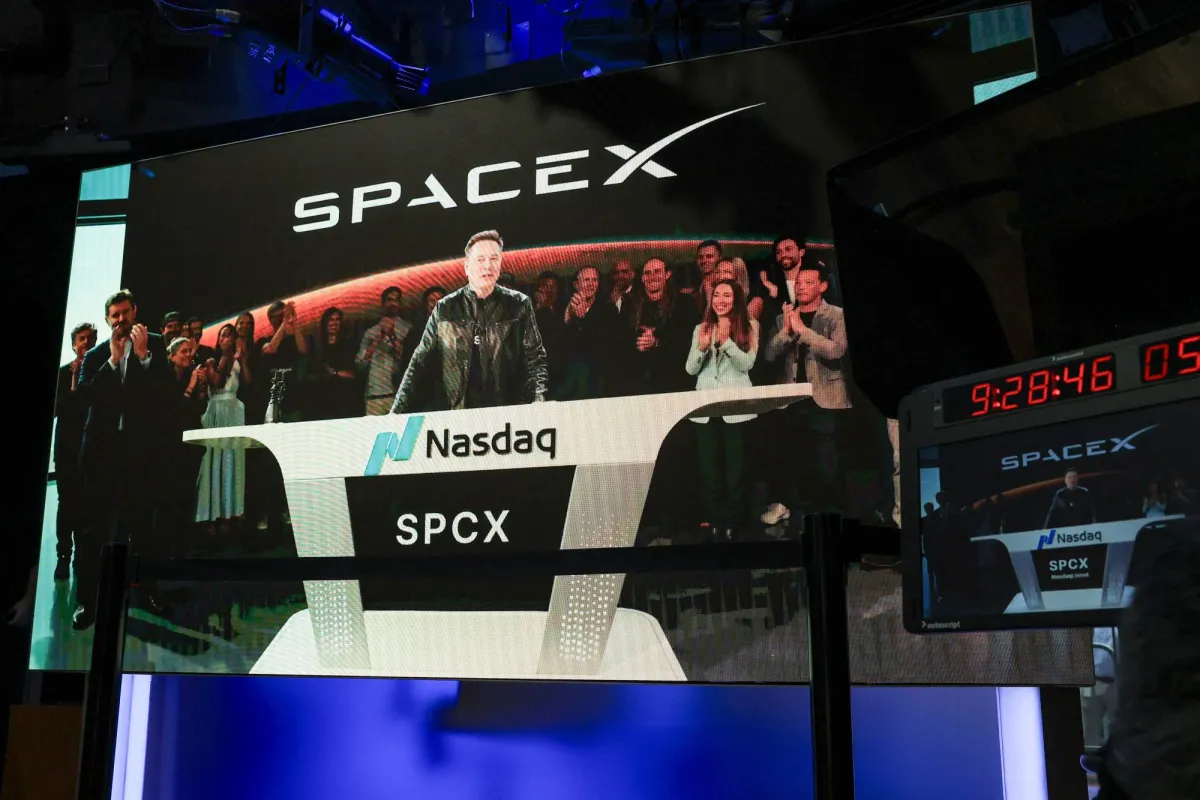
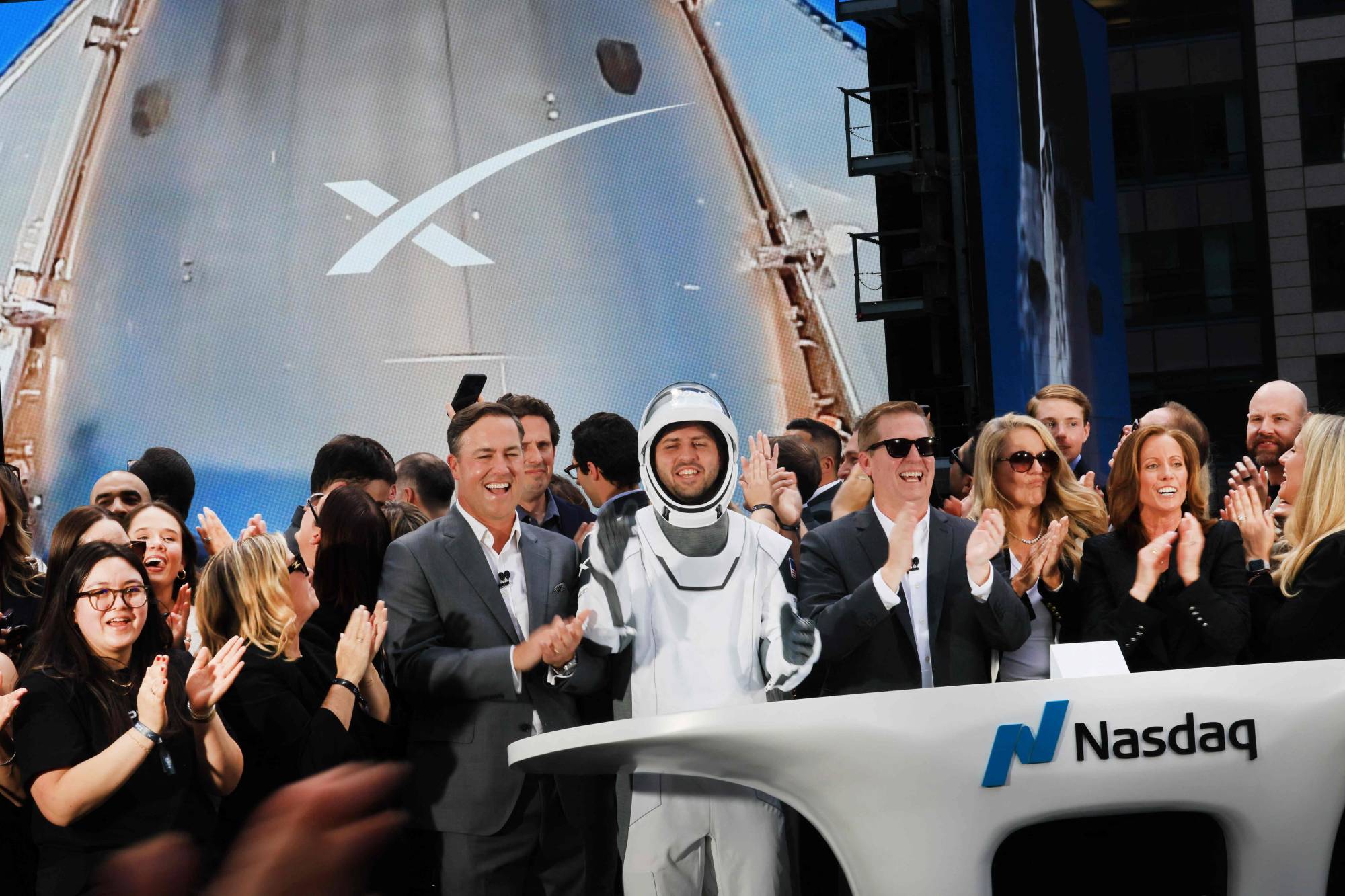
SpaceX shares began trading on Nasdaq at a market value of $1.78 trillion, turning Gulf capital’s role from market speculation into a documented fact.
Last-minute disclosures and the IPO prospectus revealed a striking economic reality: sovereign wealth funds and investors from Gulf Cooperation Council countries were not peripheral participants.
They were the backbone of the largest fundraising exercise in financial market history. This $75 billion deal made the Gulf a historic partner in shaping the future of space and artificial intelligence.
Global hedge funds saw their orders sharply cut after demand topped $250 billion. But Britain’s Financial Times, citing people familiar with the order book, reported that sovereign funds and family offices were given priority. SpaceX placed Gulf funds at the front of its list of strategic subscribers.
According to the newspaper, the official Gulf allocation put the region among the biggest subscribers.
Saudi Arabia’s Public Investment Fund, the Qatar Investment Authority and the Kuwait Investment Authority each received final allocations worth more than $1 billion. Those figures approached the scale of the $5 billion stake sought by US asset management giant BlackRock.
The rush was also driven by “fast-entry” rules approved by global index providers such as Nasdaq and FTSE Russell.
These rules allow shares to be added to major indexes, including the Nasdaq 100, within five to 15 trading days. For funds, securing stock from the first book became a preemptive fight.
The rise of the Kingdom’s stake
The case of Prince Alwaleed bin Talal and Kingdom Holding Co. offers the clearest example of how Gulf investors booked historic paper gains through long-standing strategic ties with Elon Musk.
It also gave practical meaning to Musk’s 2024 pledge, when he wrote on his platform: “Loyalty deserves loyalty,” promising priority to long-term investors.
The relationship began in 2011, when Prince Alwaleed invested $300 million in Twitter, now X. When Musk acquired the platform in 2022, Kingdom Holding and its chairman, Prince Alwaleed bin Talal, made a decisive call: they rolled over the stake instead of cashing out.
Later, as Musk merged X with his artificial intelligence startup xAI and then folded the combined entity under SpaceX, that historic holding was converted into direct equity in the rocket and satellite communications company, according to IPO documents.
The result was a dramatic paper gain. Kingdom Holding said in a separate official filing to the Saudi stock exchange that the estimated value of its joint stake with Prince Alwaleed had risen to more than $10.6 billion, based on the final IPO price of $135 a share.
The effect was not confined to the company’s books. The valuation quickly moved into the market, sparking a rally that sent Kingdom Holding shares on Saudi Arabia’s Tadawul exchange to their highest level in a decade.
The AI equation
The gains tell only part of the story. Published operating data and SpaceX’s combined deals show Gulf investors have shifted the rules of the traditional investment game.
Regional capital is no longer silent money waiting for dividends. It has become a strategic force, demanding the localization of advanced technology and the construction of computing and artificial intelligence infrastructure on Arab soil. The goal is knowledge transfer and digital sovereignty, not merely returns captured in Silicon Valley.
HUMAIN enters the picture
That strategy is clearest in the moves of Saudi Arabia’s HUMAIN, a company wholly owned by the Public Investment Fund and focused on providing comprehensive artificial intelligence capabilities globally.
According to the company’s official statement, HUMAIN invested $3 billion in xAI’s Series E funding round. The investment came just before SpaceX’s larger acquisition and merger in early February.
Under that transaction, HUMAIN’s stake was converted into declared, direct equity in the parent company, SpaceX, making it a significant minority shareholder with strategic weight.
The statement shows the partnership was not improvised. It followed a broad agreement signed in November 2025 during the US-Saudi Investment Forum.
Under the agreement, HUMAIN and xAI committed to jointly developing next-generation artificial intelligence infrastructure and data centers with more than 500 megawatts of computing capacity, while localizing and deploying advanced Grok models in Saudi Arabia.
At the time, HUMAIN Chief Executive Tareq Amin said the investment showed the company’s ability to deploy major capital behind exceptional technology platforms that combine technical excellence with long-term vision.
He said the merger of xAI with SpaceX’s vast infrastructure created a unique platform for accelerated growth and long-term investment value across four areas: next-generation technology centers, hyperscale cloud, advanced models and transformative AI solutions.
The United Arab Emirates built its own technology alliance along similar lines. Abu Dhabi secured a strategic seat through its specialized technology arm, MGX, in Musk’s merged entities, in cooperation with G42.
At the same time, it moved ahead with a large data center complex in Abu Dhabi, supported by parallel strategic partnerships, including a $15.2 billion investment commitment from Microsoft for Khazna, the group’s data center company.
Financial engineering and the space bet
Official data cited by Britain’s Financial Times set out the spending plan for the IPO proceeds. SpaceX will immediately use $20 billion of the gross proceeds to repay a bridge loan the group drew in March.
The loan covered debt tied to the integration of Musk’s artificial intelligence and social media businesses, xAI and X, under SpaceX’s financial umbrella.
The remaining liquidity, backed significantly by cash flows and Gulf billions from the top of the order book, will fund the next stage of growth.
At the center of those plans is a project Musk disclosed to the head of JPMorgan during the IPO roadshow and which the British newspaper reported: building artificial intelligence data centers in outer space.
The plan involves launching giant satellites with 70-meter wingspans as a strategic solution to the limits of Earth’s electricity resources.
Steel-like confidence
The scale of the Gulf position has drawn attention on Wall Street because SpaceX’s current numbers defy traditional market equations.
The company went public with a financial commitment that included repaying a $20 billion loan before the offering to cover obligations from the merged xAI and X businesses under SpaceX’s unified structure.
Its valuation was even more striking: 92 times annual revenue of $19 billion. In simple terms, standard market practice usually ties large-company valuations to current revenue. SpaceX’s market value therefore places it in a rare position among the world’s largest technology groups relative to the size of its existing business.
Even so, banking circles described the approach of Gulf sovereign wealth funds and family offices as a strategic vision that looked past conventional market concerns. Investment managers told the Financial Times they had offered Gulf clients financial hedging options as a standard precaution when trading began. All rejected hedging outright.
That stance reflects a more mature regional investment mindset. Gulf investors are no longer relying only on immediate readings and short-term indicators. They are trying to seize future monopolistic opportunities.
That view draws on forecasts by Goldman Sachs, the lead IPO manager, which predicted a 100-fold jump in SpaceX’s artificial intelligence revenue to $322 billion by 2030, allowing it to dominate a targeted global market worth $28.5 trillion.
In the end, SpaceX’s historic IPO showed that the region’s funds have become strategic partners with the power to impose operational conditions, localize future technology and shape a new financial geopolitical landscape stretching from the deserts of the Middle East to outer space.