
History is often kinder to leaders who build than to those who merely speak. From ancient Rome to post-war Europe, the true test of visionary leadership has rarely been eloquence or popularity, but the quiet permanence of infrastructure that outlives slogans. Roads, bridges and public works have always served as the most honest autobiography of governance.
Great leaders are remembered not because they promised transformation, but because movement became easier under them. Farmers reached markets. Children reached schools. Communities once isolated became visible. Infrastructure — especially roads — has long been the language through which power proves responsibility, particularly in societies where distance has historically functioned as a tool of exclusion.
In Nigeria, where politics is often heavy on narratives and light on endurance, the difference between leadership and performance is most visible on the ground. Asphalt does not lie. Drainage does not argue back. A road either lasts or it fails. It is within this lineage of practical leadership that the road revolution unfolding in Kaduna State, engineered by Governor Uba Sani, must be understood — not as propaganda, but as governance by execution.
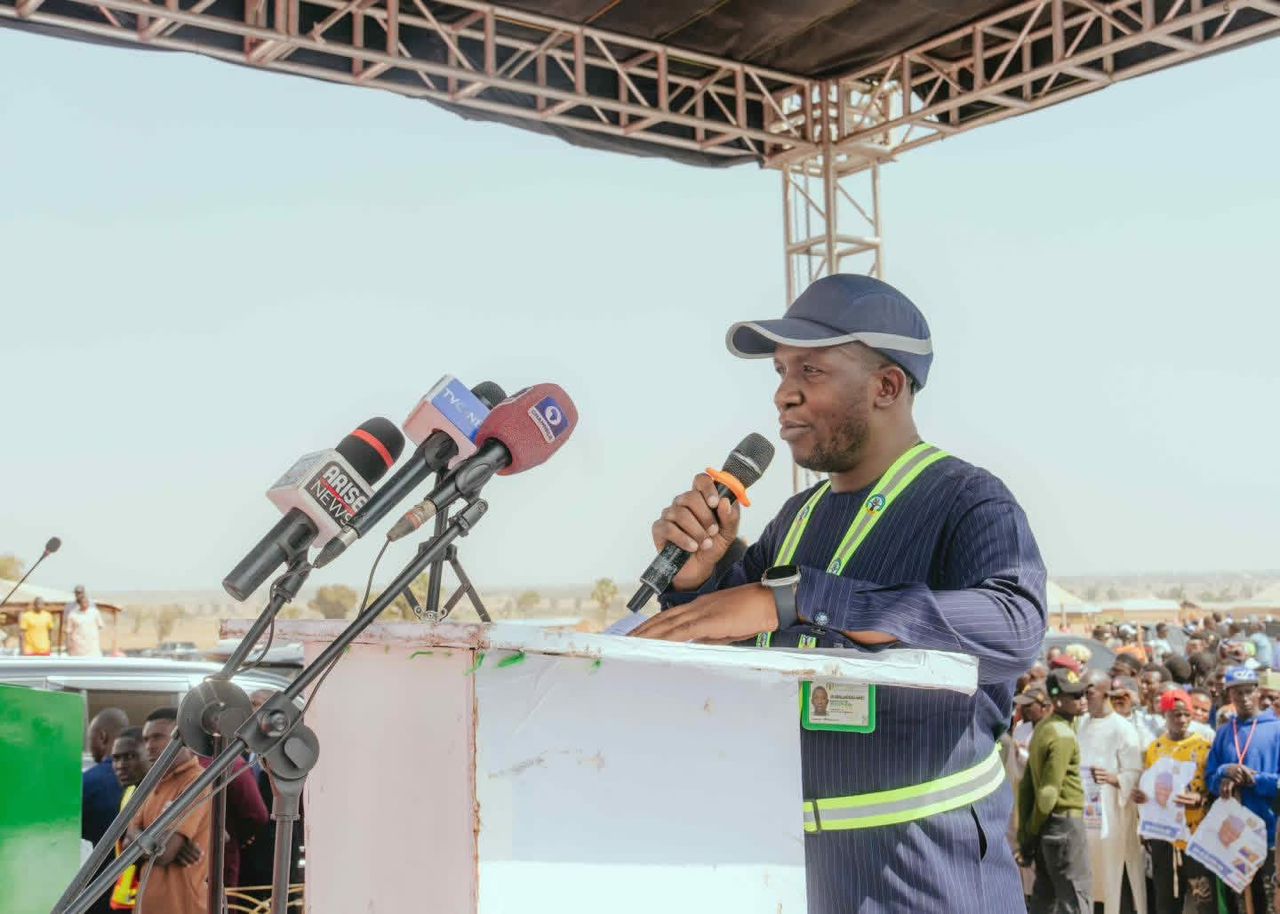
It is in this context that Dr. Abdullahi Baba Ahmed emerges, not as a headline-seeking public official, but as a technocrat whose work is measured in kilometres. Appointed in April 2024 as Managing Director of the Kaduna State Roads Agency (KADRA), he operates firmly within the development philosophy of his principal, Governor Uba Sani — an administration that has consciously chosen delivery over drama.
When Governor Uba Sani assumed office in May 2023, he inherited a state burdened by stalled projects, unpaid liabilities, unresolved compensations and roads abandoned at an average completion rate of about 30 percent. The temptation to discard the past and initiate entirely new projects was real. Yet, the administration chose the more difficult and responsible course: to fix what was broken and complete what had been left behind.
That decision is now visible across Kaduna.
Roads in Kakuri, Barnawa, Pan Drive, Raba–Rigasa and the Kabala–Aliyu Makama axis — once symbols of stagnation — have advanced decisively, many surpassing 65 percent completion as of December 2025. These corridors are not abstract lines on a map; they are lived spaces where daily life unfolds.
Kakuri and Barnawa anchor major industrial and densely populated residential communities. Pan Drive and Raba–Rigasa function as economic lifelines linking workers to livelihoods. Kabala–Aliyu Makama remains a vital urban artery. Their revival has restored movement, reopened businesses and renewed confidence in government capacity.
Beyond the urban centres, the administration’s footprint is even more pronounced, deliberately extending into rural Kaduna, where infrastructure deprivation once defined daily existence. One of the most consequential projects is the 35-kilometre Gadar Gayan–Gwaraji–Maraban Kujama asphaltic road, stretching from Gadar Gayan in Igabi Local Government Area, through Gwaraji in Kajuru, to Maraban Kujama in Chikun.
The road links three local government areas and cuts across 76 farming communities that endured decades of isolation. With a 130-metre bridge across River Kaduna, the project dismantled seasonal barriers that once dictated movement and commerce. Initiated in January 2024 and constructed by MotherCat Nigeria Limited, it stands as the longest asphalt road built in Kaduna State in over two decades, redefining connectivity at scale.
Yet, this is only one strand in a broader infrastructure web. Across the state, the administration has initiated more than 62 roads spanning over 700 kilometres within its first 16 months. Many have been completed; others are progressing steadily, strategically positioned to stimulate rural economies and curb rural–urban migration.
In Southern Kaduna, the impact is unmistakable. The 22.5km Gwantu–Kibam–Godogodo asphaltic road has reopened access across long-neglected communities. The 21.95km Madauchi–Kafanchan road now links Jema’a and Zangon Kataf LGAs with renewed ease, while the 35.6km Bagoma–Gagumi road has reconnected settlements previously cut off from economic opportunity.
Elsewhere, the reconstruction of the 6km Rafin Guza–Hayin Na’iya–Malalin Gabas–Kukumaki road has restored inner-community access that had deteriorated into impassable paths. In Soba Local Government Area, the 13km access road connecting Turawa to Dinya through Da’a, Kurungupi and Kadage has revitalised agricultural movement and eased transport burdens for farming households.
Further strengthening rural connectivity are the 5.8km Gwaraji–Wusar road linking Igabi and Kajuru LGAs, alongside the 15km Kasuwar Magani–Wusar road in Kajuru. Together, these roads now move produce more efficiently, reduce post-harvest losses and shorten journeys that once consumed entire days.
Within Kaduna metropolis, inherited urban neglect has not been ignored. The reconstruction and upgrading of access roads within Old Panteka Market have eased congestion in one of the city’s most economically vibrant hubs. The rehabilitation of Ja Abdulkadir Asphaltic Road in Unguwan Rimi has restored an important neighbourhood connector.
The construction of the 5.525km asphaltic road from Airport Road to Tudun Biri Community has extended infrastructure to growing outskirts, while the reconstruction of the 14.8km asphaltic ring road from Danbushiya Junction to Danhonou 2 has strengthened circulation within emerging residential corridors.
Equally significant is the completion of the long-abandoned PAN Drive to Kachia Road, alongside ongoing works on Ohinoyi Road and Sultan–Surami Road. These inherited projects, burdened with liabilities, now signal an administration willing to confront urban decay rather than defer responsibility.

Beyond conventional road construction, one of the most ambitious undertakings currently underway is the development of about fifteen interconnected networks of roads and bridges linking College Road in Unguwan Dosa to Millennium City. Structured under a Public-Private Partnership arrangement, the project is designed to connect hundreds of communities, unlock new economic corridors and reshape settlement patterns.
This expansive development is not accidental. It reflects a deliberate policy choice by Governor Uba Sani to govern Kaduna comprehensively, not in fragments. That policy finds disciplined execution through KADRA under Dr. Abdullahi Baba Ahmed, whose First-Class training in Quantity Surveying and advanced qualifications in Civil Engineering and Engineering Management bring technical rigour to public works delivery.
His background in procurement, project monitoring and regulatory institutions has instilled a culture of compliance, standards and completion. In a recent documentary on the administration’s infrastructure journey, he stated plainly that there are no abandoned projects in Kaduna State today. Evidence across active sites supports that assertion.
Roads once immobilised by unpaid compensations, contractual disputes and fiscal uncertainty have been renegotiated, funded and returned to construction. This required restraint, negotiation and political resolve — all traceable to a governor determined to clean inherited liabilities rather than create new ones.
Beyond asphalt, road projects have been paired with solar-powered streetlights, culverts and small bridges, particularly in flood-prone and security-sensitive corridors. These additions are not ornamental; they are functional decisions aimed at safety, durability and uninterrupted use.
In total, nearly one hundred roads spanning over 700 kilometres now define the administration’s infrastructure footprint. More importantly, these roads are built to last. Proper drainage, quality materials and supervision have replaced the era of cosmetic resurfacing. Longevity — not ribbon-cutting — has become the benchmark.
Dr. Abdullahi Baba Ahmed’s role within this framework is clear. He is not a solitary hero, but a disciplined executor within a defined chain of responsibility. The vision belongs to Governor Uba Sani; the roads exist because that vision is enforced, monitored and technically delivered.
In an era crowded with explanations and excuses, Kaduna’s roads under Governor Uba Sani speak with uncommon clarity. They affirm that governance can still be practical, fair and measurable. The contrast between past stagnation and present movement is not rhetorical — it is geographical.
From Kakuri to Barnawa, Pan Drive to Raba–Rigasa, Kabala through Aliyu Makama, Gwantu to Godogodo, Gadar Gayan to Kujama, Madauchi to Kafanchan and the expanding corridors of Millennium City, asphalt has become the language of governance in Kaduna.
Each completed stretch corrects years of imbalance and redefines inclusion within the state’s development imagination. These roads are not symbolic gestures. They carry traders to markets, workers to offices, students to schools and emergency services to communities that once waited helplessly for access. Their daily utility remains their strongest endorsement.
Over time, their impact will deepen. Settlement patterns will evolve. Local economies will expand. Transport costs will fall. Security response will improve. Trust between government and citizens will grow — not through persuasion, but through consistency.
Kaduna’s experience reinforces an enduring lesson: leaders who build durable systems rarely need to advertise their intentions. Their work announces itself each morning through ease of movement, reduced friction and restored dignity in everyday life.
Within this context, Dr. Abdullahi Baba Ahmed stands as a professional custodian of a broader political will, demonstrating what happens when technical competence meets clear executive direction — and when public institutions function as instruments of delivery rather than platforms of politics.
Ultimately, the credit rests with the visionary, pragmatic and determined Governor Uba Sani, who chose the less glamorous but more consequential path of fixing what was broken, completing what was abandoned and spreading development without regard to religion, geography or political loyalty.
Long after this administration ends, these roads will remain as records of intent. They will outlive debates, survive transitions and continue serving generations who may never know the circumstances under which they were built — but who will benefit from their endurance.
Like the visionary builders of history whose legacies were measured in stone, steel and passageways rather than speeches, this chapter of Kaduna’s story will be remembered not for narratives crafted, but for roads laid, communities reconnected and a state quietly set in motion again.
— Umar writes from Kaduna.