

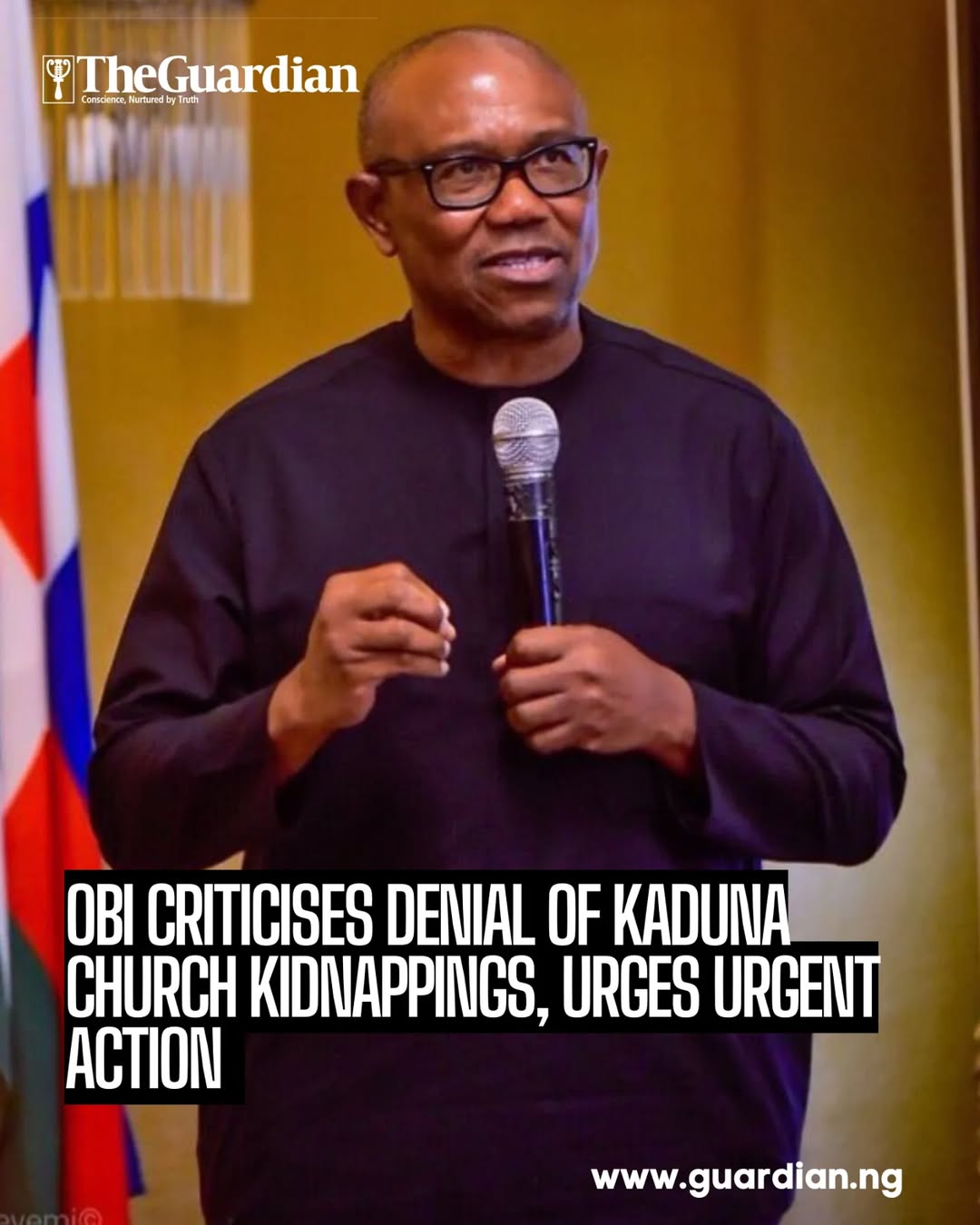
Former presidential candidate and chieftain of the African Democratic Congress (ADC), Peter Obi, has urged the federal and state government to act promptly in securing the release of the 177 worshippers abducted from churches in Kurmin Wali, Kajuru Local Government Area (LGA), Kaduna State, over the weekend.
The incident, which was initially denied by the police and other state officials, has drawn domestic and international attention and stressed the ongoing security challenges across Nigeria.
In a statement on X, Obi questioned early denials of the attack and the threats made against those reporting it.
“Since it has now been confirmed that over 150 worshippers were kidnapped from churches in Kaduna, where and how did those who denied the incident initially get their information? And since those who deny threatened to punish the people said to be spreading falsehood, who now face the punishment?” he asked.
Obi described leadership as requiring visible presence and decisive action when lives are at risk.






Divide Nigeria now to save lives
Agbotikunyo
Noise maker
I can see the slaves crawling mouth of their hole as usual to castigate common sense. Tinubu 20k can render senseless
As if you care. 2027 and nothing else. It’s only a blind person that will say Tinubu is not trying on the issues of insecurity in the north.
Mr. Agbotikuyo, what have done or suggest to better the situation than your usual destructive criticism.
All these APC hitting on Peter, are they supporting the kidnapping or what?
Gringori has crawled out of his hole to come and cap🤏🤏
Obi of the media
Are you not thier sponsor
PBAT’s Steady Hand: Repositioning Nigeria for Long-Term Prosperity
President Bola Ahmed Tinubu’s administration has demonstrated uncommon political courage in confronting Nigeria’s long-standing structural challenges head-on.
Rather than postpone difficult decisions for short-term applause, the government has chosen a reform-driven path aimed at restoring macroeconomic stability and national confidence.
From the onset, PBAT made it clear that governance would be anchored on realism, competence, and a firm commitment to national renewal.
One of the most defining actions of the administration has been the bold reform of Nigeria’s fiscal and monetary architecture. The removal of the unsustainable fuel subsidy, though initially painful, marked a turning point in freeing national resources for more productive use.
Coupled with efforts to unify the foreign exchange market, these reforms are laying the groundwork for transparency, investor confidence, and a more competitive economy. Such decisions reflect leadership that prioritizes the future over populism.
On the economic front, the PBAT administration has shown a clear focus on growth, job creation, and private-sector participation. Policies aimed at boosting local production, attracting foreign direct investment, and strengthening small and medium-scale enterprises signal a strategic shift from consumption to productivity.
Infrastructure development, particularly in transportation, energy, and digital connectivity, continues to receive attention as a catalyst for inclusive economic expansion.
Security and national cohesion have also remained central to the administration’s agenda.
Through enhanced coordination among security agencies and renewed engagement with subnational governments, there is a deliberate effort to address insecurity in all its forms. Beyond kinetic responses, the government recognizes the importance of economic opportunity, social inclusion, and good governance as long-term solutions to instability.
PBAT’s administration represents a governance philosophy rooted in experience, pragmatism, and reform. While challenges remain, the direction is clear: a Nigeria that is fiscally responsible, economically resilient, and globally competitive.
Ultimately, history often favours leaders who take tough decisions at critical moments, and Tinubu’s tenure is steadily positioning Nigeria for a more sustainable and prosperous future.