

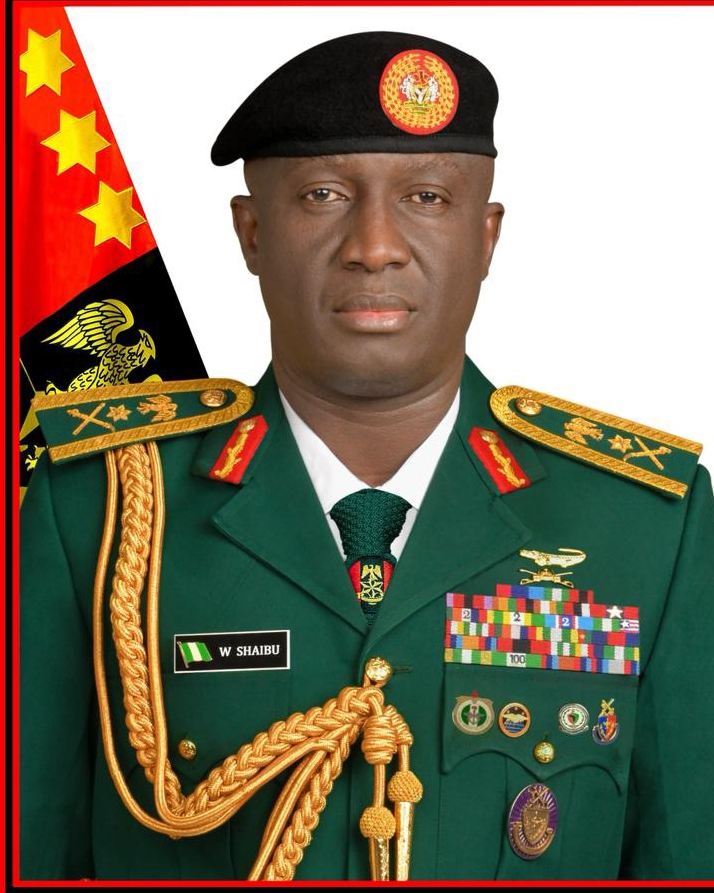
News Analysis by Sumaila Ogbaje, News Agency of Nigeria (NAN)
When Lt.-Gen. Waidi Shaibu became the 25th Chief of Army Staff (COAS) on Oct. 30, 2025, expectations were immediate, intense, and uncompromising.
He assumed command amid a highly complex security landscape.
For instance, the North-East continues to grapple with a protracted insurgency, while the North-West faces escalating banditry and kidnappings.
At the same time, persistent farmer-herder clashes in the North-Central and separatist tensions in the South-East, combined with widespread insecurity, have tested both operational capacity and public confidence.
For any new Army Chief, the first 100 days rarely produce dramatic battlefield victories.
Instead, they reveal leadership style, command priorities, and strategic direction.
In Shaibu’s case, his early tenure shows a command philosophy anchored on visibility, operational consistency, urgency, and troop welfare.
Shaibu inherited not just an Army at war, but one under intense scrutiny.
Meanwhile, communities affected by violence demanded relief, political leaders faced pressure, and frontline troops contended with adaptive adversaries exploiting terrain, intelligence gaps, and logistical weaknesses.
Thus, his immediate challenge was to establish authority and credibility; internally among officers and soldiers, and externally with a watchful public.
Leadership by presence has defined his early approach.
Shaibu visited frontline formations in the North-West and North-East, engaging with troops, inspecting bases, and holding candid discussions with field commanders.
During one early visit, he told soldiers: “Failure is not an option. The Nigerian Army must take the fight to the enemy and sustain the pressure”.
He also emphasised discipline and accountability.
“Success in internal security operations comes not from headline victories but from sustained, consistent operations.
“Every officer and soldier must understand that excellence is non-negotiable, but it cannot be demanded without the tools to achieve it,” Shaibu said.
For troops operating under austere and often dangerous conditions, such visibility and direct communication carry significant weight.
It signals that leadership understands the risks and sacrifices inherent in frontline duty, boosting morale and reinforcing performance expectations.
Within military circles, these visits have been widely interpreted as a reminder that initiative, accountability, and operational excellence matter at every level.
Unlike some transitions accompanied by sweeping doctrinal pronouncements, Shaibu’s approach has been restrained in rhetoric but firm in execution.
Instead of unveiling entirely new strategies, he has focused on tightening existing operations, closing gaps, and enforcing discipline.
Commanders have been directed to prioritise sustained operations over episodic offensives, with emphasis on denying armed groups freedom of action, disrupting logistics networks, and degrading command structures.
Intelligence-led operations have been repeatedly highlighted.
Shaibu stressed the need to “reduce predictability and adapt tactics to evolving threats,” reflecting an understanding of the fragmented and adaptive nature of Nigeria’s security challenges.
Troop welfare, logistics, and equipment have also been central to his messaging.
Shaibu openly acknowledged constraints, from equipment shortages and maintenance backlogs to supply chain inefficiencies.
“You cannot demand excellence from soldiers without giving them the tools to succeed,” he told officers and troops during one visit.
Although systemic logistics challenges cannot realistically be resolved within 100 days, his early emphasis on these issues has resonated within the ranks, signalling that welfare and sustainment are now core command priorities.
Professionalism and discipline remain non-negotiable pillars.
Troops are reminded to adhere to rules of engagement and respect civilian populations, especially in complex internal security operations where the line between combatant and non-combatant is blurred.
Shaibu noted, “Operational success and public trust are inseparable. The Nigerian Army must protect civilians even as it neutralizes threats”.
Civil-military relations and strategic communication have also been emphasised.
At a time of heightened public scrutiny, the Army under Shaibu has sought to balance operational secrecy with transparency, explaining actions that affect civilians and reinforcing that modern conflicts are fought not just on the battlefield but also in the court of public opinion.
Albeit early momentum, entrenched challenges remain.
Nigeria’s vast terrain, multiple threat groups, intelligence gaps, and resource constraints continue to shape operations.
Analysts caution that leadership tone and presence alone cannot secure durable gains.
Therefore, institutional reforms, improved inter-agency coordination, intelligence fusion, technological upgrades, and sustained political support are critical.
A military scholar and Publisher of OurNigeria News Magazine, Dr Sani Abubakar describes Shaibu’s early tenure as “reassuring and energising”.
He praises the COAS’s combat credibility, operational boldness, and focus on troop welfare.
According to Abubakar, Shaibu’s operational philosophy centres on sustained dominance of the battlespace, intelligence-led targeting, and uncompromising control of reclaimed terrain, principles critical to breaking cycles of retreat and resurgence by armed groups.
Among the early gains cited by Abubakar are the neutralisation of numerous terrorist elements and the surrender of others weakened by sustained pressure.
He also commends Shaibu’s emphasis on sound administration, especially fairness and transparency in postings and appointments, which is gradually restoring confidence within the officer corps and rank and file.
Reflecting on Shaibu’s career, Abubakar said, “He is a thoroughbred, no-nonsense officer who led from the front and was unflinching in confronting Boko Haram terrorists.
“His insistence on integrity, accountability, and merit-based leadership comes from experience at every level of command”.
Looking ahead, Abubakar advises deeper investment in human intelligence (HUMINT) and greater use of unmanned aerial vehicles (UAVs).
He also stresses the need for a sustained focus on security sector governance reforms; measures he says are essential for efficiency and professionalism within the Army.
At 100 days, Shaibu’s tenure is defined more by direction than outcomes.
Communities affected by violence will now judge him by tangible results; fewer attacks, improved protection, and restored public confidence.
Officers and soldiers will assess whether leadership intent is matched by resources, reforms, and consistent follow-through.
Ultimately, whether this early momentum yields lasting security gains will depend on how effectively intent is translated into institutional capacity and sustained action.
For now, the clock is ticking, and the mission is far from over. (NAN)
* **If used, please credit the writer and the News Agency of Nigeria.