
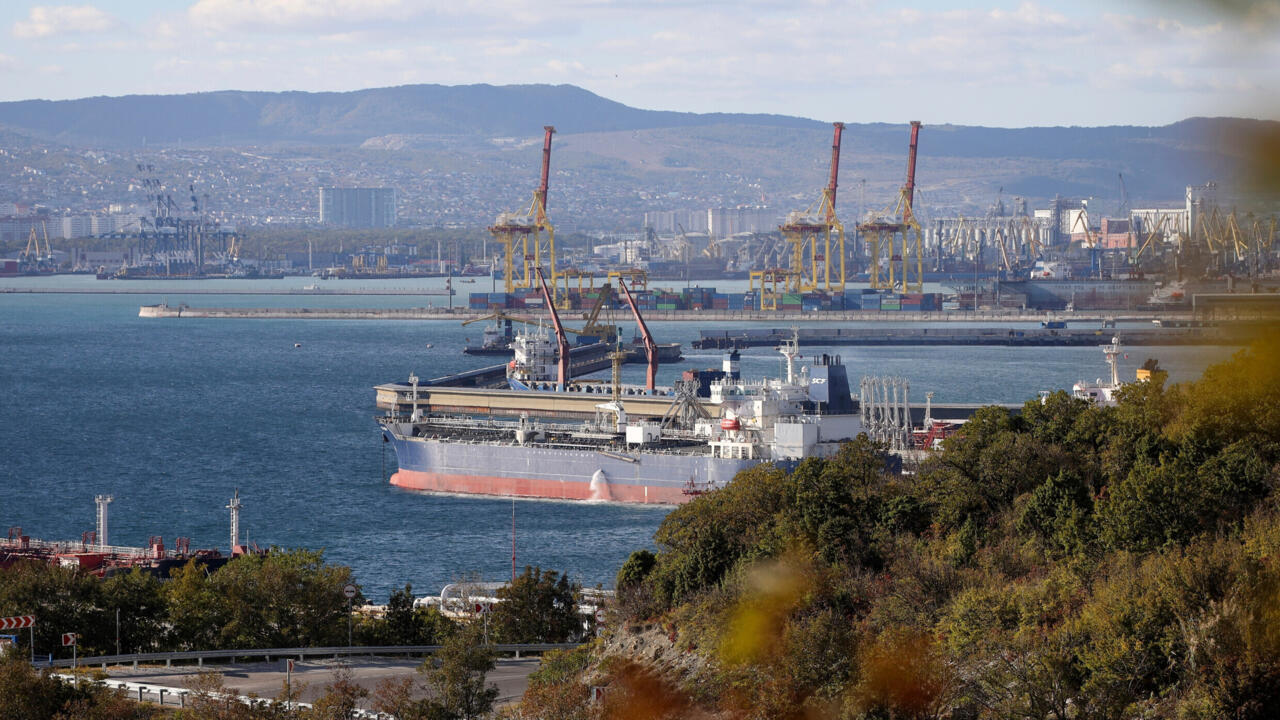
Across the world’s vast oceans, more and more tankers bearing crude oil drawn from the Russian soil have begun to sit idle in the water.
Reuters estimates suggest 19 million barrels of Urals crude loaded before December 15 are still in transit as traders deliberately slow their journeys, struggling to nail down buyers amid declining demand.
And where the oil does flow, it’s bringing in less and less in return. Last year, Russia’s revenue from oil and gas sales dropped by about a fifth to their lowest point in five years.
That Russia is getting less and less money from flogging fossil fuels is not in itself surprising – a global glut of crude has pushed oil prices down all over. On top of that, a strong rouble means that Moscow is getting less in its own currency for each dollar it earns from its exports.
But years of Western sanctions, including US President Donald Trump’s decision in October to target Rosneft and Lukoil – Russia’s two largest oil exporters – also appear to be increasingly eating into Moscow’s much-needed oil rents.
Under pressure
Since the October sanctions, the discount at which Russia is forced to sell its oil to tempt trading partners to risk taking sanctioned crude has doubled. In December, the country’s Urals crude fell below $40 a barrel – its lowest point since global oil prices plummeted in the early days of the Covid-19 pandemic.
Taken with the outgoing Biden administration’s decision in January to impose sanctions on the country’s third- and fourth-largest oil exporters, four-fifths of Russia’s oil production is now under US sanctions.
And unlike earlier sanctions, these latest measures hit not just the named companies themselves, but anyone doing business with them.
Alexander Kolyandr, a financial analyst and a senior scholar at the Center for European Policy Analysis, said that the secondary sanctions imposed by Trump threatened to cut companies receiving Russian oil off from the US-run financial infrastructure that underpins much of the global economy.
Read moreFour more years? Russia-Ukraine war nears two million casualties mark
“The main feature of the American sanctions is that the United States, unlike Europe, is ready to apply secondary sanctions – in other words, if the United States sanctions you, and I trade with you, the US feels within its rights to fine or sanction me,” he said.
“We saw that, for example, in China, the main buyer of the Russian oil was not the state-owned companies or large companies, but rather, what’s called ‘teapot refineries’ – small refineries which get sanctioned oil, refine it and then sell it. They have no exposure to the United States, and they can risk it.”
Ruling the waves
Targeting Russia’s oil rents has been a core strategy of Western governments’ economic response to the full-scale invasion of Ukraine. In the months that followed the Russian advance, European Union and Group of 7 countries imposed a “price cap” on Russia’s seaborne oil exports.
The cap effectively banned commercial operators based in EU or G7 countries from transporting Russian oil – or providing insurance or other financial services to those who did – unless it was sold for less than a fixed price.
Originally set at $60 a barrel, the price cap will fall to under $44 a barrel as of February 1.
Ukraine steps up campaign to strike deep into Russia
One of your browser extensions seems to be blocking the video player from loading. To watch this content, you may need to disable it on this site.
Catherine Wolfram, the William Barton Rogers professor of energy economics at MIT’s Sloan School of Management, said that the price cap had been designed to avoid a sudden spike in oil prices that could have been triggered by keeping Russian oil off the world market altogether. Russia is the world’s third-largest producer of oil.
“The price cap was designed to A, drive a wedge between the global price and what Russia received for its oil, and B, keep oil on the market – especially in 2022 when oil prices were very high and inflation was running rampant,” she said. “It succeeded with B. With A, it drove a bit of a wedge, but the Trump administration’s actions on Rosneft and Lukoil widened that wedge.”
To sell its oil at higher prices, Russia has become increasingly reliant on what some have dubbed a “shadow fleet” of ageing commercial oil tankers of unclear ownership.
Read moreSinking Russia’s ‘shadow fleet’: Has the Ukraine war reached Senegal?
Earlier in January, the French navy boarded an oil tanker in the Mediterranean and forced it to dock in Marseille. The captain who, like all members of the crew is an Indian national, has been taken into custody. French President Emmanuel Macron accused the tanker of helping to “finance Russia’s war of aggression against Ukraine”. He was released from custody on Monday.
“We see a mounting campaign against Russia’s shadow fleet – it seems that both the Americans and the Europeans are ready to up the ante and start seizing these ships, which increases the cost of transportation,” Kolyandr said. “It all results in the buyer’s attempt to push prices lower. That’s where the discount is coming from.”
Increasingly cut off from Western markets, Moscow initially found willing buyers in India and China, where refiners have jumped at the chance to buy Russian crude at bargain prices.
But Daniel Spiro, an associate professor at the department of economics at Sweden’s Uppsala University, said that the latest US sanctions seemed to have spooked even these once-eager buyers.
“For maybe the first time, it seems to have affected India’s and China’s willingness to buy Russian oil,” he said. “India decreased the volumes and China seems to have demanded a higher discount on the oil it buys. And this hasn’t really been the case previously.”
Fire sale
Another casualty of these sanctions has been Lukoil’s extensive overseas assets. Founded in the frantic privatisations that marked the former Soviet Union’s wrenching transition to a market economy, Lukoil is believed to have some $22 billion worth of assets across the world, including in Iraq, Egypt, Nigeria and Mexico.
This week, the company announced that US private equity titan the Carlyle Group had agreed to buy up these assets – except for those in Kazakhstan – for an undisclosed price. The deal would require final approval from the US Treasury.
Spiro said that while the sale would likely eat into Russia’s oil and gas revenue, it would nevertheless boost the country’s critical foreign reserves.
“Presumably they do that at a low price compared to if this would have just been any regular market exchange,” he said. “So it is reducing the profits from oil and gas for Russia, but it is increasing the money they have – because they sold it off.”
He said that it was unclear what impact the sale would have on Russia’s vast oil and gas industry.
“Sanctions are a cat-and-mouse game – somebody imposes sanctions on Russia, and initially, they can be quite painful,” he said. “And Russia, of course, tries to avoid it in some way. For all I know, it could be that when they sell these assets, they use the money to invest in oil and gas production in Russia.”
Wolfram said that the planned sale was partly born from financial necessity.
“This feels like eating your seed corn, but Russia really needs the funds now,” she said.
Russia’s shrinking oil revenues risk eating into the wider state budget.
Oil and gas revenue made up less than 23 percent of the federal budget by the end of 2025 – something not seen for 20 years. With government spending outstripping revenue, last year’s budget deficit ended up around 2.6 percent of GDP.
To make up for the shortfall, the Russian government has already begun increasing a range of domestic taxes, including raising VAT to 22 percent – as well as the threshold under which small businesses are exempt from paying it.
Spiro said that declining oil and gas revenues would push the government into making difficult decisions.
“Russia has a few choices. They can raise other taxes – that has a cost, and it’s not going to be popular,” he said. “Or they need to increase government take in Russian oil and gas, but it’s already quite high – I don’t think there’s a lot of margin to move on there. Or it has to reduce spending.”
Ukraine city of Kherson protects itself from drones with French fishing nets
One of your browser extensions seems to be blocking the video player from loading. To watch this content, you may need to disable it on this site.

While Russia’s war-time economy has driven up wages in some of the country’s poorest regions as workers man the production lines of a growing military-industrial complex, the overall economic situation is less rosy.
Economic growth has slowed as the central bank cracks down on inflation with double-digit interest rates, and social spending has already been slashed from 38 percent in 2021 to 25 percent this year.
“There’s essentially two ways it can reduce spending – either reduce the war effort or reduce pensions and things like that,” Spiro said. “One of the key questions since the full-scale invasion has been, how far can the Russian government push its economy – or essentially push the costs onto its population.”
Ultimately, though, Kolyandr said it was unlikely the rising cost of Western sanctions would impact Putin’s determination to continue the nearly four-year war in Ukraine.
“Those decisions can only be made by Putin himself if he decides to wind down the war,” he said. “And I think his priorities are pretty clear – that the war and all this geopolitical struggle has priority. That the Russians had a couple of years of pretty good economic growth, and they can suffer a little bit. I don’t think that it will derail his ideas.”