

Shiba Inu’s token burn rate surged by 2,807% in the past 24 hours, sparking widespread discussion across cryptocurrency communities. The percentage increase appears substantial at first glance. The actual impact on SHIB’s market fundamentals remains negligible.
Approximately 18.8 million SHIB tokens were removed from circulation during this period. Social media channels celebrated the development as a bullish signal, but market data tells a different story.
The Numbers Don’t Add Up
Shiba Inu’s circulating supply exceeds hundreds of trillions of tokens. Burning 18.8 million units represents a fraction so small it becomes statistically insignificant. The reduction accounts for less than 0.00002% of the total supply.
Even sustained daily burns at this rate would require decades to create measurable supply compression. The math simply doesn’t support the narrative that such activity drives meaningful price appreciation.
The burn mechanism itself lacks systematic implementation. Transactions remain small, voluntary, and scattered. No protocol-level changes have been introduced to automate or enforce token destruction at scale.
This stands in stark contrast to deflationary models employed by networks like Ethereum. ETH burns transaction fees automatically through its base fee mechanism. The process is predictable, substantial, and built into network operations.
SHIB’s burns depend on community participation and manual wallet sends. They carry no economic weight comparable to programmatic supply reduction.
Price Action Contradicts the Hype
Market performance provides the clearest evidence that burn activity isn’t influencing SHIB’s value. The token continues trading below critical moving averages. Technical indicators show no reversal pattern forming.
Volume remains weak across major exchanges. Recent attempts to establish upward momentum have failed to generate follow-through. Price consolidation persists within a defined downtrend.
If token burns were creating genuine scarcity pressure, markets would respond. Buyers would accumulate in anticipation of a tightening supply. Trading volume would expand as participants positioned for appreciation.
None of these signals is present. SHIB trades with the same characteristics it displayed before the burn rate increase. The correlation between burn announcements and price movement is essentially zero.
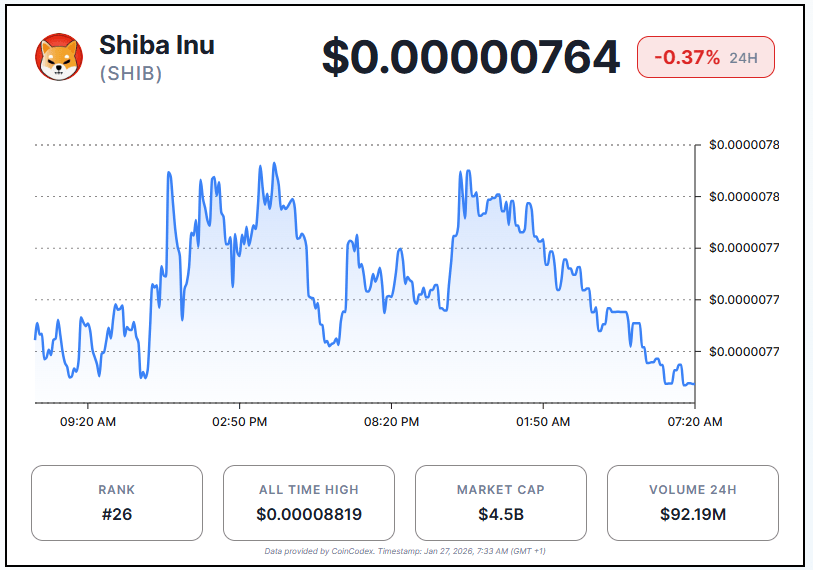
SHIB has dropped 0.37% over the last 24 hours, trading around $0.00000764 at the time of writing.