

First comes the coin that suddenly seems to be everywhere, literally, everywhere. On TikTok, in Instagram Reels, in X threads, with someone or the other declaring “why this is the next 100x.” Then the chart points upwards, before the search bar fills up with people trying to work out whether they are early or already late.
Waiting suddenly feels less like patience and more like a mistake. Weirdly enough, crypto’s version of a deadline does not arrive in an email. It arrives as a green candle, usually while the market is still open at 3 a.m., right after you told yourself you would stop checking the chart.
THIS is Fear of Missing Out or FOMO! A tidy acronym for a rather disorderly process that falls neatly under Gen Z psychology.
It makes the problem sound personal and simple. As if the whole episode begins and ends inside an investor’s head and revolves around a harmless TikTok or a trading app.
But wait, it is not that simple. Because the market is far from tidy.
This is what AMBCrypto found after it looked into July 2026’s Bitcoin rally. Whether it was search interest or trading volume or Open Interest or even the price, the signals did not move as one clean wave. Instead, they arrived in stages.
So maybe the actual food for thought is — Crypto FOMO might start as a private feeling, but the market gives it public footprints. In the form of a search spike, a delayed volume surge, a swelling derivatives book and eventually, a forced exit.
Hence, the question — What happens when the fear of being late meets a market that never closes?
Where does crypto FOMO actually begin? Conviction or visibility
The first encounter with crypto rarely takes the form of a prospectus. It’s in the form of a feed, a chart, an influencer, or a friend forwarding a post that begins with some version of “you’re still early.”
For example, a survey of 176 Gen Z crypto investors in Indonesia found that higher FOMO scores tracked with more active, more impulsive investment decisions.
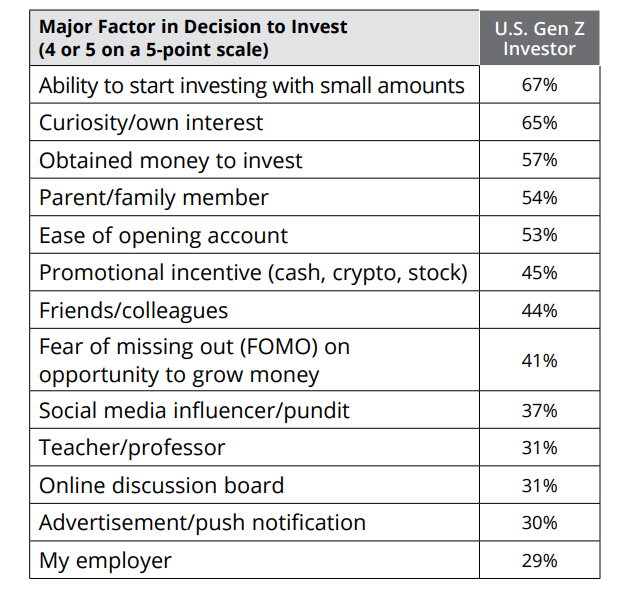
In a similar effort, the CFA Institute and FINRA data put a number on where those feelings originate. They found that 55% of U.S Gen Z investors hold crypto, 48% learned about it on social media, and 37% named a specific influencer or pundit as a factor in getting started.
CoinGecko’s report on TikTok’s memecoin audience adds some demographic texture too. It found that 56% of engagement with the #memecoin hashtag comes from viewers aged 18 to 24.
Now, none of this proves a single viewer saw a post and opened a Binance account. However, it does show which road most of them walked in on.
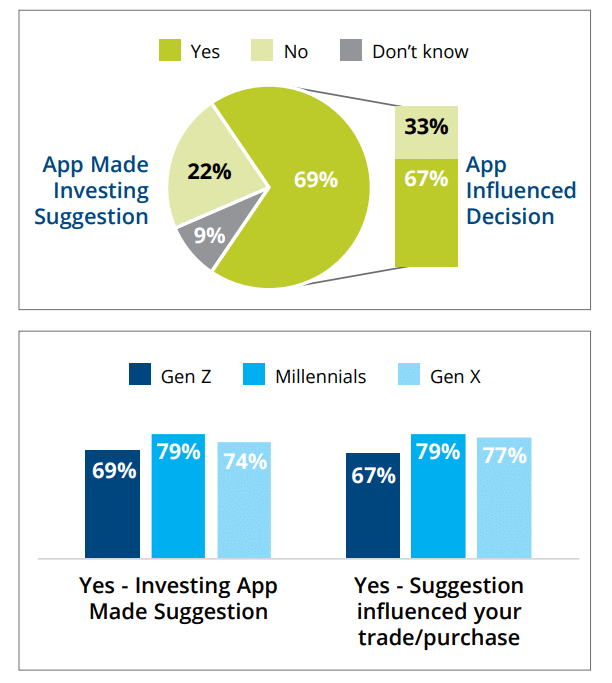
That bias itself is older than TikTok.
According to Bitget CEO Gracy Chen, FOMO is “more of a human bias than crypto.” That is a useful distinction because crypto did not invent the fear of missing a winning trade. It merely gave that fear a market that remains open at all hours, with information moving faster than most people can evaluate it.
A green candle can now do the work of a sales pitch.
Dr. Panagiotis Andriotis (Birmingham) and Dr. Essam Ghadafi (Newcastle) also examined thousands of TikTok videos and comments to find that explicit risk disclosures are rare and mostly confined to trading-heavy content. AND… even that’s a floor estimate since their method only accounted for text, captions, and transcripts, not what was muttered on screen or flashed for 2 seconds as a disclaimer.
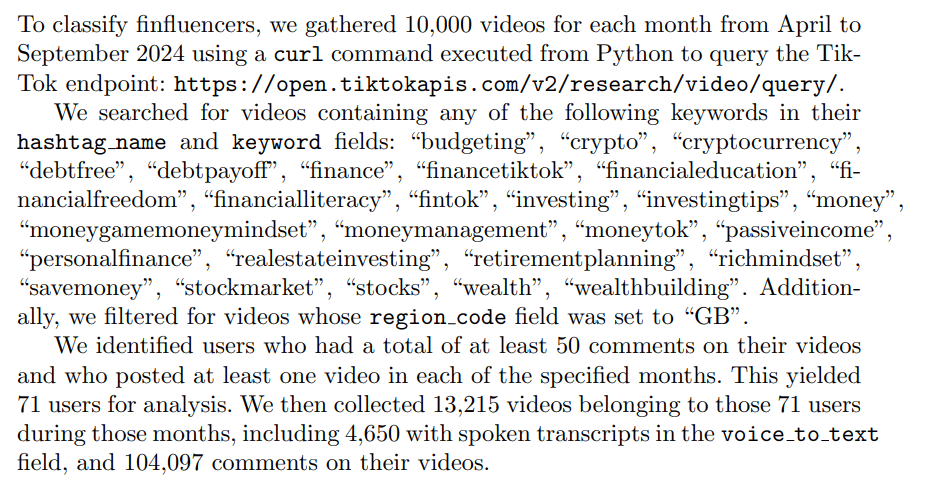
Dr. Andriotis described the result as “algorithmically reinforced financial behavior.” It basically means that once a creator learns which stories attract engagement, the platform keeps rewarding those stories. Soon, viewers encounter the same confidence from several directions.
Ultimately… high engagement begins to look like consensus. Is it though?
When does crypto FOMO become visible in market data?
Market data arrives after the feeling. It misses what a trader felt while staring at a chart. It does not account for hesitation, regret, or the moment someone decides to “just check one more time” before clicking buy.
What it can do is show the residue those decisions leave behind.
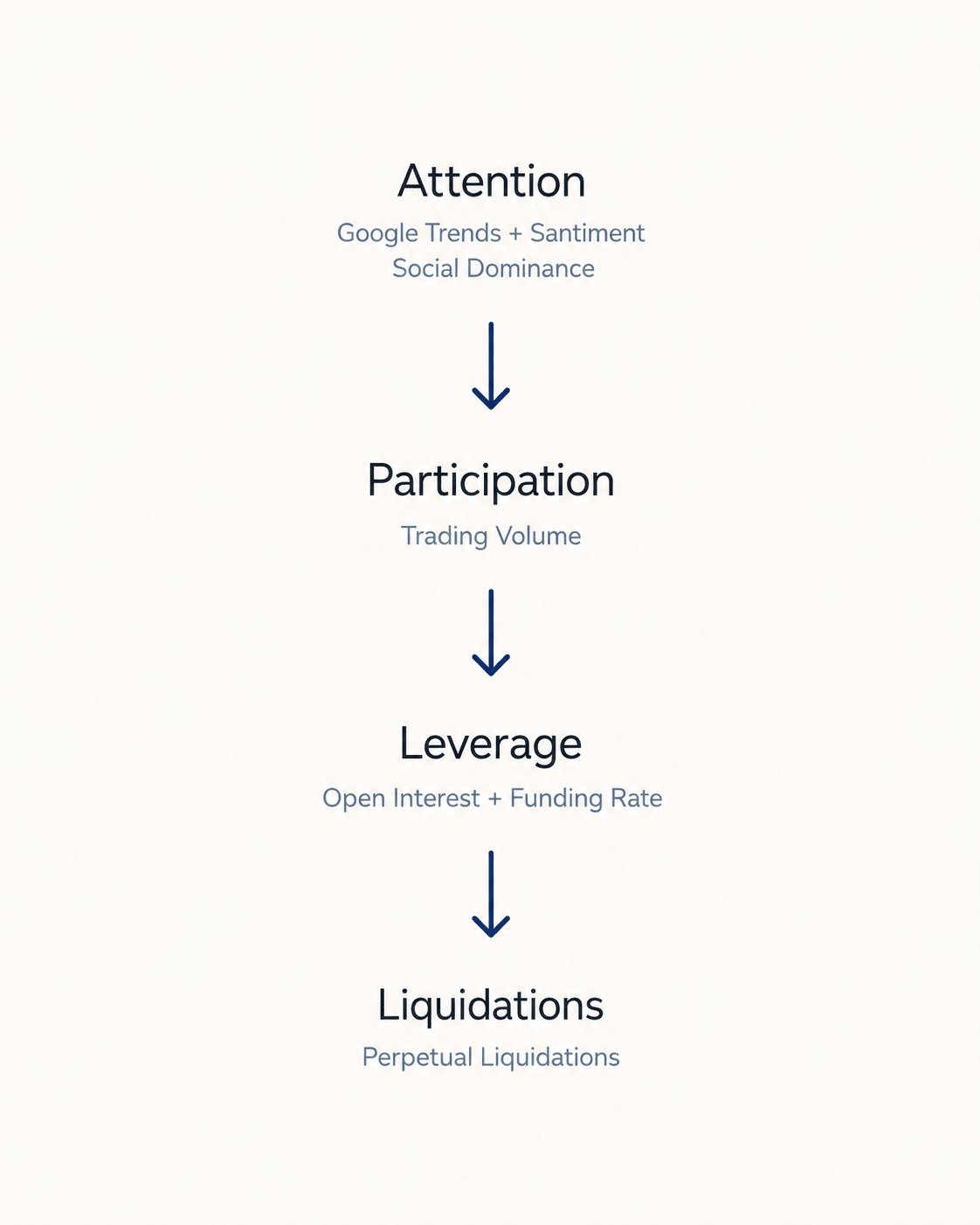
Google Trends records searches. Trading volume captures activity, not intent. Open Interest reflects how much derivatives exposure is sitting in the system. Funding Rates hint at which side is willing to pay to stay positioned. Liquidations show where leverage stopped being optional.
So, do the indicators arrive in an order that resembles the behavior FOMO is expected to produce?
Does Bitcoin search interest rise before or after price rallies?
If FOMO is a pipeline rather than a feeling, then Bitcoin is the cleanest place to test whether attention actually leads price, or merely shadows it. July 2026’s rebound offers a controlled enough window to observe that sequence without too many competing narratives interfering.
The question is whether search interest led the price high or simply followed it.
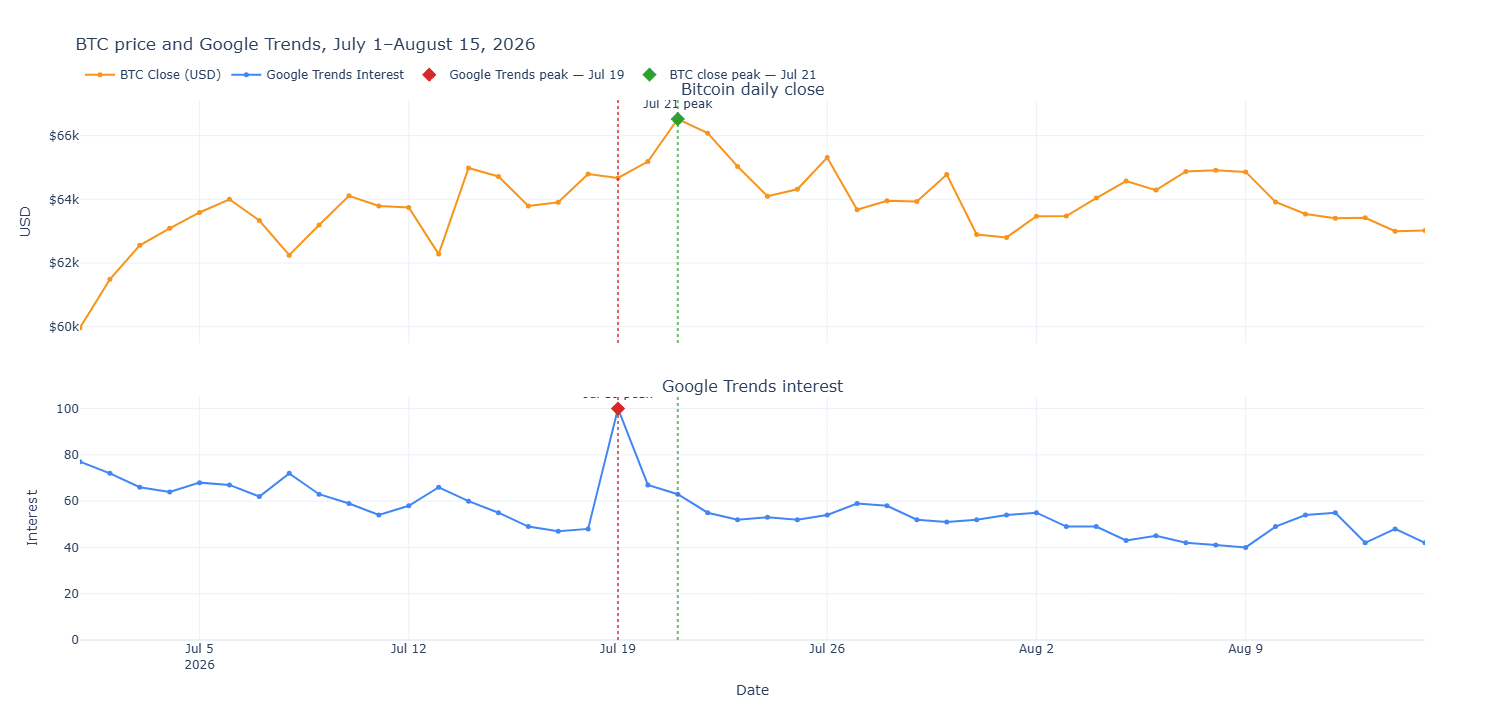
From 1st to 21st July, Bitcoin’s spot price rose by 10.9% from $59,968 to $66,521. Over the same period, worldwide Google Trends interest for “Bitcoin” increased from 77 to 100, a rise of about 29.9%.
The timing carries more information than the size of the move. Google Trends peaked on 19th July, exactly two days before Bitcoin hit its highest daily close on 21st July. And by the time the price reached that local high, search interest had already fallen to 63.
So, we can say that broad public attention behaved like a short-lived impulse. It surged, peaked, and faded while Bitcoin moved higher.
Did trading volume rise when Google Trends peaked?
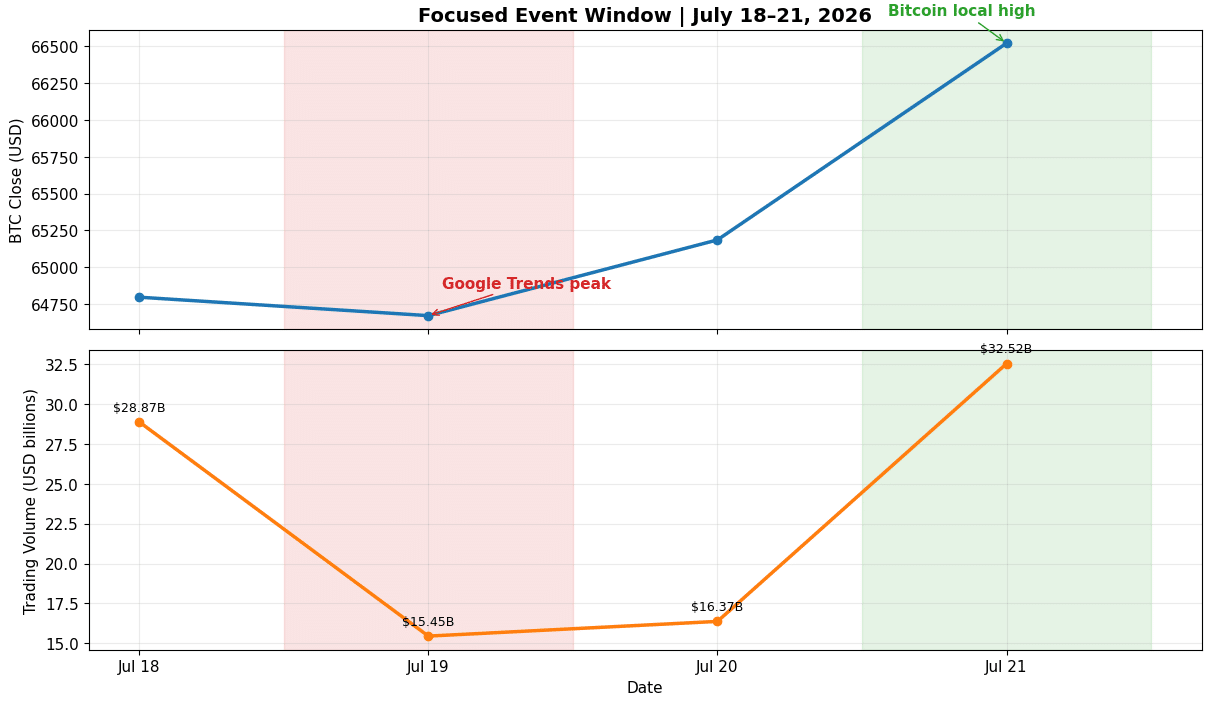
A common market assumption is that search interest translates directly into immediate buying pressure. In this case, no. Trading volume was weakest on the day Google Trends reached its peak.
On 19th July, the exact day public curiosity hit its maximum of 100, Bitcoin’s daily trading volume plummeted to $15.45 billion. This represented a sharp 46.5% drop from the $28.87 billion traded a day prior. This is the classic “window shopping” phase of retail behavior.
Millions of observers were actively staring at the charts, researching the breakout, and asking, “is it too late?” And yet, they hesitated to click buy. The actual execution of these trades lagged. Trading volume only staged its massive comeback as Bitcoin closed in on its local peak, surging by 110.5% over the next 48 hours to reach $32.52 billion on 21st July.
Retail participants did not lead the rally with their capital; they watched the breakout, waited for confirmation, and finally capitulated into the local top.
According to Tim Sun, Senior Researcher at HashKey Group, attention and trading volume are “largely surface signals.” They show where activity is increasing, but they cannot identify who traded or why.
That limitation matters here because the data doesn’t show whether the hike on 21st July came from retail buyers, institutional participants, short sellers closing positions or derivatives-related activity. It simply shows that more Bitcoin changed hands.
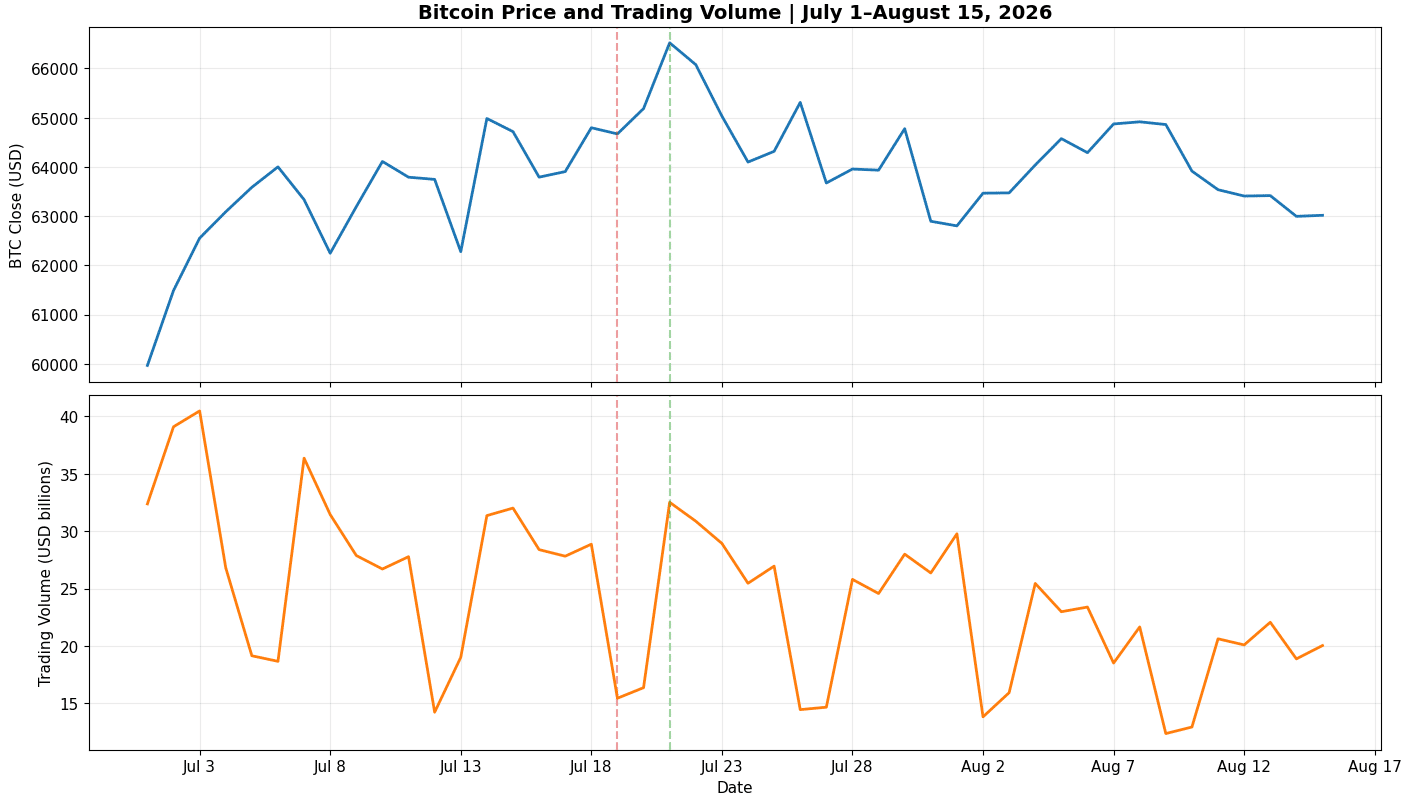
21st July’s hike was therefore a local rebound, not a broader participation peak.
The sequence is clearer now. Search interest peaked first. Trading volume was subdued at that point, then rose near the price high. While attention appeared before stronger market activity, the data does not establish that one caused the other.
HODL expectation: Why the trap took 10 days to snap
When Bitcoin’s spot rally hit a ceiling at $66,521 on 21st July, spot buying volume began to dry up. And yet, the market did not immediately roll over. Instead, market activity shifted into the derivatives suite, where traders used leveraged perpetual swap contracts to keep the momentum story alive.
Notional Open Interest expanded from $45.04 billion on 1st July to $48.65 billion on 21st July, before peaking at $51.06 billion on 22nd July. Throughout this window, Open Interest-Weighted Funding Rates remained positive.
So, it ultimately confirmed that long-side traders were actively paying a daily premium to shorts to maintain their bullish positions at the local high.
| Date | BTC Spot Price | Open Interest | Funding Rate | Long Liquidations |
|---|---|---|---|---|
| July 19 | $64,670 | $48.15B | 0.0070% | $5.26M |
| July 21 (Price Top) | $66,521 | $48.65B | 0.0018% | $7.39M (Shorts Squeezed) |
| July 22 (OI Peak) | $66,077 | $51.06B | 0.0035% | $17.22M |
| July 31 (Reckoning) | $62,813 | $47.93B | 0.0059% | $100.93M (Wipeout) |
As Ajeet Khurana, Founder of Reflexical, told AMBCrypto,
The clearest red flag is when derivative greed outpaces spot demand. When you see prolonged, excessively positive funding rates on perpetuals paired with volume rotating rapidly from majors like BTC, the market is approaching speculative exhaustion.
However, the most compelling anomaly in the dataset is not that leverage built up, but how long it stayed stuck in the system. If top-buyers were trapped on 21st July, why did the eventual $100.93 million long liquidation cascade delay itself until 31st July?
The explanation comes from a landmark behavioral study published in the Journal of Financial Economics. Researchers examined the transactional histories of 200,000 retail accounts on eToro and found that –
- Retail investors trade contrarianly. When stock or gold prices rise, they rebalance by selling; when prices dip, they buy.
- The exact same investors abandon rebalancing. They display a momentum-like strategy, passively absorbing price drops without trimming their positions.
Crypto investors interpret price rallies as fundamental proof of impending mainstream adoption. When prices rise, expectations of future institutional and regulatory acceptance surge and that leads traders to “HODL,” rather than take profit. This behavioral inertia explains the ten-day lag in our market data.
Retail traders did not de-risk when Bitcoin stalled at $66,521. Instead, they passively held their unhedged leveraged positions as spot prices slowly drifted lower.
On 31st July, the exchange liquidation engines executed forced exits automatically. This ultimately triggered a $100.93 million long wipeout in a single day.
Here, it’s worth highlighting what DroomDroom’s Ronak Shah told AMBCrypto about FOMO’s origins and the role of market structure –
Features like 24/7 trading and constant social media hype are actively designed to amplify and weaponize that exact feeling
Is crypto FOMO a bias or a market structure problem?
Crypto FOMO does not manifest as a single, isolated transaction; it reveals itself through a readable sequence of market footprints. What begins as a private psychological impulse is rapidly amplified when the fear of being late meets a 24/7 market structure and social media platforms optimized for continuous engagement.
As market data demonstrates, attention rises first, trading volume lags and intensifies near local price peaks, derivatives exposure expands into the top, and the market eventually enforces a mandatory exit. This progression highlights that market fragility develops when surface-level curiosity transitions into unhedged leverage.
Crypto traders rarely sell on dips because they believe every price surge proves long-term adoption. That mindset leaves leveraged bets trapped in the system even when spot buying dries up. First, the price push squeezes short sellers at the top. Days later, when buying momentum evaporates, exchange liquidation engines automatically execute a massive wipeout of the trapped longs.
Ultimately, crypto FOMO is neither a purely personal psychological flaw nor an unexplainable market glitch. It represents the direct intersection of human behavioral bias, uninterrupted market availability, and algorithmically reinforced attention loops.