Iran Latest: Lebanese state media reports attacks by Israel despite announced ceasefire

Trump touts Iran success in early morning posts
President Trump was up early on Saturday, posting about the success of his war with Iran, despite the situation in Lebanon heating up overnight.
“Radical Left fools and Dumocrats realize how well we have done in our War against Iran, with their Country being completely defeated militarily,” Mr. Trump wrote on Truth Social at 7 a.m. “Obuma just kept giving them $Billions in cash, and never used our then depleted military for what should have been done to reign in the World’s number one sponsor of terror, Iran.”
He went on to also insult former President Joe Biden, before concluding, “Iran got away with ‘murder’ for 47 years, until I came along. Then it all changed.”
Mr. Trump posted again about an hour later, criticizing Democrats for saying Iran was in a better position now than three months ago, “despite the fact that they have been defeated militarily.”
The president spent the night at Camp David after revealing the new Air Force One at Joint Base Andrews and has no public events on his schedule Saturday.
Israel, Hezbollah trade accusations of ceasefire violations
Israel and Hezbollah are trading specific accusations of ceasefire violations in Lebanon as their fighting threatens to drag down the entire agreement between the U.S. and Iran.
Israel accused Hezbollah of firing more than 50 projectiles at Israeli soldiers operating in southern Lebanon.
“These attacks constitute repeated and ongoing violations of the ceasefire agreement by the Hezbollah terrorist organization,” the Israeli army said in a statement Saturday. “The IDF will not tolerate attacks against Israeli civilians or IDF soldiers and will respond with determination to any act of aggression directed against them.”
However, Hezbollah said it will continue to consider any Israeli presence in Lebanese territory to be a violation of the U.S.-Iran memorandum in and of itself. Israeli Prime Minister Benjamin Netanyahu has said Israeli troops will not exit the security zone it established in southern Lebanon. While the memorandum of understanding requires fighting to stop and Israel to respect Lebanese sovereignty, neither party was actually involved in the negotiations.
“The Islamic Resistance declares that, while remaining committed to the ceasefire, it will not hesitate to confront any attempt by the enemy to seize territory and expand its occupation,” Hezbollah said in a statement.
Hezbollah also accused the Israeli army of conducting an operation Friday night to take Ali Al-Taher Height, a strategic high ground above the Litani River in Lebanon, which Israel has been unable to acquire.
Witkoff heads to Switzerland for talks; Vance’s travel canceled
Special envoy Steve Witkoff traveled to Switzerland overnight, CBS News has confirmed. The first round of talks regarding a potential nuclear agreement between the U.S. and Iran are expected to be held in Bürgenstock in the coming days to handle the technical details of implementing the broad terms in the already signed memorandum of understanding. The MOU stipulates the talks will be a duration of 60 days but could be extended if both sides agree.
Qatar’s prime minister, Sheikh Mohammed bin Abdulrahman bin Jassim Al-Thani, arrived in Switzerland Friday. Doha has been a key mediator and shuttled between the two sides in recent weeks to hash out the 14-point MOU.
Iranian foreign affairs minister Abbas Aragchi is not in Switzerland, his office confirmed to CBS News. Aragchi is an experienced negotiator having handled past rounds of nuclear negotiations with the U.S. and Europe. It is not clear at this time who will attend from Tehran.
Vice President JD Vance’s travel has been canceled.
Rafael Grossi, the leader of the International Atomic Energy Agency, the United Nations’ nuclear watchdog, is also expected to be in Switzerland and lead some portion of technical talks dealing with Iran’s nuclear program. The MOU stipulates that the IAEA will carry out inspection verification and oversee the downblending of Iran’s enriched uranium.
Fighting continues in Lebanon, state media says
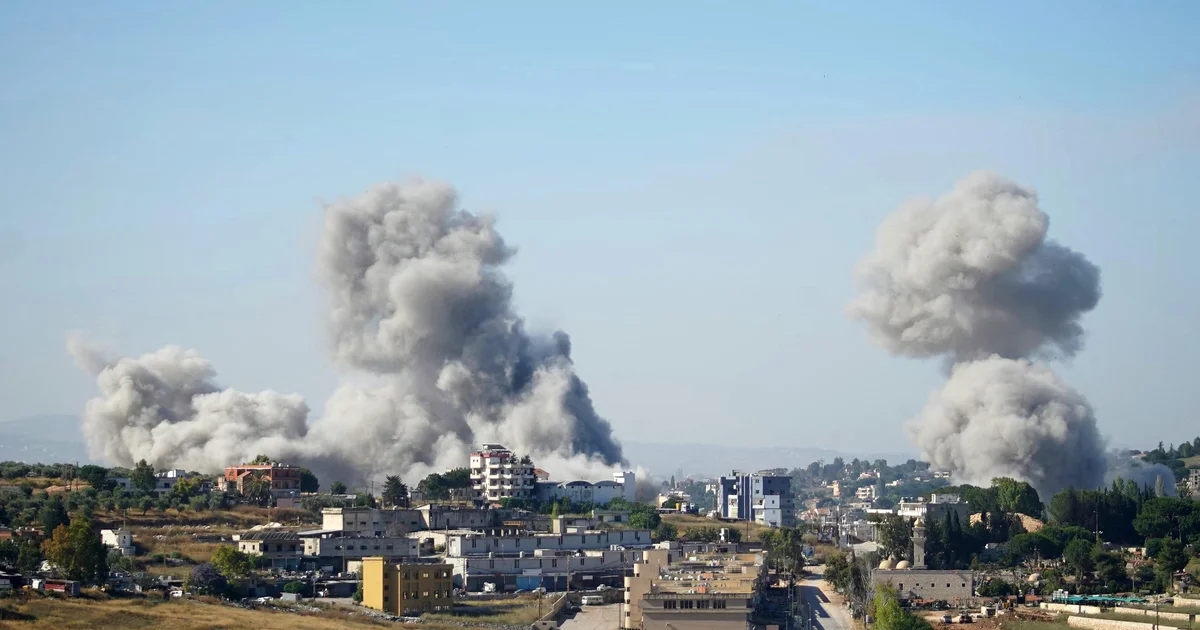
Israeli strikes on southern Lebanon on Saturday killed at least seven people, including two children, hours after reports emerged of a ceasefire agreement and threatening an interim agreement between the United States and Iran to end the war in the Middle East.
Lebanon’s National News Agency said the strikes hit the southern town of Nabatieh and nearby villages. At least seven people remained trapped under the rubble, it said. Lebanon’s civil defense agency said 16 people were killed in the Nabatieh area, where an AFP photographer saw smoke rising over the city after strikes.
An Israeli military official said Hezbollah had fired more than 50 projectiles at Israeli forces in southern Lebanon overnight, prompting the military to start targeting the militant group there. The official spoke anonymously in line with regulations.
Hezbollah has not officially claimed any attacks on Israel or its troops in Lebanon since the ceasefire was announced.
Mediators were scrambling to halt the fighting between Israel and the militant Lebanese Hezbollah group, after a heavy exchange on Friday killed at least 47 people in Lebanon and four Israeli soldiers.
Trump says he personally asked Israel to agree to ceasefire with Hezbollah
In a Friday phone interview with NBC News, President Trump said he spoke with Israeli officials and requested they agree to a ceasefire with the Lebanon-based militant group Hezbollah, an Iranian proxy.
NBC News said the president declined to say, however, whether he had specifically spoken with Israeli Prime Minister Benjamin Netanyahu.
Mr. Trump told NBC News the ceasefire in Lebanon was “a positive,” and referred to it as “little icing on the cake.”
Israel and Hezbollah reached a ceasefire deal earlier in the day, three diplomats briefed on the agreement previously told CBS News. The exact terms of the deal were unclear. Iran has insisted that fighting stop in Lebanon as part of any broader ceasefire with the United States.
Israel is honoring ceasefire, but Hezbollah must be “destroyed,” ambassador says
Countering claims from Hezbollah that the ceasefire has been broken by Israel, Yechiel (Michael) Leiter, the Israeli ambassador to the U.S., said on X that Israel has not carried out any strikes since 11:30 a.m. local time.
“Israel remains firmly committed to an immediate ceasefire,” Leiter wrote. “At 11:30 this morning, Israel halted all offensive operations; Hezbollah and Iranian claims to the contrary are bold lies.
“If Hezbollah honors the agreement and ceases its hostilities, they will be met with quiet.”
However, Leiter still said Hezbollah must be eliminated from Lebanon in order for the country to “prosper and enjoy democratic freedoms.”
“This will only happen when Hezbollah, a murderous Iranian proxy, is destroyed,” Leiter said. “The end of Hezbollah will mark the beginning of a beautiful peace between our two countries.”
While the strikes have ended, Israel has no plans to leave the security zone it established in southern Lebanon, Leiter said. Hezbollah has said Israel must exit Lebanese territory entirely or it will consider it a violation of the memorandum of understanding.
Lebanon-Israel talks still expected next week: U.S. State Department
Secretary of State Marco Rubio indicated talks scheduled for next week between representatives from Israel and Lebanon will still take place after holding a phone call with Lebanese President Joseph Aoun on Friday, according to the U.S. State Department.
“Secretary Rubio underscored that Lebanon’s bilateral negotiations with Israel represent the only feasible path to reconstruction, economic recovery, and ending recurrent cycles of violence,” State Department spokesperson Tommy Pigott said in a statement about the call. “They discussed the next round of negotiations, scheduled for June 23–25 in Washington, where the two sovereign governments will make progress toward a lasting peace.”
Hezbollah and Israel agreed to a ceasefire, brokered by the U.S. and other Middle Eastern countries, on Friday. Hezbollah, an Iranian-backed militia in Lebanon, has not been part of previous rounds of talks between Lebanon and Israel and rejected a previous negotiated deal between the two sides.
“Secretary Rubio reiterated the need to disarm Hizballah and to re-establish control over all Lebanese territory,” Pigott said of the call. “They also discussed the need to coordinate with regional allies to advance these aims.”
How the Iran war united, and then divided, Trump and Israel’s Netanyahu
The stage — and the cage — were set Sunday at the White House as President Trump prepared to mark his 80th birthday with a long-planned night of UFC combat, and an announcement of a long-awaited deal with Iran to extend a ceasefire and reopen the Strait of Hormuz.
Hours before it was to be signed, however, Israeli jets struck Lebanon’s capital Beirut, killing at least three people.
“This morning’s attack on Beirut should not have happened, particularly on a special day when we are so close to a Peace Deal with Iran,” Mr. Trump said in a post on Truth Social.
His call with Israeli Prime Minister Benjamin Netanyahu soon after was less diplomatic.
Read the full story here.
Latest Israeli strikes killed 47 in Lebanon: Health ministry
Israeli airstrikes and bombardments killed at least 47 people and wounded 97 others in Lebanon on Friday, according to the latest updated toll from the Lebanese health ministry.
The dead included at least seven women and two children, according to the health ministry. The figures were released as a new ceasefire between Israel and Hezbollah was due to start.
Consultations ongoing regarding next round of talks, says Iran
Consultations are ongoing through mediators regarding the next phase of U.S.-Iran talks aimed at drafting a final deal to end the war, according to Iranian Foreign Ministry spokesperson Esmaeil Baqaei.
He said Friday that the public would be informed if and when the necessary conditions for launching negotiations are met.
Since the two countries’ memorandum of understanding has now been signed both digitally and by President Trump in person, the meeting in Switzerland is no longer considered urgent, he said, adding that planning is underway for a direct meeting to be held in the coming days.
Iran mediators to meet in Egypt on Sunday
Mediators in the U.S.-Iran conflict, including Pakistan, Saudi Arabia and Turkey, are due to gather for talks in Egypt on Sunday, Cairo and Islamabad said.
Pakistan’s foreign ministry said Friday that the four-way meeting would bring together the foreign ministers of Pakistan, Saudi Arabia, Turkey and Egypt to “discuss regional developments and exchange views on issues related to peace, security and stability.”
Egypt’s foreign ministry said late Thursday that the meeting would be followed by expanded talks and a joint news conference.
The Cairo meeting comes after U.S.-Iran talks scheduled in Switzerland for Friday, aimed at following up on the agreement to end the war, were postponed.
The White House confirmed that Vice President JD Vance’s planned trip to Switzerland for the talks had been canceled.
The deal, signed this week by President Trump and his Iranian counterpart Masoud Pezeshkian, aims to end the war that began on Feb. 28 with joint U.S.-Israeli strikes on Iran.
Iran says ships transiting Strait of Hormuz will need insurance approved by Tehran
Iran says ships transiting the Strait of Hormuz will need insurance approved by Tehran, according to a document from the regime’s new Persian Gulf Strait Authority (PGSA) seen by CBS News on Friday.
The undated document says “all vessels must hold a valid insurance policy approved by
the PGSA.”
The PGSA – an agency created by Iran during the war, and which the regime says has sole responsibility for regulating traffic through the vital waterway – said Friday that ships intending to transit the strait are still required to request permission via the body during the 60-day period set out in the U.S.-Iran memorandum of understanding (MOU).
Ships must also follow Iran’s approved route around the country’s Larak Island, in the north of the narrow strait, according to the document, which says the PGSA reserves the right to introduce insurance fees in the future.
Trump rejects Iran’s claim that he signed agreement “out of desperation”
President Trump denied on Friday the Iranian Supreme Leader’s claim that the U.S. signed the agreement with Tehran this week “out of desperation.”
“We didn’t meet out of desperation, Iran did. They are FINISHED!” Mr. Trump declared in a Truth Social post.
The president said the U.S. would “play out” the 60-day negotiation period laid out in the memorandum of understanding with Iran, but he didn’t offer any further explanation of his remark. That two-month period of direct talks on Iran’s nuclear program and other contentious issues had been expected to start Friday, but it has been delayed amid renewed fighting in Lebanon between Israel and Hezbollah.
In a reference to criticism over the deal from both sides of the political aisle in Washington, President Trump reiterated his insistence in his Friday post that Iran would “get no money, not ten cents!” under the deal signed this week.
While the release of billions of dollars in frozen Iranian assets is to be negotiated during the now-postponed next phase of negotiations, the memorandum of understanding states that the “U.S. and regional partners will develop a reconstruction plan for Iran worth at least $300 billion.”
Israel and Hezbollah agree to a ceasefire, diplomat briefed on the deal says
Three diplomats briefed on the agreement told CBS News on Friday that Israel and Hezbollah had agreed to a ceasefire in Lebanon, as first reported by the Reuters news agency.
The agreement was scheduled to begin at 9 a.m. Eastern on Friday, according to Reuters.
Suleiman Amhaz/Anadolu/Getty
The truce was agreed following the deadliest flare-up in fighting between the two sides since the U.S. and Iran reached an agreement Sunday on their memorandum of understanding.
That agreement, signed by President Trump and Iran’s president Wednesday, calls for hostilities to end on all fronts, including in Lebanon, though neither Israel nor Hezbollah were parties to the memorandum.
Hezbollah again blames Israel for continued fighting as U.S.-Iran deal fails to bring Lebanon peace
Hezbollah accused Israel on Friday of not complying with any ceasefire agreement pertaining to Lebanon for nearly two years. The Iranian-backed group said it would continue attacking Israeli troops in response, as their war threatened to derail the U.S.-Iran deal signed by President Trump only two days ago.
“The Israeli enemy has intensified its continuous violations of the ceasefire, committing massacres and destroying residential buildings and civilian infrastructure,” Hezbollah, which has long been designated a terrorist organization by Israel and the U.S., said in a statement. “It has continued land assaults through attempts to infiltrate and control villages and areas it was unable to reach before the agreement.”
Hezbollah accused Israel of never complying with any ceasefire agreement reached since Nov. 2024, including the most recent deal between Iran and the U.S. – a memorandum of understanding that demands an immediate cessation of hostilities on all fronts, including in Lebanon.
Hezbollah said its fighters in Lebanon would “defend their land and people with courage” and continue “inflicting losses on the enemy army among its officers and soldiers.”
Israel has, in turn, accused Hezbollah of violating all ceasefires, virtually from the moment they are agreed. The Israeli military said Friday that its operations in Lebanon would continue until the threat posed by Hezbollah is eliminated.
France calls on U.S. to pressure Israel to cease hostilities in Lebanon
France’s foreign minister called Friday on the U.S. to pressure Israel to halt its fighting with Iran-backed Hezbollah in Lebanon to “respect” the U.S.-Iran agreement.
“This agreement involves the cessation of hostilities, the Israeli government must respect it, and the United States in particular must exert all the necessary pressure on the Israeli government so that this is the case,” Jean-Noël Barrot said during an interview with French broadcaster Franceinfo.
Barrot also called on Iran-backed Hezbollah to stop attacking Israel and to begin a disarmament process.
Israel says it hit at least 80 Hezbollah targets in Lebanon overnight in response to “repeated, ongoing, and blatant violations of the ceasefire.”
Hezbollah and Israel have exchanged fire – and accusations of ceasefire violations – almost daily for weeks, even before the U.S.-Iran deal was signed on Wednesday. While the fighting eased earlier this week, it flared again on Thursday evening.
Netanyahu says Hezbollah will pay “heavy price” for deaths of 4 Israeli soldiers
Prime Minister Benjamin Netanyahu said Friday that Israel will “exact a very heavy price from Hezbollah” for the death of four Israeli soldiers.
“My instructions are clear: Israel will not tolerate attacks on our soldiers or our territory, and it will exact a very heavy price from Hezbollah for these attacks,” Netanyahu said.
The Israeli leader also echoed previous statements on Israeli forces’ continued presence in southern Lebanon.
“As I have made clear unequivocally, including yesterday: Israel will remain in the security zone in southern Lebanon as long as necessary to protect the northern communities,” he said in the statement.
Iran regime says it doesn’t trust the U.S. to adhere to terms of deal
Iran’s powerful Supreme National Security Council said Friday that the regime signed the memorandum of understanding with the U.S. but has “complete distrust” in the United States to uphold the agreement, and it warned that “any deviation or violation” would bring a reciprocal action.
In a statement, the 12-member council said Iran’s theocratic rulers were monitoring developments under the agreement “with complete distrust of the faithless and treaty-breaking enemy, and with precise supervision over the negotiation process and the implementation of the programs.”
“Should any deviation or violation occur on the part of the American side, a reciprocal action will be taken according to the plan determined in advance,” it said.
The U.S.-Iran deal is already facing a major test, as direct talks scheduled to take place on Friday were postponed amid intensified fighting between Israel and Hezbollah in Lebanon.
25 five ships tracked transiting Strait of Hormuz Thursday as Iran and U.S. lifted restrictions
A total of 25 commercial vessels transited through the Strait of Hormuz on Thursday, the highest number seen on any day since mid-April, according to data from maritime tracking firm AXSMarine.
The increase came after President Trump and his Iranian counterpart signed an initial agreement that calls for the crucial shipping route to reopen amid an extended ceasefire between the U.S. and Iran – and an end to hostilities in Lebanon.
The memorandum of understanding signed Wednesday also calls for 60 days of direct bilateral negotiations aimed at a much wider peace deal to begin, but that next step – which had been expected to start Friday in Switzerland – has been delayed amid increased fighting between Israel and Hezbollah in Lebanon.
On June 18 “we observed 25 verified commercial vessel crossings through the Strait of Hormuz — the highest single-day count since 18 April and more than five times the average daily level recorded during the first ten days of June,” AXSMarine said in a news release.
Israeli military says it attacked 80 Hezbollah targets in Lebanon
Israeli military said Friday that it had struck at least 80 Hezbollah targets across southern Lebanon as fighting between the two sides reignited in the first major test of the fragile U.S.-Iran agreement aimed at ending the war.
“Overnight, the IDF struck more than 80 command centers, terrorists, launch positions, and additional terrorist infrastructure sites,” the Israel Defense Forces said in a statement
The statement said “dozens” of Hezbollah fighters were killed in the strikes, which the IDF called a response to “repeated, ongoing, and blatant violations of the ceasefire” by the U.S.- and Israeli-designated terrorist group based in Lebanon.
Lebanon’s state-run National News Agency said at least 18 people were killed in the attacks on the country.
Iran’s top negotiator says Tehran will not waver from its “red lines” in new talks with U.S.
Iran’s chief negotiator Mohammad Bagher Ghalibaf said Friday that direct talks with the United States, provisioned by the memorandum of understanding signed on Wednesday but currently delayed, would be bound by Tehran’s “red lines.”
“As we have shown in the past path of negotiations, we are steadfast in fulfilling the conditions and red lines set, and in achieving the interests of the Iranian nation,” Ghalibaf said in remarks published by Iran’s official IRNA state news agency. “If the enemy seeks to be excessive, we have proven that our fingers are on the trigger and we have no hesitation in giving a crushing response to the enemy.”
Iranian Supreme Leader Khamenei says Trump signed agreement “out of desperation”
A statement attributed to Iran’s Supreme Leader Mojtaba Khamenei, conveyed by the nation’s state media on Thursday evening, claims President Trump, “out of desperation, used all kinds of leverage” to reach a deal with Tehran.
“In the course of reaching this stage, the officials in charge, out of sincere concern and goodwill, made extensive efforts — and of course, it was the American president who, out of desperation, used all kinds of leverage to bring this about,” Khamenei said in the statement.
Khamenei – who has not been seen or heard from directly since he inherited his position from his father, who was killed on the first day of joint U.S.-Israeli strikes, said Iran had accepted the terms of the agreement and that there would be “in-person negotiations in the future,” but that Tehran would not necessarily accept the Trump administration’s demands for a broader peace deal.
Iran pulled out of talks with U.S. over Israel’s conflict with Hezbollah in Lebanon, official tells AP
Two regional officials, speaking to The Associated Press on condition of anonymity to discuss the closed-door talks, said mediators were focused Friday on calming newly intensified fighting in Lebanon.
One of the officials said Iran had suspended plans to begin direct talks with U.S. officials in Switzerland on Friday specifically over the fighting and comments by Israeli Prime Minister Benjamin Netanyahu, which they described as violating the interim deal between Iran and the U.S.
Vice President JD Vance on Thursday put off his trip to Switzerland, where he had been set to lead the next-phase talks with Iran provisioned by the memorandum of understanding signed by both countries on Wednesday. The White House blamed logistical issues for the delay in beginning the talks, which are expected to last 60 days.
Trump calls on Hezbollah and Israel to stop fighting
President Trump said Thursday night he expected Hezbollah and Israel to stop fighting under the agreement struck between the U.S. and Iran.
“The United States is committed to PEACE, and we encourage everyone in the Middle East Region to maintain their commitment to allowing our negotiations to beautifully unfold,” Mr. Trump said in a Truth Social post. “We expect a complete Ceasefire on all fronts, including Lebanon, Hezbollah, and Israel.”
Israel said it attacked Hezbollah in the early hours of Friday morning in response to “repeated violations of the ceasefire.”
In a brief statement the Israel Defense Forces said it had “struck throughout the night and continues to strike Hezbollah terrorists and infrastructure sites in several areas across southern Lebanon.”
Lebanese officials said at least 18 civilians were killed, making it the deadliest attack since the U.S. and Iran reached an agreement early this week on the memorandum of understanding signed Wednesday by Mr. Trump and Iranian President Masound Pezeshkian.
Israeli strikes kill 18 in Lebanon as fighting with Hezbollah flares up, health ministry says
Israel’s military said Friday its forces struck targets throughout southern Lebanon overnight as Hezbollah reported intense fighting in the area.
Lebanon’s state-run National News Agency reported at least 18 people were killed in Israeli airstrikes, which the Israeli military said were ongoing. Israel, meantime, said four of its soldiers had been killed in fighting in southern Lebanon, including a lieutenant colonel. An explosive drone attack hurt another five, it added.
Continued fighting in Lebanon could unravel the newly signed deal, which calls for an immediate halt to military operations “on all fronts, including in Lebanon,” where Israel has been battling the Iran-backed Hezbollah militant group, and for ensuring Lebanon’s “territorial integrity and sovereignty.”
Vance no longer traveling to Switzerland for talks with Iran tonight, White House says
Vice President JD Vance is no longer planning to fly to Switzerland late Thursday to help kickstart talks with Iran, a White House spokesperson told reporters.
“As the Vice President said at his press conference, the plans for the upcoming technical talks have not been finalized, and the U.S. delegation has been prepared to depart at the first available opportunity. But the logistics of these negotiations have never been simple or predictable,” the spokesperson said in a statement to the White House press pool. “As of now the Vice President is not departing tonight. We will let you know as soon as we have a concrete update about next steps.”
The spokesperson added: “We look forward to beginning technical talks as soon as possible.”
Under the memorandum of understanding signed by Iran and the U.S. this week, the two sides are planning to hold 60 days of technical talks on the fate of Iran’s nuclear program.
Earlier in the day, Vance told reporters the plan was for those talks to begin this weekend, and he intended to travel to Switzerland for the start of negotiations, but “that could change” because Iran is “not an easy country … to get out of.”
“It just depends on exactly when the Iranians can get there,” he said. “We’re trying to figure that out as we speak, but again, I suspect it will happen this weekend.”