
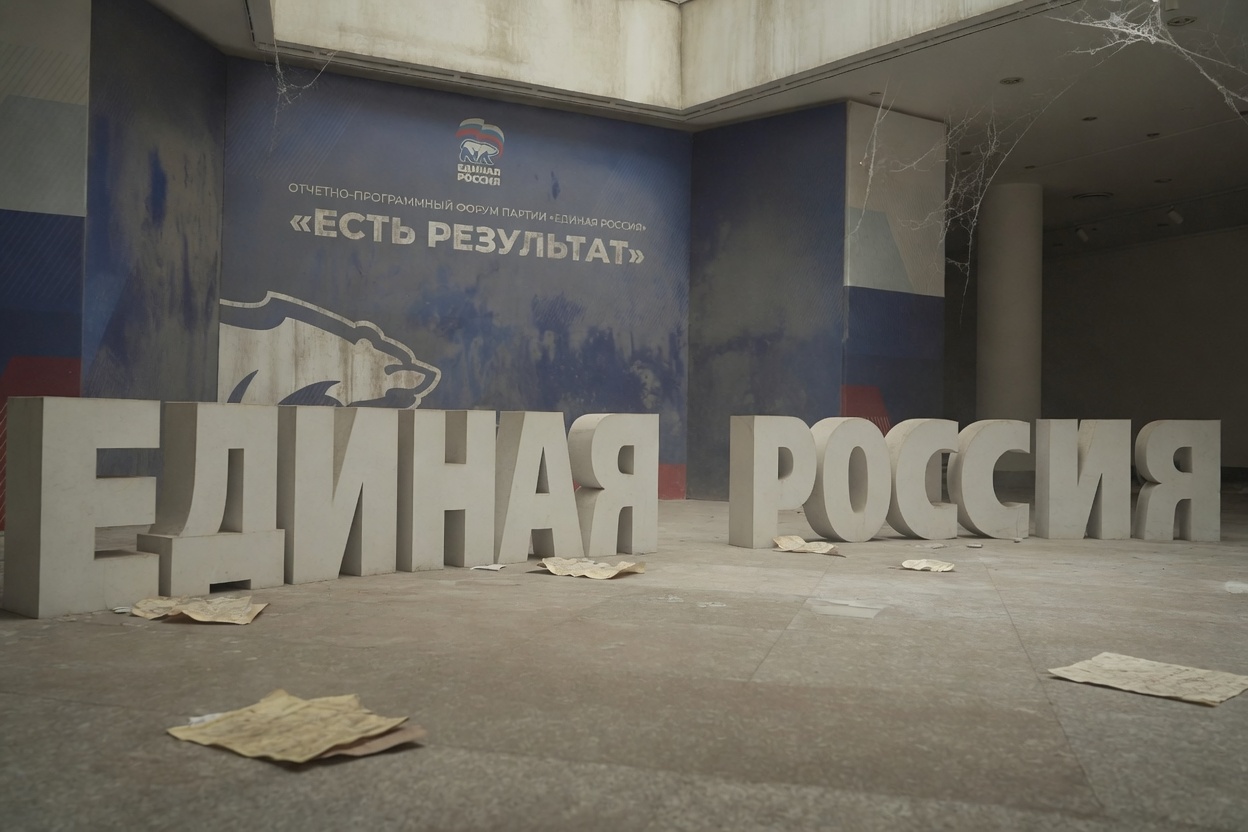
United Russia held its final pre-election forum under the slogan “There Is a Result!” To avoid accusations of illegal campaigning, the events staged across all federal districts were presented as a review of the party’s work in the State Duma.
Party chairman Dmitry Medvedev spoke at the Moscow forum, though he did not appear at the parallel events in other districts. The former president, now deputy chairman of the Security Council, announced that United Russia’s congress would take place in two stages. On 28 June, party members will formally nominate candidates for the State Duma and unveil a “framework program for the coming decades” — a broad strategic vision for Russia’s development. A more concrete program for the current election campaign will be released only at the end of August, near the close of the official campaigning period.
The decision to split the congress into two stages points to serious difficulties with internal planning inside the ruling party. Electoral legislation strictly governs the timing and procedures for candidate nomination, and even United Russia cannot simply bypass these rules despite its privileged position. The 28 June “first stage” is therefore required mainly to register the candidate lists in proper legal form. The “framework for decades” appears designed chiefly to lend the event an air of substance. This strategic exercise can comfortably accommodate any number of grand aspirations — global leadership, breakthroughs in new technologies and artificial intelligence, or the defense of traditional values.
Yet this framework has no connection to problems that actually preoccupy Russian society — problems that even Kremlin-friendly sociologists continue to record. Citizens want answers to straightforward questions about what will happen to them and their finances in the coming weeks and months. United Russia has none. That is why the party is delaying the release of a full election program.
Neither United Russia nor the Kremlin’s political bloc — and most likely the government as well — knows what the country will look like closer to election day. Will the war continue or will a ceasefire be declared? Will economic difficulties intensify, or will high oil prices provide at least partial relief? How will gasoline supplies hold up in the southern regions, and what will that mean for the harvest? The planning horizon of the ruling party and its Kremlin supervisors has become extremely short.
The overall situation in the country is steadily worsening, and new challenges keep appearing for the leadership — from Ukrainian long-range drone and missile strikes deep inside Russia to gasoline shortages. All key decisions still rest with Vladimir Putin, who retains personal control over every major lever of power. What decisions will ultimately be taken — or whether any will be taken at all — remains unknown even to the party. It is entirely possible that the president himself does not yet know; in moments of crisis he has traditionally preferred to wait and see, hoping the problem will resolve itself.
This uncertainty shapes United Russia’s entire election campaign. For most of the campaigning period the party will have to operate without a program — apparently the least bad option available. Any concrete promises made in June risk becoming irrelevant or even embarrassing by late August or mid-September. That is why this summer’s billboards and candidate meetings will contain none of the specific pledges the party’s voters have come to expect. Any program released shortly before the vote will likely function as a “one-day program,” tailored only to whatever public concerns are most acute at the end of August.
For the same reason, United Russia has still not settled even the broad outlines of the top of its federal list. One option under discussion features a trio of Dmitry Medvedev, Sergei Sobyanin and war correspondent Yevgeny Poddubny, deputy head of VGTRK — a version with a moderate military accent. A list without Medvedev is also being considered. At the same time, the party and the Presidential Administration’s political bloc are examining a more hawkish configuration: a federal “top five” heavy with siloviki and participants in the war in Ukraine. Should United Russia’s ratings continue to slide, the Kremlin retains one final fallback — asking Vladimir Putin to head the list himself. In that case the federal part would consist of a single name. Until now, the Presidential Administration’s political team has tried to avoid this extreme measure.
The steady stream of rumors around the congress and the composition of the federal list’s leadership shows that United Russia’s campaign is running in an atmosphere of deep uncertainty and internal unease. Major decisions are repeatedly postponed. For a system built on clear top-down planning, this level of improvisation has become a serious irritant.
Divvying Up the Positives
Faced with economic headwinds, United Russia and the other systemic parties have predictably run short of positive talking points. Any piece of relatively good news is therefore quickly claimed and presented as the party’s own achievement.
This happened with the partial unblocking of the popular gaming platform Roblox, which Roskomnadzor had banned in December 2024. The ban had caused noticeable irritation among children and parents and contributed to broader public discontent. Several months ago the authorities had already floated the idea of lifting unpopular restrictions during the election campaign. The decision to restore access to Roblox (while still blocking the general chat for Russian users) fits this pattern perfectly: it costs nothing yet delivers a clear positive effect. It is therefore unsurprising that both United Russia and New People are competing to take credit for the move.
A similar episode occurred with the revenue threshold for preferential taxation of small businesses. United Russia is presenting itself as the driving force behind the decision to keep the threshold fixed at 20 million rubles until 2030. Last year the authorities cut it from 60 million to 10 million rubles, provoking protests from entrepreneurs. The government then planned a gradual reduction — first to 20 million in 2026, then 15 million in 2027, and finally 10 million in 2028. At the St. Petersburg International Economic Forum, Vladimir Putin proposed temporarily locking the threshold at 20 million rubles and instructed United Russia to turn the idea into legislation. The party duly introduced a bill that freezes the threshold at that level until 2030.
“Divvying up the positives” is set to become one of the defining features of the State Duma campaign. In a country at war with a stagnating economy, genuinely positive news stories are scarce, so every one of them will be actively claimed. At the same time, it is already clear that neither the authorities nor the systemic parties are offering anything genuinely new. They are mainly engaged in reversing their own earlier unpopular decisions and restrictions. The Kremlin, the government and the parliamentary parties simply lack both the resources and the planning horizon to do more.
The result is a paradoxical situation: United Russia is forced to play the role of a quasi-opposition, trying to portray itself as the initiator of scrapping its own unpopular policies. This positioning reveals a great deal about how Russians view the current authorities.