‘The aim is to erase our identity’: How south Lebanon’s cultural heritage is going up in smoke

It’s been a month since Israel and Lebanon agreed to a ceasefire on April 19. During that time, the Israeli army has been working to establish what it calls a “forward defence zone” in southern Lebanon – an area that it says it wants to turn into a “buffer zone” to thwart future Hezbollah attacks.
The Israeli Defense Forces (IDF) banned Lebanese civilians from entering this area encompassing 55 villages. And, in the meantime, the IDF has been carrying out widespread demolition – using bulldozers and dynamite to destroy buildings and sometimes even entire villages.
Israeli authorities claim that they have “no intention to strike civilian infrastructure or religious buildings” but are seeking to demolish Hezbollah infrastructure in southern Lebanon, as Israeli army spokesman Avichay Adraee said in an X publication on May 2.
However, Lebanese NGO Green Southerners has been sharing photos on Facebook and X that document the destruction of religious structures, historic sites and other important cultural heritage sites in the region.
Convent destroyed
One site that has been destroyed is the convent and school run by the Salvatorian Sisters in the village of Yaroun, which was bulldozed on May 1 – as documented by images that contradict denials issued by the Israeli military.
Hicham Younès, who runs the NGO Green Southerners, explains:
“We were informed of the operation the day it happened because eyewitnesses were capturing images of the destruction as they watched it unfold.”
The army admitted that they had “damaged” a building in the complex but said “it had no external signs indicating it was a religious building.”
Younès, however, doesn’t buy these claims.
“Israeli forces occupied this zone for many years before it was liberated in 2000 [Editor’s note: when Israel withdrew from southern Lebanon after 15 years of occupation], so they know both where these buildings are and what they are used for.
In the same vein, the claim that the occupying forces are making the effort to avoid targeting structures with religious or cultural importance does not correspond with what is being documented on the ground in a large number of border villages, including the village of Yaroun.”
Less than 400 metres from the Salvatorian Sisters convent, the village’s historic church, Saint George, which was built in the 19th century, was seriously damaged during Israeli strikes in October 2023, and then again in the autumn of 2024. Yaroun is home to both Christians and Shiite Muslims; the Israeli army also destroyed the village’s main mosque, Imam Ali mosque – which also dates from the 19th century – while carrying out a ground offensive in the region in October 2024.
Green Southerners published before and after images of the mosque that document the extent of the destruction carried out using explosives.
Younès continues:
“Many buildings and neighbourhoods that managed to escape destruction in the intensive bombing that has taken place since October 2023 have now been destroyed in the systematic demolition campaign that the Israeli army has been waging since it entered the region.”
A thousand-year-old sanctuary wiped from the map
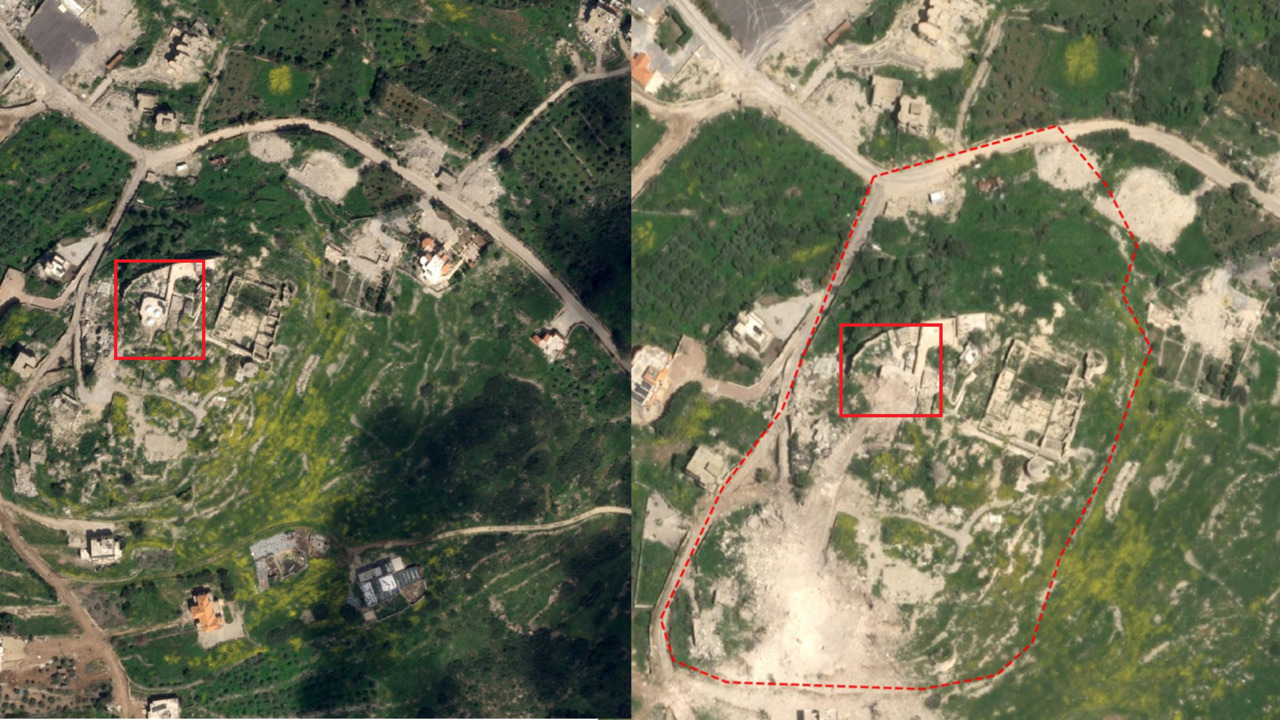
Younès is also devastated by the destruction of the Shamoun al-Safa sanctuary, one of the most remarkable religious and historic sites in southern Lebanon. Located in the village of Chamaa in the Tyr district, this Shiite sanctuary – which also includes a mosque – is said to hold the grave of Saint Peter, according to local tradition. It was reportedly built in 1097.
The site was first seriously damaged during an Israeli ground offensive in November 2024. Israeli forces placed explosives inside the citadel and detonated them, later claiming that they were targeting Hezbollah infrastructure. A neighbouring medieval castle, more than 900 years old, is thought to have been destroyed at the same time.
When the Israeli army pulled out of the region, locals carried out restoration work on the sanctuary. The domes, a key feature of the building, were partially repaired.
But satellite images obtained by both Green Southerners and Lebanese media outlets on April 13, 2026 seem to show that the site has been razed to the ground.

Aside from its religious significance, this building was also an important part of the region’s cultural heritage, Younès says.
“What is happening is part of a wider strategy, a methodical process of ripping out memory, identity and the historic relationship between people and their environment.
Deliberately targeting religious and cultural sites, which are protected under international law, represents a serious violation of international law and constitutes a war crime, but the international community remains silent.”
Back in November 2024, UNESCO said that it would offer the Chaama citadel and 34 other sites in Lebanon enhanced protection.
Al-Qantara mosque destroyed
A historic mosque in Al-Qantara, another village that falls within the boundaries of Israel’s “forward defence zone”, was also destroyed during these operations, according to a post by Green Southerners on May 4. The mosque is thought to have been built during the 14th century. It was restored in the middle of the 20th century and then again in 2014.
Younès explains:
“The satellite images, photos and videos that we published show the extent of the destruction in the village: it’s been very nearly razed. There are a few buildings on the outskirts of the village, but it is important to specify that we’ve observed that the occupiers tend to target the historic centre of towns and villages.
You can clearly see this in videos shared by the occupiers themselves. It’s very clear to us that the main objective is to erase a town’s identity, to erase the town in such a way that its cultural heritage is destroyed.”

Uncertainty remains about one of the country’s oldest wells in Al-Taybeh
Al-Taybeh, a village that has a number of traditional homes, is located five kilometres from the Israeli border. Videos and satellite images show the mass destruction of historic buildings and homes – at least 400, according to a BBC investigation published April 16, 2026.
A video posted by Israeli army spokesman Avichay Adraee shows large explosions on April 6. In his post, he says that forces from the Golani brigade were working to enlarge the “security zone” and destroy Hezbollah infrastructure.
Younès is worried for the Taybeh well, one of the oldest water sources in southern Lebanon, which was built in the Roman or Byzantine era.

‘Explosives were detonated along the entire perimeter’
Younès says:
“The Taybeh well is one of the most beautiful cultural and archaeological sites in the region. It’s hundreds of years old and built as a spiral. A spiral staircase takes you down 15 metres or more below the earth.
“It is one of the remnants believed to be of Romano-Byzantine origin, serving as a testament to the site’s identity and historical significance. Unfortunately, explosives were detonated along the entire perimeter and we don’t know today where the wells are. The explosions might have damaged it – but we don’t know the extent.”
Alongside Qantara and Yaroun, Taybeh is one of the iconic villages in Jabal Amel, a historic region in southern Lebanon which is considered the cradle of Twelver Shi’ism, one of the most ancient communities in the Arab world.
Younès says that most of this cultural heritage has been lost in the mass destruction of these villages:
“Jabal Amel is a culturally rich region. The churches, mosques, hussayniyya [Editor’s note: a gathering place for Shiite Muslims], traditional homes with stone arches, windmills, squares and ancient markets are not just buildings. They are living memories that belong to families and villages. They represent both seasons of nature and of life, like the pressing of olives or the tobacco harvest, as well as weddings and funeral wakes.
When the home of your ancestors is razed, people don’t just lose the roof over their heads. They lose a witness to their existence and their history of living on this land. And when a church, a mosque or a convent is destroyed, the message to people who were forced out of their homes goes beyond just material destruction. It’s a message that the possibility of any kind of return is now threatened, not just because of security reasons, but because of symbolic and psychological reasons.”
A number of social media initiatives have emerged in order to attempt to preserve the memory of these cultural heritage sites, such as this blog that lists religious sites destroyed in Jabal Amel – including the Bint Jbeil Mosque, built in the Ottoman period, and the mosque in Zrarieh, which was built two centuries ago.
Bombings have also taken place near UNESCO world heritage sites such as Tyr and Baalbek – though, for the time being, neither site seems to have been seriously damaged.
In Tyr, an Israeli strike caused damage just a few metres from the entrance to the Roman necropolis Al-Bass on March 6. The area near the entrance of the site was damaged, but the important historic site was not directly hit.
UNESCO announced on April 1 that they were granting temporary reinforced protection to 39 cultural sites, as well as international financial aid for emergency operations on the ground.
One of the protective measures entails setting up so-called “blue shields” at 34 archaeological and cultural sites to make them more visible to armed forces.
This article has been translated from the original in French by Brenna Daldorph.