Insurgent alliance strikes at heart of Mali’s junta, exposing limits of Russian protection

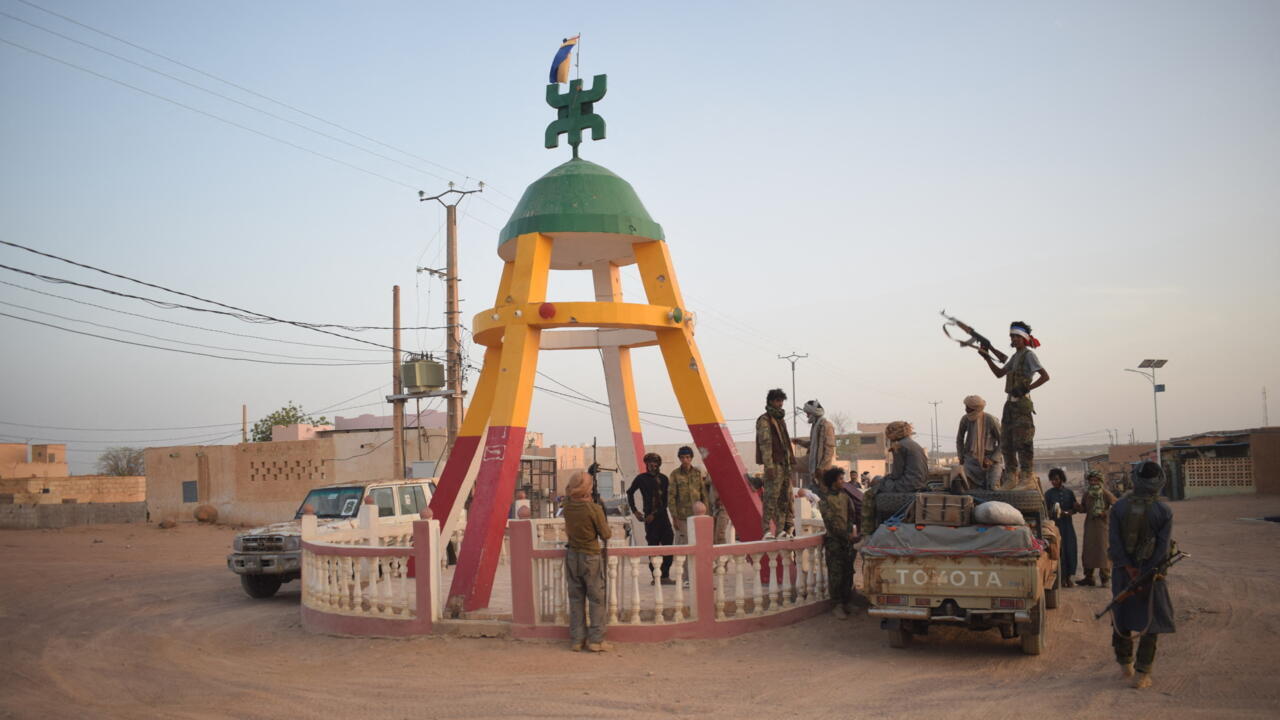
Mali has been plunged into its worse security crisis in more than a decade after Tuareg separatists and al Qaeda-linked jihadist fighters joined forces to launch sweeping attacks on Saturday, delivering a huge setback for its ruling military junta and its Russian allies.
Insurgents struck the main army base outside the capital Bamako and killed General Sadio Camara, the country’s defence minister, further undermining the junta’s claim that it is restoring order to impoverished West African nation that has long battled Islamist militants and separatist rebellions. The violence also saw rebel forces drive Russian mercenaries out of the key northern city of Kidal.
One of your browser extensions seems to be blocking the video player from loading. To watch this content, you may need to disable it on this site.
It was the most sweeping rebel offensive since 2012, when Tuareg separatists joined forces with Islamist groups and eventually seized control of two-thirds of the country. As fighters advanced on the capital, Mali’s government appealed to former colonial ruler France for reinforcements. After France helped oust the Islamists, the subsequent presence of French troops and a UN peacekeeping mission helped ensure a wary peace over most of the next decade.
A 2020 military coup in Mali saw relations with France deteriorate, and by 2022 France had withdrawn the last of its troops despite a jihadist resurgence.
But history now appears to be repeating itself, with many of the same players on the ground – alongside some new elements that further complicate Mali’s search for stability.
· Defence minister killed, key town captured
Several strategic towns and areas around Bamako were targeted in Saturday’s dawn offensive by Tuareg rebels of the Azawad Liberation Front (FLA) and the al Qaeda-linked jihadist Group for the Support of Islam and Muslims (JNIM).
Defence Minister Sadio Camara, seen as the military regime’s second-most-powerful figure and a key Moscow ally, was killed in an apparent suicide truck bombing on his residence in Kati, a garrison town near Bamako that serves as the junta’s headquarters.
JNIM fighters also struck near Bamako airport and in localities farther north, including Mopti, Sevare and Gao.
In another major blow to the junta, FLA rebels claimed “total” control of their historic northern bastion of Kidal, where they secured the withdrawal of junta-allied mercenaries from Russia’s Africa Corps, which has taken over from the Wagner paramilitary group in much of Africa.
Read moreStreet battles and withdrawal of Russian mercenaries: Inside the 48-hour fall of Mali’s Kidal
General Assimi Goita, the military ruler who deposed Mali’s civilian government in a 2020 coup, has not been seen or spoken publicly since the start of hostilities.
“This is a dramatic setback for the Malian government and a new phase in the ongoing insurgency in the Sahel,” said Andrew Leibovich, a research fellow with the Clingendael Conflict Research Unit focusing on North Africa and the Sahel.
“The fact that they were able to assemble so many fighters, particularly in and around Bamako and Kati, without detection and without the government being able to stop them, indicates how tenuous the security situation is, even around the capital,” he added.
· JNIM and FLA: Who are the insurgent forces?
One of Africa’s deadliest jihadist groups, JNIM formed in 2017 through the merger of five separate militant groups. It has been the main force behind a resurgence of jihadist attacks across several West African nations, including Mali’s neighbours Burkina Faso and Niger.
The group is believed to have around 6,000 fighters. Its leader is Iyad Ag Ghaly, the ethnic Tuareg head of the Ansar Dine Islamist group that took over the historic city of Timbuktu in northern Mali in 2012 and imposed sharia law there.
JNIM aims to establish Islamist governance across the Sahel. Its years-long insurgency broadened to economic warfare last year when it staged a fuel blockade that paralysed Bamako and large swaths of the country.
But experts have cast doubt on the group’s ability to govern.
“JNIM fighters don’t have the capacity to take and run a city like Bamako. What they are trying to do is to target major regime figures, destabilise the junta and perhaps spark an uprising,” said Ulf Laessing, head of the Sahel Program at the Konrad Adenauer Foundation.
One of your browser extensions seems to be blocking the video player from loading. To watch this content, you may need to disable it on this site.

Mali has been grappling with ethnic Tuareg rebellions since shortly after it gained independence from France in 1960. The Azawad Liberation Front (FLA), officially formed in November 2024, is just their latest iteration.
Present across the Sahara region, nomadic Tuaregs are fighting for an independent homeland they call “Azawad”. In 2012, it was the National Movement for the Liberation of Azawad (MNLA) that first swept through northern Mali until its campaign was hijacked by Islamist groups.
Mali struck a peace deal with Tuareg separatists in 2015, but the military junta withdrew from the agreement in 2024, leading to a resumption of hostilities.
In July 2024, Tuareg fighters attacked a convoy of Malian soldiers and Wagner fighters in the north, claiming to have killed 84 Russians and 47 Malian soldiers. Ukraine’s military intelligence service then suggested it had helped the Tuareg rebels carry out the attack by providing intelligence, and Mali responded by cutting ties with Kyiv.
· ‘A shaky, ad hoc alliance’
Saturday’s coordinated attacks mark the first time since 2012 that jihadists and Tuareg separatists have cooperated on this scale, providing the most concrete evidence yet of a rapprochement negotiated more than a year ago, according to FRANCE 24’s expert in jihadist networks Wassim Nasr.
“We now have proof that there is genuine coordination across the country: all these attacks took place simultaneously,” Nasr explained.
“The aim was not to bring down Bamako, but to tie down the army in order to cut off the north and gain control of it,” he added. “There is a clear coordination to resume fighting against the Malian junta, but also against the Russians.”
An FLA spokesperson confirmed the coordinated push on Sunday, stating that JNIM “is also committed to defending the people against the military regime in Bamako”.
However, analysts caution that the two groups have relatively little in common aside from a common enemy, suggesting theirs could be little more than an alliance of convenience.
“They both know they can’t really force regime change on their own – that’s why they are teaming up the way they did in 2012,” said Laessing. “The jihadists eventually got rid of the Tuaregs back then, so this is a very shaky, ad hoc alliance, and not something that can run Mali.”
· Twin blows for the junta
Saturday’s brazen attacks on the heart of government, coupled with the fall of Kidal, constitute major setbacks for a military junta that seized power in 2020 on a promise to stabilise the country and assert the central government’s control throughout its territory.
Kidal had long served as a stronghold of the rebellion before being taken by junta forces and mercenaries from Russia’s Wagner. Its capture in late 2023 marked a significant symbolic victory for the junta and its allies in Moscow.
One of your browser extensions seems to be blocking the video player from loading. To watch this content, you may need to disable it on this site.

The attacks on Kati and Bamako, and the killing of Defence Minister Camara, are “an even greater blow to the junta’s confidence”, said Paul Melly, Consulting Fellow on the Africa Programme at Chatham House.
“The fact that they could even launch a truck bomb at the house of the regime’s number two shows the fragility of the regime’s military hold. Even in Kati, basically the headquarters of the junta, they could not guarantee the security of their most senior figures,” he said.
“The reason the military junta took over from civilian authorities was because of the mounting insecurity in the region, under the promise that they would quell the violence. But the data shows that insecurity in Mali and across the Sahel region has only worsened,” added Folahanmi Aina, a lecturer at the School of Oriental and African Studies (SOAS) in London.
He pointed to early signs of a “legitimacy crisis” for the regime.
“While part of the population remains supportive of the junta, we’re beginning to see an erosion of trust in its ability to address the situation on the ground and guarantee the safety and security of the Malian people,” Aina said.
· Russia’s African ambitions undermined
The fall of Kidal and the failure to thwart attacks on Bamako and Kati have also exposed the limits of Russian military power in West Africa.
Russia’s Africa Corps confirmed its withdrawal from Kidal on Monday, acknowledging that “the situation in the Republic of Mali remains difficult”. Moscow also lost a key ally with the killing of Defence Minister Camara, a key architect of the rapid shift in alliances that saw the junta expel French and UN forces and turn to Russia for military support.
“The attacks show that Russian mercenaries only have a limited capacity, in stark contrast to the situation before the coup, when Mali had a military partnership with France and there was a very large UN peacekeeping force of 13,000-14,000 soldiers, many of them West African, which helped to maintain a basic degree of security and stability,” said Chatham House’s Melly.
One of your browser extensions seems to be blocking the video player from loading. To watch this content, you may need to disable it on this site.

“The French never really had a chance to pacify this vast country and the Russians even less so,” added Laessing. “In fact, they (the Russian mercenaries) made the conflict worse by being brutal and not distinguishing between civilians and combatants, which has made it easier for jihadists to recruit fighters.”
The regime’s political isolation – and that of allied juntas in Burkina Faso and Niger, which have also severed ties with France and left the ECOWAS group of West African states – has left them with few other options to confront the security emergency, he added.
“Mali, Niger and Burkina Faso are on a nationalist, anti-Western course and it is not clear who will want to engage with them,” Laessing explained. “I don’t think Europe or France will be willing or even welcome to put boots on the ground to help stabilise the situation, which is probably beyond a military solution anyway.”