‘I’m the only person who can do it’: Why 102-year-old Dachau survivor Jean Lafaurie tells his story

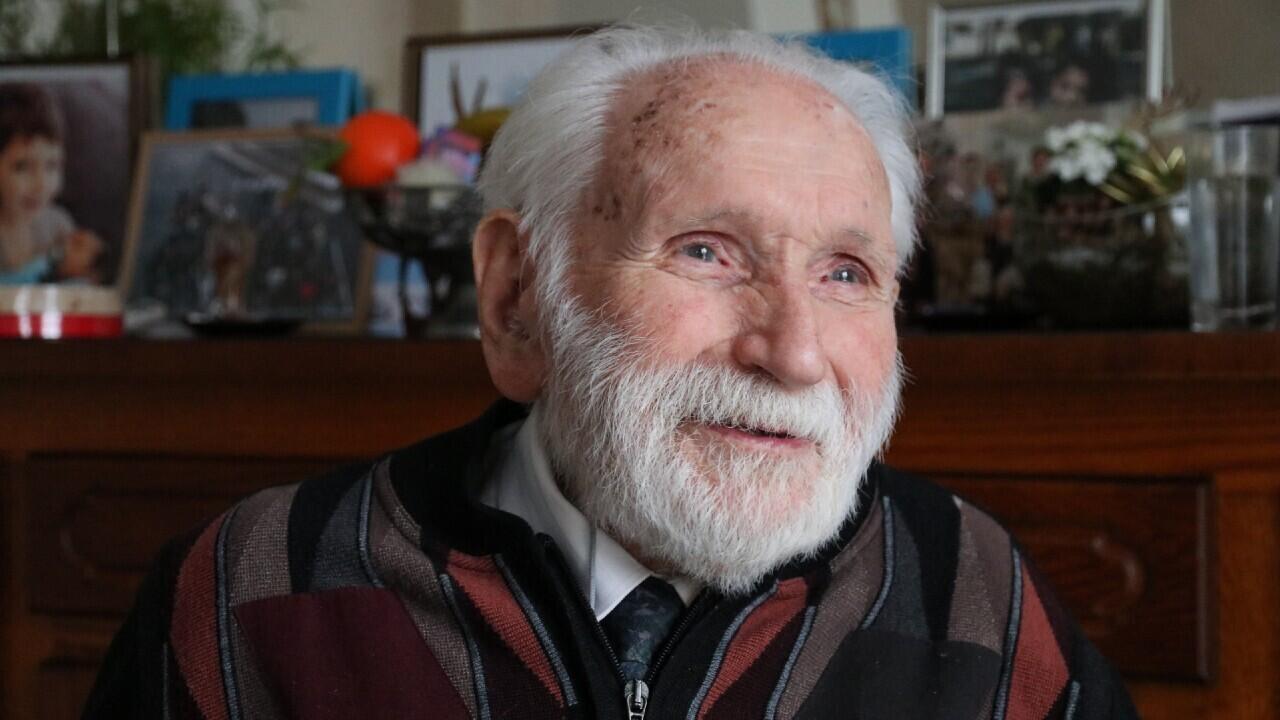
“I’m still a member of the resistance. I resist everything! The proof is that I’m still here.”
With a playful smile, Jean Lafaurie repeats the words that he has lived by his whole life: to continue to resist, no matter what.
He wears his 102 years lightly. Since his wife’s death, he lives by himself in his own home in the Seine-et-Marne department east of Paris, and manages his own packed schedule.
Read moreHolocaust survivor, 93, bears witness for young ‘messengers of peace’
Immaculately dressed, he receives visitors with a smile on his lips and a tie knotted firmly around his neck. The centenarian still looks at the world through the twinkling eyes of a boy who learned to say “no” at an early age.
“The red one is the Legion of Honour. The yellow is the Military Medal. The other one, it’s for volunteers who fought for the Resistance. And this one is the medal of deportation – the other one, I can’t remember anymore.” His proud eyes pass over the medals he earned half a lifetime ago. “The most beautiful to me is the Military Medal, because to receive it you have to have done something special – a major act for the Resistance.”
‘Patriotic to the core’
Lafaurie’s life spent fighting for his beliefs began in the small town of Souillac in France’s southwestern Lot region, where he was born to a family of modest means. He left school at 13 years old, throwing himself into the ideas that drove France’s left-wing Popular Front and the country’s thriving union movement. Soon, he joined the Communist Youth.
“The old folk told us about the First World War,” he said. “We were patriotic to the core.”
In May 1940, the sight of newspaper photos showing Nazi troops marching in the streets of Paris left him shaken.
“I broke down in tears, because it seemed impossible,” he said.
When a friend suggested they hand out political tracts and underground newspapers a few months later, Lafaurie didn’t hesitate.
“I said yes right away,” he said.
By day, Lafaurie sold scrap metal. By night, he handed out the words of the French Resistance. In March 1942, the police told him that they’d received a letter denouncing him. He denied everything, but knew that his days were numbered.
Lafaurie decided to join a group of partisans in the forests of Corrèze. The group took its name – Guy Môquet – from a young Communist member of the Resistance shot dead by the Nazis in 1941.
“There were 17 of us in the forest. We had nothing but an old parachute to keep the rain off us. We slept on the ground. Some days we didn’t eat,” he said. “Some of our weapons didn’t even work.”
In 1943, he was finally arrested by a Vichy police patrol.
“When they saw us coming out of a small path with our weapons, they quickly realised we weren’t out on a stroll,” he said.
The Eysses insurrection
It was the start of the young Lafaurie’s long stretch behind bars. He was imprisoned in Tulles, then in Limoges for “terrorist acts” before finally ending up in the Eysses detention centre in Villeneuve-sur-Lot. The Vichy authorities had locked up more than 1,200 members of the Resistance in this prison alone – most of them communists.
It didn’t take long for these deeply political prisoners to get organised. They negotiated a series of concessions from the prison director – including activities such as theatre and sporting competitions.
“We had a Youth Day,” Lafaurie said. “All the young people came in red, white and blue jerseys to form the French flag. There was even a portrait of De Gaulle.”

The “Eysses Republic”, as it became known, was not just a place of unlikely recreation: the prisoners were plotting their escape. On February 19 1944, a Vichy inspector-general paid a visit to the detention centre. The prisoners took him hostage, declaring themselves masters of the centre. A day of fierce fighting followed.
“A grenade landed at the feet of Louis Aulagne, one of our friends,” Lafaurie said. “He bent to pick it up and hurled it at a watchtower, but it exploded in mid-air. The blast cut him open. He died half an hour later.”
It was far from a fair fight. The Germans threatened to unleash their artillery on the prison, and the insurgents were forced to give themselves up. Twelve of the mutineers were shot dead on February 23. Lafaurie’s throat tightened when he spoke of his fallen comrades, and he had to pause.
“They refused to wear a blindfold,” he murmured at last.
The hell of Dachau
The surviving insurgents weren’t spared punishment. More than 1,000 men, including Lafaurie, were delivered into the hands of the Nazi authorities by the Vichy regime. They passed through the Royallieu internment camp in Compiègne and were deported in 1944 to Dachau concentration camp, the first camp opened by the Nazis in 1933 to hold the government’s political opponents.
“My first memory when we got off the train was young boys throwing stones at us,” Lafaurie said. “The kids had been told that we were criminals, that we had killed Germans. We were also surprised to see prisoners in striped uniforms beating other detainees.”

He knew he was stepping into a new world.
“We could have said, like Dante, ‘Abandon all hope, ye who enter here,’,” he said.
But the 20-year-old held on for 11 months, forced to work 12 hours a day in the BMW factory making parts for the German army. The workload was harsh; he was beaten regularly.
In January 1945, he cut his arm on a rusty piece of metal.
Read more‘Unwavering friendship’: The true story of nine women who escaped a Nazi death march
“It quickly became infected, and then inflamed,” he said. “I couldn’t get medical care. One day, I was so sick of my swollen arm that I told my friends I would stop eating – I preferred to die than continue to live like that. But one of them said to me, ‘Little one, if you let yourself die, I’m going to kick your arse, and that will hurt a lot more than your arm,’. It made me laugh, and I forgot what I’d just said.”
As in Eysses, it was this camaraderie that enabled the deportees to keep going. Every day, the prisoners kept a piece of bread or a mouthful of soup to give to the weakest among them.
“For me, what stuck with me the most was the solidarity,” he said. “When we have nothing left, what can we give? We realised that we could give a great deal. Even just a word of comfort.”

In the spring of 1945, after several air raid alerts, the prisoners knew that the Allies were advancing. They feared that the SS would kill them all to wipe away all trace of what they’d done – but in the end, the German military left the camp.
US troops entered Dachau on April 29.
“I needed someone to help me get up so I could make it to the fence to watch them arrive,” he said. “Obviously there was a great deal of joy, but we were also thinking of all those that we’d lost.”
More than 15,000 French passed through the concentration camp in total. Some 1,600 died there.

A long silence
Lafaurie weighed just 36 kilos when he came back to France. His family couldn’t believe what he’d been through.
“The worst was my mother,” he said. “She asked me to tell her what it had been like in the camps. I started writing, and after just three pages she told me that it wasn’t possible, that I was making things up. After that, I told myself that it wasn’t worth talking about it.”

Seven months after France was liberated from the Nazi occupation, Lafaurie married a young woman from the same part of France, with whom he had six children. His work in material handling led him to travel widely. He kept his silence over the decades. It wasn’t until he retired in 1983 that he decided to finally tell his story.
Since then, he travels across France throughout the year to share his story with students.
“I’m the only person who can do it,” he said. “I want people to know the story of Eysses and the deportation. They need to understand that what we did helped free France.”
Lafaurie, who saw his own childhood lost to war, makes no secret of the fear that he feels when he sees the way the world is going.
“The situation scares me, as it scares a lot of people,” he said. “History teachers bring me in to speak because they see what’s happening in Europe. It’s the hard right that’s been elected all over the place, and everyone’s rearming.”

Even at 102, Lafaurie is still ready to fight. Despite his age, he has no plans for a peaceful retirement.
“More than anything, I speak to young people about solidarity, and I tell them that freedom and democracy need to be defended,” he said. “Because I see that they can be suppressed overnight.”
This article has been adapted from the original in French by Paul Millar.