

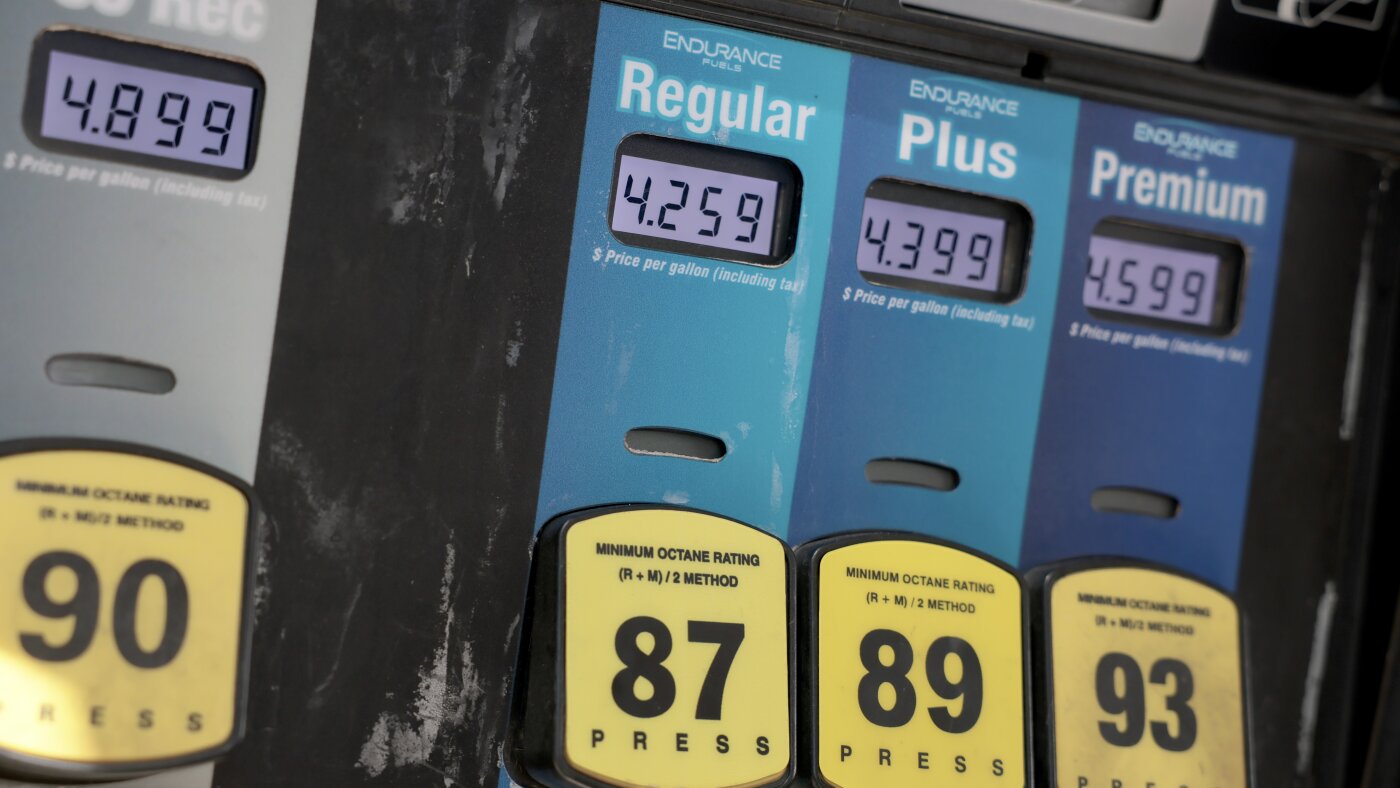
Gasoline prices jumped more than a dollar a gallon in March, pushing inflation higher.
Joe Raedle/Getty Images North America
hide caption
toggle caption
Joe Raedle/Getty Images North America
The U.S. war with Iran and the resulting spike in energy prices has pushed inflation to its highest level in nearly two years.

A report from the Labor Department Friday showed consumer prices in March were up 3.3% from a year ago. That’s the biggest annual increase since May of 2024. Prices jumped 0.9% between February and March, with higher gasoline prices accounting for nearly three-quarters of that increase.
Gas prices have jumped by more than a dollar a gallon, on average, since the U.S. and Israel launched their attack on Iran. Pump prices have remained high this week, despite a tentative cease fire.
Higher jet fuel prices also contributed to a jump in the cost of airline tickets last month, although food prices were flat, as rising costs for restaurant meals offset a decline in grocery prices.
Excluding volatile food and energy prices, so-called “core” inflation was 2.6% in March.
Inflation spike reverses stabilizing trend
Although inflation is nowhere near the four-decade high it reached in 2022, following Russia’s invasion of Ukraine, progress on stabilizing prices fizzled out last year, partly as a result of President Trump’s tariffs. The wartime jump in energy prices has pushed inflation even higher.

“We were making progress, making progress. Then we kind of stalled out and now it’s been inching itself up the other way,” Chicago Federal Reserve Bank President Austan Goolsbee told the Detroit Economic Club this week.
Goolsbee worries that the longer inflation stays above the Federal Reserve’s 2% target, the greater the risk that high inflation becomes baked into the economy. But a survey from the New York Fed this week showed that even though people expect higher inflation in the short run, they still believe it will come down in the long run.
Fed policymakers try not to over-react to a spike in gasoline prices which are notorious for bouncing up and down. But core inflation has also been climbing, which is likely to make the central bank cautious about any quick cuts in interest rates.
The Fed is also keeping a close eye on the job market, which showed some signs of life in March when employers added 178,000 jobs, after cutting workers the previous month. While employers have not been adding a lot of jobs, they’ve been reluctant to lay people off as well.
“I think it’s from uncertainty,” Goolbee said. “I think that’s what happens when businesses are uncertain and they say we’re just going to sit on our hands until we figure out, is the war going to be a temporary shock?”