
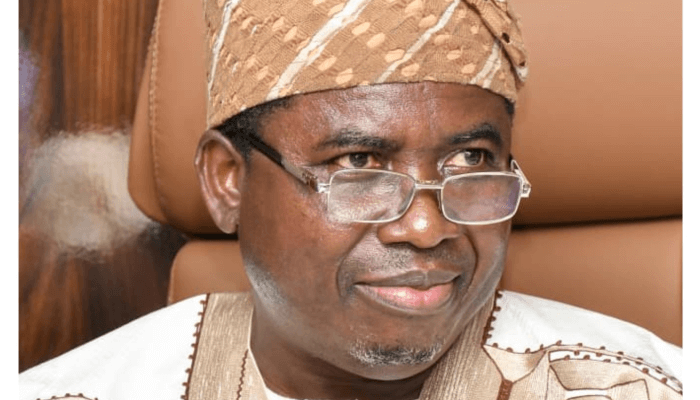
Joash Amupitan, the chairman of the Independent National Electoral Commission (INEC)
The chairman of Nigeria’s electoral commission has told citizens to temper their expectations ahead of the 2027 general election, saying that operational constraints, particularly in remote areas, make a flawless exercise unrealistic.
Speaking at a citizens’ town hall broadcast live on major television networks on Sunday, Prof. Joash Amupitan said the Independent National Electoral Commission was committed to delivering its best performance but could not guarantee perfection. “INEC will strive as much as possible to give this country the best election,” he said. “However, we may not be able to achieve a 100 per cent perfect election for now.”
On the question of electronic transmission of results, which became one of the most bitterly contested issues in the aftermath of the 2023 elections, Amupitan said the commission had the capacity to transmit results in 2027 and intended to do so. The sticking point, he said, was not technology or network coverage in principle, but the practicality of achieving real-time transmission from Nigeria’s most inaccessible polling units.
He illustrated the challenge with a concrete example from the recent Federal Capital Territory Area Council elections. Five of the six area councils returned results on time, but a single ward in Kuje — Kabi ward, roughly three and a half hours from Kuje town across difficult terrain, went completely out of contact on election day. “The moment they entered that place, we could not reach them. They were not accessible by phone,” he said. Results from that ward did not arrive until the following morning.
Read Also: Will PDP, LP, ADC sheath swords for the common candidate?
Amupitan was careful to frame the problem as one of infrastructure adequacy rather than institutional failure. “The problem is not even the network. The problem I have seen is the adequacy of the network we have.” He also acknowledged logistical shortcomings in the FCT poll, including human errors, but said the commission was addressing them. “Your election can be as good as your logistics. Where there is logistics failure, you know that you are beginning to fail.”
Despite the caveats, he expressed confidence that 2027 would represent a meaningful improvement on previous elections, citing what he described as a more politically aware electorate. “The Nigerians of 2023 are different from what you have in 2027. People are much more aware.”
Presenter Seun Okinbaloye and Yiaga Africa executive director Samson Itodo anchored the town hall, which had APC National Chairman Nentawe Yilwatda, Labour Party Interim National Chairman Nenadi Usman, former Education Minister Oby Ezekwesili, and Senator Ireti Kingibe, among others in attendance.
Separately, INEC has convened a technical workshop in Abuja to carry out a clause-by-clause review of the regulations governing political parties, aligning its subsidiary rules with the Electoral Act 2026 and drawing lessons from persistent problems identified in previous election cycles — among them opaque party primaries, membership disputes, weak financial disclosure, and the systematic exclusion of women, youth, and persons with disabilities from party structures.
The commission said it intended to shift its regulatory posture from reactive enforcement to proactive supervision based on measurable standards, supported by its Political Party Performance Index. Technical facilitation is being provided by the Westminster Foundation for Democracy alongside Nigerian legal and electoral experts.
WFD Nigeria Country Director Adebowale Olorunmola described the exercise as consequential. “This isn’t just a review of a document; it is a reconstruction of the democratic foundation,” he said. “We are moving toward an era where political parties are held to the same high standards of integrity as the electoral commission itself.”
INEC will validate the consolidated draft internally before sharing it with the Inter-Party Advisory Council and all registered parties.