
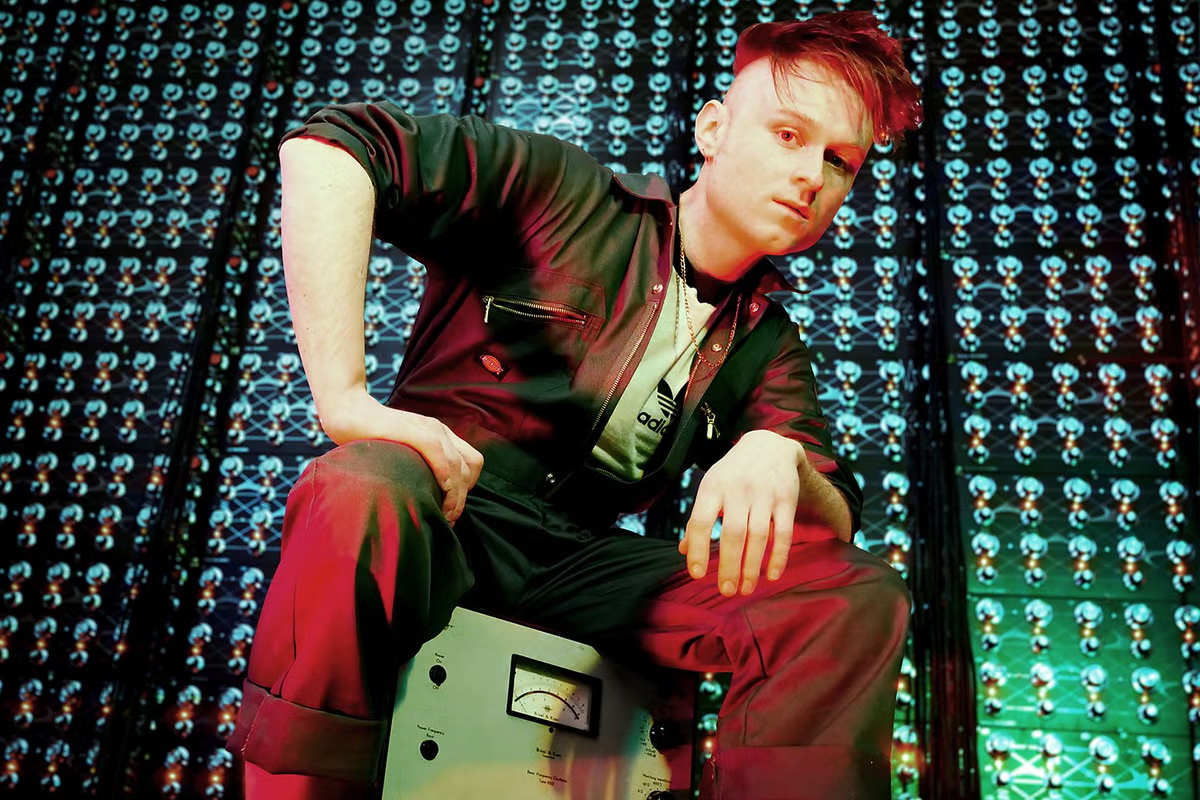
Kent-based solo artist and YouTube star Look Mum No Computer has been announced as the singer representing the UK in this year’s Eurovision Song Contest.
The news was announced on the Scott Mills Breakfast Show on BBC Radio 1 on Tuesday morning (17 February), ahead of the competition, which is taking place in Vienna, Austria, in May 2026.
The musician, born Sam Battle, said in a statement: “I find it completely bonkers to be jumping on this wonderful and wild journey. I have always been a massive Eurovision fan, and I love the magical joy it brings to millions of people every year, so getting to join that legacy and fly the flag for the UK is an absolute honour that I am taking very seriously.
“I’ve been working a long-time creating, writing, and producing my own visions from scratch, and documenting my process. I will be bringing every ounce of my creativity to my performances, and I can’t wait for everyone to hear and see what we’ve created. I hope Eurovision is ready to get synthesised!”
Battle previously fronted the indie-rock band ZIBRA, who performed at Glastonbury in 2015 for BBC Introducing. Since then, however, he has pursued a solo career with a more electronic and synth-based sound, releasing a string of singles, EPs and full-length albums.
He may be best known for his popular YouTube channel, launched in 2016, in which he builds and plays eccentric electronic instruments. Examples include organs crafted from Furbies and Game Boys, synthesizer bicycles and flame-throwing keyboards.
Battle also holds a Guinness World Record for building the world’s largest drone synthesiser. His music has been described as “experimental”.
In addition to his music and content creation careers, he has overseen the opening of a interactive museum in Kent, which “celebrates obsolete and experimental technology”, and has also put his name to a synthesizer-based video game.
Battle’s name is certainly appropriate given the UK’s patchy performance history at Eurovision in recent years. Last year’s entry, country-pop trio Remember Monday, crashed into 19th place (out of a possible 26) following their performance of original song “What the Hell Just Happened?”.
It was a similarly poor result in 2024 when pop singer Olly Alexander competed with his song “Dizzy”, coming in 18th place, and again in 2023 with Mae Muller singing “I Wrote a Song”, landing a dismal 24th place out of 25.
The most successful entry in recent years was Sam Ryder, who dazzled with his Freddie Mercury-emulating rock song “Space Man!” in 2022, coming in second place after Ukraine’s winning entry, Kalush Orchestra.
Battle, who will perform at Eurovision under his Look Mum No Computer moniker, was chosen as the UK’s representative following a search led by the UK’s Eurovision project director David May, along with BBC Studios North executive producer Andrew Cartmell.
His single will debut on BBC radio in the coming weeks, on The Scott Mills Breakfast Show on BBC Radio 2 and BBC Sounds.
Kalpna Patel-Knight, head of entertainment at the BBC, said: “We are absolutely thrilled to have Look Mum No Computer representing the UK at Eurovision in Vienna in 2026. His bold vision, unique sound and electric performance style make him a truly unforgettable artist.
“Look Mum No Computer embodies everything the UK wants to celebrate on the Eurovision stage – creativity, ambition, and a distinctly British wit. I am sure he will make us all proud on the international stage in May.”
The 2026 Eurovision Song Contest will feature the smallest number of participating countries since 2003, when the semi-finals were introduced.
Five countries – Iceland, Ireland, the Netherlands, Slovenia, and Spain – are boycotting Eurovision over the decision to allow Israel to compete.