

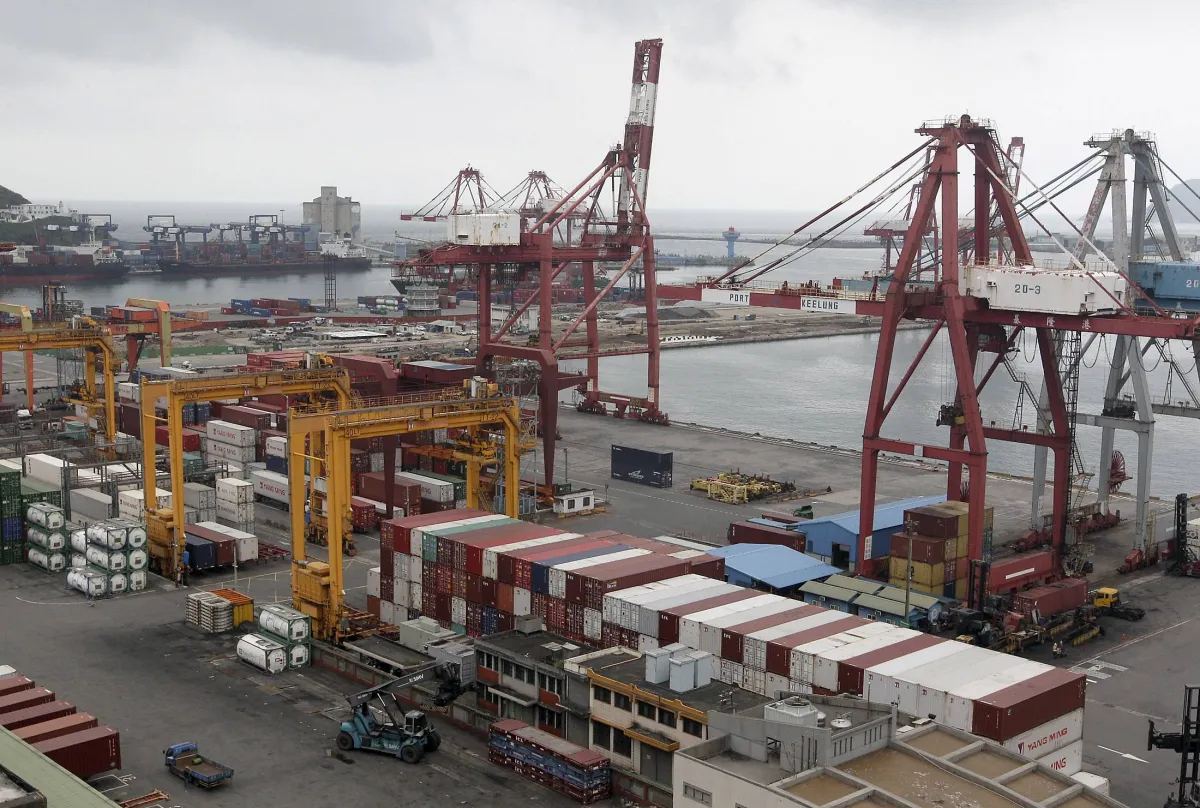
The Trump administration reached a trade deal with Taiwan on Thursday, with Taiwan agreeing to remove or reduce 99% of its tariff barriers, the office of the US Trade Representative said.
The agreement comes as the US remains reliant on Taiwan for its production of computer chips, the exporting of which contributed to a trade imbalance of nearly $127 billion during the first 11 months of 2025, according to the Census Bureau.
Most of Taiwan’s exports to the US will be taxed at a 15% rate, the USTR’s office said. The 15% rate is the same as that levied on other US trading partners in the Asia-Pacific region, such as Japan and South Korea.
Trade Representative Jamieson Greer and Commerce Secretary Howard Lutnick attended the signing of the reciprocal agreement, which occurred under the auspices of the American Institute in Taiwan and the Taipei Economic and Cultural Representative Office in the United States. Taiwan’s Vice Premier Li-chiun Cheng and its government minister Jen-ni Yang also attended the signing.
“President Trump’s leadership in the Asia-Pacific region continues to generate prosperous trade ties for the United States with important partners across Asia, while further advancing the economic and national security interests of the American people,” The Associated Press quoted Greer as saying in a statement.
The Taiwanese government said in a statement that the tariff rate set in the agreement allows its companies to compete on a level field with Japan, South Korea and the European Union. It also said the agreement “eliminated” the disadvantage from a lack of a free trade agreement between Taiwan and the US.
The deal comes ahead of President Donald Trump’s planned visit to China in April and suggests a deepening economic relationship between the US and Taiwan.
Cheng said Taiwan hopes the agreement will make it a strategic partner with the US “so as to jointly consolidate the democratic camp’s leading position in high technology.”
The agreement would make it easier for the US to sell autos, pharmaceutical drugs and food products in Taiwan. But the critical component might be that Taiwanese companies would invest in the production of computer chips in the US, possibly helping to ease the trade imbalance.
In a separate but related deal, Taiwan will make investments of $250 billion in US industries, such as computer chips, artificial intelligence applications and energy. The Taiwanese government says it will provide up to an additional $250 billion in credit guarantees to help smaller businesses invest in the US.
The investments helped enable the US to reduce its planned tariffs from as much as 32% initially to 15%.
Taiwan’s government said it will submit the reciprocal trade deal and investment plans to its legislature for approval.
In Taipei, President Lai Ching-te told reporters that Taiwan had agreed to reduce tariffs on imports from the US but stressed that the rate on 93 items would remain unchanged to protect important agriculture and industrial sectors such as rice farming.
The US side said the deal with Taiwan would help create several “world-class” industrial parks in America in order to help build up domestic manufacturing of advanced technologies such as chips. The Commerce Department in January described it as “a historic trade deal that will drive a massive reshoring of America’s semiconductor sector.”
In return, the US would give preferential treatment to Taiwan regarding the possible tariffs stemming from a Section 232 investigation of the importing of computer chips and semiconductor manufacturing equipment.