
“No roti due to gas cylinder crisis.” “Only coffee and tea available today.” Signs like these have been popping up more and more frequently on Indian storefronts over the past few days.
These are one of the ripple effects of the war unfolding in the Middle East. India’s supply of liquefied petroleum gas (LPG) – a primary cooking fuel in the country – has faced disruption following US-Israeli strikes on Iran, which led to a near-total blockade of the strategic Strait of Hormuz.
India imports about 60% of its cooking gas, and around 90% of those imports come from the Middle East.
India has repeatedly said there was no LPG shortage, with Prime Minister Modi saying on March 12 that “some people (…) are trying to create panic.”
But while the government invoked emergency powers to boost national LPG production and cut sales to industry to prioritise supply to households, this has left restaurant owners struggling to secure sufficient fuel.
‘Our menu has been reduced by almost 50%’
We spoke to Syed Jameel, the owner of a dozen restaurants in Bengaluru, the capital of India’s southern Karnataka state:
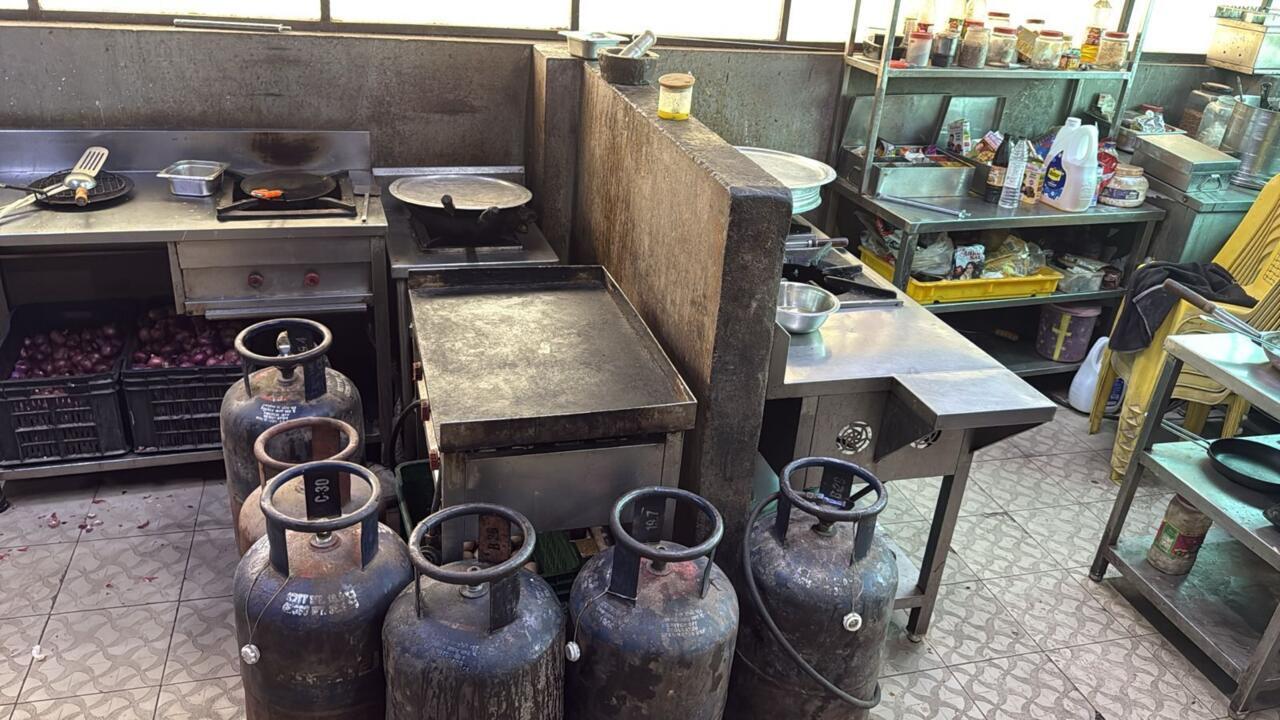
“We are finding it really difficult. The supply is really low. We aren’t able to get gas. All the commercial supplies have been stopped. In India, one gas cylinder is about 21 kilograms. We use about 15 to 20 cylinders a day. And for the available gas, the prices are nearly four times the actual price.
So slowly we have reduced the menu. We just cut down the menu. Our menu has been reduced by almost 50%.”
In Raysan, in the northwestern state of Gujarat, chef Liju Ninan faces a similar situation with his Spicy Dine Inn restaurant.
“We’re just surviving. We don’t have any supplies.
Normally, the supply comes every week. When I called our supplier, the phone was switched off. I thought he might have gone to a wedding or some hospital issue. The next day, his son told me that his father had kept his phone switched off because he was receiving 100 calls daily.
We have reduced the menu. We only have two to three items: one vegetarian, one non-vegetarian. Usually, we have seafood, we have mutton, we have chicken. Now, only the basic chicken item will be cooked. We cook chicken in a pressure cooker so that the consumption of gas is reduced.”
In response to the ongoing disruptions, restaurants nationwide have turned to social media to alert customers of menu changes.
“We are compelled to limit the number of dishes and include only essential food items,” a vegetarian restaurant in Kochi, Kerala state, wrote on Facebook on March 13, pointing to a “nationwide shortage in the availability of cooking gas”.
The National Restaurant Association of India (NRAI) wrote to the minister for petroleum and natural gas on March 11, calling for the uninterrupted supply of commercial LPG to restaurants. They stressed that the restaurant industry is highly dependent on LPG, and food supply is an essential service.
Restaurant associations have also pointed to widespread confusion among distributors regarding recent government notifications, calling on authorities to provide clarity on commercial LPG supplies.
The government has said it has set up a panel to review requests from the industry.
Restaurants turning to charcoal, wood or electric air fryers
To keep their kitchens running, restaurant owners try to pivot to alternative energy sources whenever possible.
A restaurant in Madurai, in the state of Tamil Nadu, warned on March 10 of a “slight delay in service” because “some items are being prepared using coal instead of gas, which may take a little longer.”
But this is no magic bullet, according to Jameel:
“There are alternatives. We have electric fryers. Two days ago, I purchased a lot of electric oil fryers. Charcoal is also used. BBQ is also used.
So whatever can be prepared in a fryer, we can serve. But much of the food which is served here is gravy. So it needs a constant flame. You cannot depend on charcoal or firewood for that.”
Chef Liju Ninan said he would need to start adopting wood fire or charcoal “within the next two days” if the crisis continues, but also stressed that “it generates smoke” and “is not practically possible”.
Besides reducing items that require long simmering and using lids while cooking, the NRAI also told its members to consider shorter operating hours.
That’s what chef Liju Ninan resolved to do:
“Now, we are closed in the morning and in the afternoon. We are only open in the evenings.
Tomorrow, for the college, we also had an event for two days. I just cancelled it because of a lack of LPG.”
‘If the crisis continues for another five days, I will have to shut down’
In light of the current situation, chef Liju Ninan warns of grave consequences if the crisis is not resolved:
“The government has to take proper, appropriate action because we, small vendors or small restaurant owners, what can we do? We don’t have an option apart from shutting down the premises and losing our customers.
If the crisis continues for another five days, I will have to shut down.”
Jameel shared similar concerns:
“I look around when I go out. I see small shops have closed. The bigger restaurants have cut down their menu, which is a sign that they will be shortly running out of resources.
I have a centralised kitchen where I have stocked a couple of gas cylinders. So I think I can supply gas for another four to five days. Because gas is not something you can stock. It’s not safe. It’s not like food items, like rice or flour, that you can stock.”
The Hotel and Restaurant Association (Western India) warned on March 11 that half of the restaurants in Mumbai may be forced to close if the situation doesn’t improve within the next two days.
‘It’s not only money (…) it’s also about passion’
While his doors remain open for now, Jameel says he is already feeling the economic toll.
“Already, almost about 30% to 40% of business is low now. Customers are there, but what they want isn’t.
I don’t know why we should suffer for somebody else fighting. The sufferers are not only us: it’s also the labourers who are working, the cooks who are there. It is also going to affect them.”
“And it’s not only money,” chef Liju Ninan adds. “Everybody doesn’t run the shop for money, but it’s also about passion. I’m a chef. I cook with my heart for my customers.”