

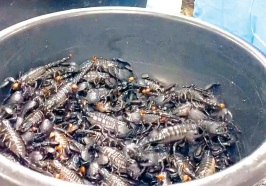
As scorpions continue to produce drops of liquid venom valued at around $39 million per gallon, they offer a compelling reminder that innovation often lies in overlooked places waiting to be unlocked. Medical experts say the venom can be used to treat many illnesses and could also contribute significantly to the economy. UDEH ONYEBUCHI reports.
A thin glass capillary fills slowly with a clear droplet.
Under laboratory light, it looks ordinary until its value is calculated.
Less than a millilitre of scorpion venom has just been extracted in a quiet laboratory in Isolo, Lagos.
On the global biomedical market, liquids like this rank among the most expensive substances on earth.
Industry estimates compiled by international toxin trade platforms and pharmaceutical procurement reports, including those cited by global digital news organisation Business Insider in an interview with Venomtech CEO Steve Trim, place purified scorpion venom at up to $39 million per gallon, depending on species and peptide concentration.
Behind the glass enclosure, the scorpion curls back into stillness, alive and unharmed. Around it, thousands more wait – biological assets in an industry Nigeria has barely begun to notice.
This is not a scene from science fiction. It is the daily reality inside one of the country’s most unconventional biomedical ventures, where fearsome creatures are quietly being transformed into export-grade research materials with implications far beyond a single laboratory.
At the centre of it all is Muhammad Usman, a retired Nigerian Air Force corporal turned pioneer of commercial scorpion farming—an enterprise sitting at the intersection of agriculture, medicine and global science markets.
From combat zones to controlled laboratories
Usman’s journey into venom science did not begin in a laboratory. It began in uniform.
He joined the Nigerian Air Force in 2013 and served during intense internal security operations across northern Nigeria, participating in missions such as Operation Safe Haven, Operation Harbin Kunama and Operation MESA.
The experience, he says, shaped both his discipline and patience, qualities that would later prove essential.
When he retired from active service in December 2014, few imagined that his next mission would involve breeding scorpions.
Yet the transition, while unexpected, was not accidental.
“The Air Force teaches structure, precision and emotional control. Those things stay with you,” he said.
The moment curiosity took hold
The “Scorpion Doctor,” as he is now known, explained that the idea emerged during a quiet moment on sentry duty.
Scrolling through his phone, Usman came across an article describing commercial scorpion farming in Morocco, where venom extraction had been systematised for pharmaceutical export.
“It immediately caught my attention, not because it was strange, but because it was structured,” he said.
Instead of dismissing it as impractical, Usman began researching obsessively, studying scorpion biology, venom chemistry, extraction techniques and international demand.
He started small, keeping fewer than ten scorpions at home to observe their behaviour and survival needs.
Those early experiments delivered a reality check: scorpion farming was slow, capital-intensive and unforgiving of mistakes.
Balancing military responsibilities with experimental farming soon became impossible.
Usman sought partners and investors, openly outlining the risks, long gestation period and delayed profitability.
“This is not quick money. You must understand the waiting,” he warned potential entrepreneurs.
Fear, myth and biological reality
In popular imagination, scorpions are symbols of danger. In Usman’s laboratory, they are treated with studied calm.
“Scorpions are defensive, not aggressive. They sting only when they feel threatened,” he explained.
Years of observation have allowed him to handle them with confidence, understanding stress triggers and environmental needs.
That knowledge is essential because stress directly affects venom quality.
Scorpion farming remains exceedingly rare in Nigeria.
According to Usman, his facility in Isolo is currently the only fully operational commercial scorpion farm in the country, although he also trains interested individuals under strict guidelines.
High capital, higher precision
The economics of scorpion farming quickly dispel any illusion of simplicity.
Usman noted that scorpions are sourced from forest hunters at an average cost of N5,000 each, and that the Isolo facility houses over 10,000 scorpions.
He said more than 600 transparent enclosures, costing about N3,000 each, are used to isolate and monitor individual animals.
He also explained that venom storage requires biomedical-grade freezers, some costing up to N6 million, to preserve peptide stability for export.
Recreating nature indoors
In the wild, Usman explained, scorpions can live up to eight years. But in captivity, their lifespan often drops unless conditions are carefully replicated.
He said each enclosure contains water sources, tree stems and textured surfaces designed to mimic forest habitats.
Even with these measures, Usman estimates a controlled lifespan of about five years.
Feeding presents another challenge
He emphasised that scorpions consume live prey, including cockroaches, snails and especially mealworms, which are difficult to source locally.
Substitutes such as black soldier fly larvae, he said, do not work.
“Mealworms are not widely farmed in Nigeria, and scorpions cannot survive on substitutes like black soldier fly larvae,” he said.
Usman believes this gap presents a new business opportunity within the agricultural value chain.
“If you go to Dubai, Malaysia and Pakistan, they have people into mealworm farming and cockroach breeding who earn a lot of money from the business,” he said.
Harvesting without killing
He also noted that venom extraction is neither frequent nor forceful.
Using low-voltage electrostimulation, tweezers and tongs, Usman and his team extract venom from roughly 1,000 scorpions per day, yielding only nine to ten millilitres in total.
Each scorpion is rested for seven to ten days between extractions to minimise stress.
Contrary to popular belief, he said the scorpions survive the process.
“Killing them would destroy the sustainability of the operation. There are methods to extract venom without causing harm. However, regular extraction places stress on them and can affect reproduction,” he said.
Explaining the method, he said that once stimulated, the scorpion releases venom naturally and is returned to its enclosure to recover.
Evolutionary biologist Dr. Arie van der Meijden of the CIBIO-InBIO Institute in Portugal confirmed this in comments to IFLScience, explaining that the extraction does not harm the animal and that scorpions resume normal activities, including feeding, almost immediately.
The venom is collected, sealed and immediately frozen for preservation before export under strict agreements to pharmaceutical firms and research institutions.
Why a clear liquid is worth millions
Usman explained that not all scorpions are equal.
Certain species, including the Emperor scorpion, are prized for their higher venom yield and peptide diversity.
Once purified, he noted, the venom becomes raw material for advanced biomedical research.
Usman said global demand continues to rise, with prices ranging from $7,000 to $9,000 per litre, while a gallon can cost as much as $39 million.
“The global market for scorpion venom is growing rapidly. This is not something you can just sell casually,” he said.
“Go online and you will see different sources showing that one gallon of scorpion venom can cost up to $39 million. When converted to naira, the worth is extraordinary.”
International toxin trade databases and pharmaceutical sourcing reports corroborate these figures, noting that premium species command even higher prices.
Dr. van der Meijden also explained that while venom can sell for hundreds of dollars per microgram, laboratories typically require only very small quantities for years of research.
“It’s very expensive to buy, and the venom has to be extremely high quality. Refining it to isolate specific components is even more costly,” she said.
Medicine, not myth
The President of the Association of Medical Laboratory Scientists of Nigeria (AMLSN), Dr. Casmir Ifeanyi, explained that scorpion venom is a complex mixture of bioactive peptides capable of interacting with human cells in highly specific ways.
“These peptides can distinguish cancer cells from normal cells,” he said, making them valuable for tumour imaging, targeted therapy and experimental drug development.
He added that international studies have already applied venom-derived compounds in brain tumour surgeries, helping surgeons identify tumour margins more precisely.
Other research explores applications in epilepsy, Parkinson’s disease, autoimmune disorders, cardiovascular conditions and drug-resistant infections.
Recent studies in Mexico and the United States have identified new antimicrobial compounds from scorpion venom with activity against tuberculosis and Staphylococcus.
According to a Stanford News report, scorpion venom expert Prof. Lourival Possani of the National Autonomous University of Mexico, who has spent 45 years collecting and analysing venom compounds, said some species are difficult to access.
“Venom from the eastern Mexican scorpion species Diplocentrus melici is hard to come by. During winter and dry seasons, the scorpion is buried. We can only find it in the rainy season,” he said.
Nigeria’s missed advantage
Dr. Ifeanyi emphasised that despite abundant scorpion species, Nigeria remains largely absent from the global venom-based research economy.
He lamented that most extraction efforts are private, small-scale and focused on exporting raw materials without value addition.
“We produce papers, not products. Research that does not translate into therapy or industry is wasted effort,” he said.
He called for government-backed applied research, stronger regulation and institutional support under the Ministry of Science and Innovation to develop a local biopharmaceutical pipeline.
Beyond economics, he warned of ecological consequences.
Scorpions, he said, play critical roles in soil aeration and pest control, and their decline, driven by herbicide use and habitat loss, disrupts local ecosystems.
Returning to the droplet
Back in the Isolo laboratory, the glass capillary is sealed and labelled. Another extraction cycle is complete.
The scorpion retreats into its enclosure. The droplet will travel first into cold storage, then across borders, and eventually into laboratories where it may help map tumours or fight resistant infections.
For Nigeria, questions linger: will this remain a curiosity driven by a handful of disciplined pioneers, or become a deliberate national industry?