
2
… Tinubu Declares Armed Non-State Actors as Terrorists
… Budget Of Consolidated Renewed Sufferings, Says PDP
SAMUEL OGIDAN; INNOCENT OWEH ; SOLA SHITU,
ABUJA – Few hours before President Bola Tinubu went to the National Assembly to present the 2026 budget, the Federal Executive Council (FEC) first approved the draft bill of N58.47 trillion, representing a six per cent increase over the 2025 budget.
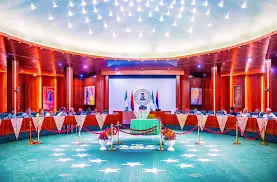
President Tinubu convened the emergency session at the State House, Abuja, on Friday, to consider a single-item memorandum on the 2026 estimates. He was represented at the meeting by Vice President Kashim Shettima.
Meanwhile, the Peoples Democratic Party (PDP) has described the 2026 budget presented by President Bola Ahmed Tinubu to the joint session of the National Assembly, as a budget of consolidated renewed sufferings.
The budget, themed as ‘Budget of Consolidation, Renewed Resilience and Shared Prosperity,’ claimed that the economy is stabilising and promises shared prosperity.
Responding to the budget, PDP, in a statement on Friday in Abuja by its National Publicity Secretary, Comrade Ini Ememobong, said that Nigerians see it as budget of consolidated renewed sufferings, because what they have witnessed since the birth of this administration is nothing but unmitigated hardship on the people, while the governing class relishes in affluence.
“President Bola Ahmed Tinubu undertook the yearly ritual of presenting the 2026 budget to the National Assembly.
“The budget, which is themed ‘Budget of Consolidation, Renewed Resilience and Shared Prosperity,’ claims that the economy is stabilising and promises shared prosperity.
“In response, we see it rather as a budget of consolidated renewed sufferings, because what Nigerians have witnessed since the birth of this administration is nothing but unmitigated hardship on the people, while the governing class relishes in affluence.
“Nigerians have suffered greatly from many economic woes under this administration.”
The Director-General of the Budget Office of the Federation, Dr. Tanimu Yakubu, said the expenditure framework comprises projected spending by government-owned enterprises (GOEs) totalling N4.98 trillion, alongside N1.37 trillion for grants and donor-funded projects.
The proposal also provides N4.1 trillion for statutory transfers.
N15.52 trillion for debt servicing, including N3.39 trillion for a sinking fund to retire maturing domestic obligations owed to contractors and other creditors.
N10.75 trillion for personnel costs, including pensions, 7% higher than 2025 and incorporating N1.02 trillion for GOEs.
N2.22 trillion for overheads
Total capital spending is set at N25.68 trillion, a 1.8% reduction from the 2025 capital provision.
Yakubu said the adjustment reflects “a more conservative approach to capital planning,” with priority placed on completing ongoing projects and securing value for money.
He listed capital allocation priorities as:
N11.3 trillion for ministries, departments and agencies (MDAs)
N2.05 trillion for multilateral and bilateral loan-funded capital projects
N1.8 trillion as the capital component of the development levy.
Yakubu said the 2026 budget is structured to balance macroeconomic stabilisation and development imperatives within the medium-term fiscal framework.
He added that the assumptions underlying the budget are “conservative and realistic,” particularly regarding oil price benchmarks, exchange-rate assumptions and expected dividends from GOEs.
On the revenue outlook, the DG said projected government revenues are expected to decline year-on-year.
However, non-oil revenues now make up about two-thirds of total receipts, signalling a structural shift away from crude oil dependence.
Corporate income tax, value-added tax, customs revenue and independent income remain the government’s fiscal anchors.
Yakubu noted that expenditure growth is being driven mainly by debt servicing, wages and pensions, not discretionary spending, while the anticipated fiscal deficit reflects structural pressures rather than policy loosening.
He said financing the deficit will rely largely on domestic borrowing, supported by concessional multilateral loans.
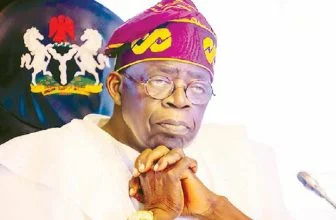
The President, addressing lawmakers at the National Assembly Complex in Abuja, said the 2026 budget was designed to lock in recent macroeconomic gains, strengthen national security, and translate economic recovery into improved living standards for Nigerians after two and a half years of difficult but necessary reforms.
“This is a defining moment in our national journey of reform and transformation,” Tinubu told senators and members of the House of Representatives. “The reforms were not painless, but they were unavoidable. The sacrifices of Nigerians are not in vain.”
Tinubu said the budget was prepared against the backdrop of improving economic indicators, arguing that Nigeria was moving from crisis management to consolidation.
He cited economic growth of 3.98 per cent in the third quarter of 2025, compared to 3.86 per cent in the same period of 2024, alongside eight consecutive months of declining inflation. Headline inflation, he said, had moderated to 14.45 per cent in November 2025 from a peak of 24.23 per cent in March.
“With stabilising food and energy prices, tighter monetary conditions, and improving supply responses, we expect the disinflationary trend to persist through 2026, barring major shocks,” the President said.
He also pointed to improved oil production, rising non-oil revenues driven by better tax administration rather than “excessive taxation,” renewed investor confidence, and a rebound in external reserves to about $47 billion as of mid-November 2025, representing over ten months of import cover.
“These outcomes are not accidental,” Tinubu said. “They reflect deliberate policy choices. Our task now is to ensure that stability becomes prosperity, and prosperity becomes shared prosperity.”
Reviewing the performance of the outgoing 2025 budget, Tinubu acknowledged execution challenges, particularly in capital spending, due to the transition period and the extension of the 2024 capital budget.
As of the third quarter of 2025, the Federal Government recorded ₦18.6 trillion in revenue, representing 61 per cent of the target, while expenditure stood at ₦24.66 trillion, about 60 per cent of projections. Only ₦3.10 trillion—roughly 17.7 per cent of the 2025 capital budget—had been released by Q3.
The President assured lawmakers that 2026 would mark a turning point in fiscal discipline and execution.
“I have issued clear directives to ensure that the 2026 budget is implemented strictly in line with appropriate details and timelines,” he said, warning that government-owned enterprises (GOEs) would be held to stricter revenue remittance standards.
He announced plans for endto-end digitisation of revenue mobilisation across ministries and agencies, including automated reconciliation, real-time dashboards, and data-driven performance tracking to plug leakages and enforce accountability.
Under the proposed fiscal framework, the Federal Government expects total revenue of ₦34.33 trillion against projected expenditure of ₦58.18 trillion, including ₦15.52 trillion for debt servicing.
Recurrent non-debt expenditure is pegged at ₦15.25 trillion, while capital expenditure stands at ₦26.08 trillion. The budget deficit of ₦23.85 trillion represents 4.28 per cent of GDP.
Tinubu said the assumptions underpinning the 2026–2028 Medium-Term Expenditure Framework include a crude oil benchmark of $64.85 per barrel, daily production of 1.84 million barrels, and an exchange rate of ₦1,400 to the dollar.
“These figures are not mere accounting lines,” he said. “They reflect our commitment to fiscal sustainability, debt transparency, and value-for-money spending.”
Security Takes Centre Stage
Security emerged as one of the most striking elements of the President’s address, both in allocation and policy direction.
The 2026 budget proposes ₦5.41 trillion for defence and security, the largest single sectoral allocation, as Tinubu pledged a comprehensive reset of Nigeria’s security architecture.
“We are establishing a new national counterterrorism doctrine anchored on unified command, intelligence integration, community stability, and decisive counter-insurgency,” he said.
In a firm policy declaration that drew visible attention in the chamber, Tinubu said any armed group operating outside state authority would now be classified as terrorists.
“Bandits, militias, armed gangs, criminal networks with weapons, forest-based armed collectives, and foreign-linked mercenaries are terrorists,” he declared. “Anyone who finances, harbours, negotiates for, or protects them—including political, traditional, or religious leaders— will be treated as terrorists.”