
How to Sell on Amazon From Nigeria (2026): Account Setup, Fees, Payouts and Shipping

Last updated 21 November 2026. Fees, document rules and payout options change, so check Amazon’s own pages before you pay or ship anything. This is general information and not financial or tax advice.
Plenty of Nigerians sell on Amazon, and the sign-up itself is easier than most people expect. The parts that cost money come later: a payout account that actually works, shipping from Lagos to a foreign buyer, and identity checks that can freeze an account if your documents do not match. This guide sets out what Amazon says, what other sources report, and where I could not confirm a claim.
Can a Nigerian sell on Amazon?
Yes. WorldFirst’s guide (17 August 2026) says Nigeria is among the countries Amazon Seller Central accepts for registration. There is no Nigerian Amazon store, so you sell through Amazon’s overseas marketplaces. The same guide names the US, UK, Germany, Canada and the UAE as the usual choices. In practice you are an exporter: your buyer is abroad, your payment arrives in dollars, pounds or euros, and your goods have to cross a border.
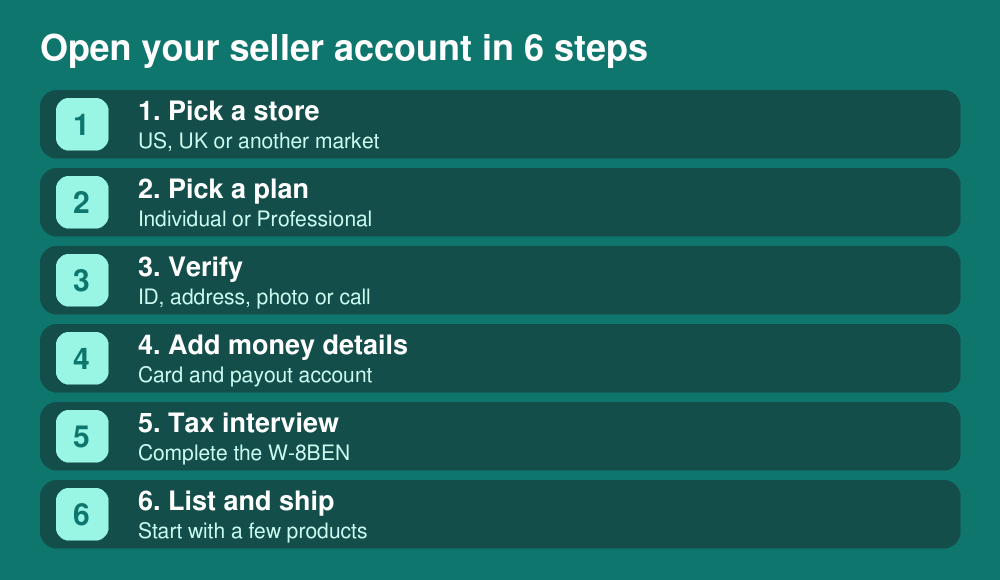
What Amazon asks for at registration
Amazon’s registration guide lists a government-issued ID, an email address, an internationally chargeable credit card, a bank account, proof of address dated within the last 180 days and tax information. A business licence is only needed if you register as a business. Entrepreneurs.ng (updated 17 February 2026) lists an international passport, national ID card or driver’s licence, and a Visa or Mastercard that works for international online payments.
Use your legal name exactly as it appears on your ID. Entrepreneurs.ng warns that mismatched names and unclear scans are a common reason for delays. If you plan to register a company, our guide to registering a business name with CAC explains the steps.
Which plan to choose, and what it costs
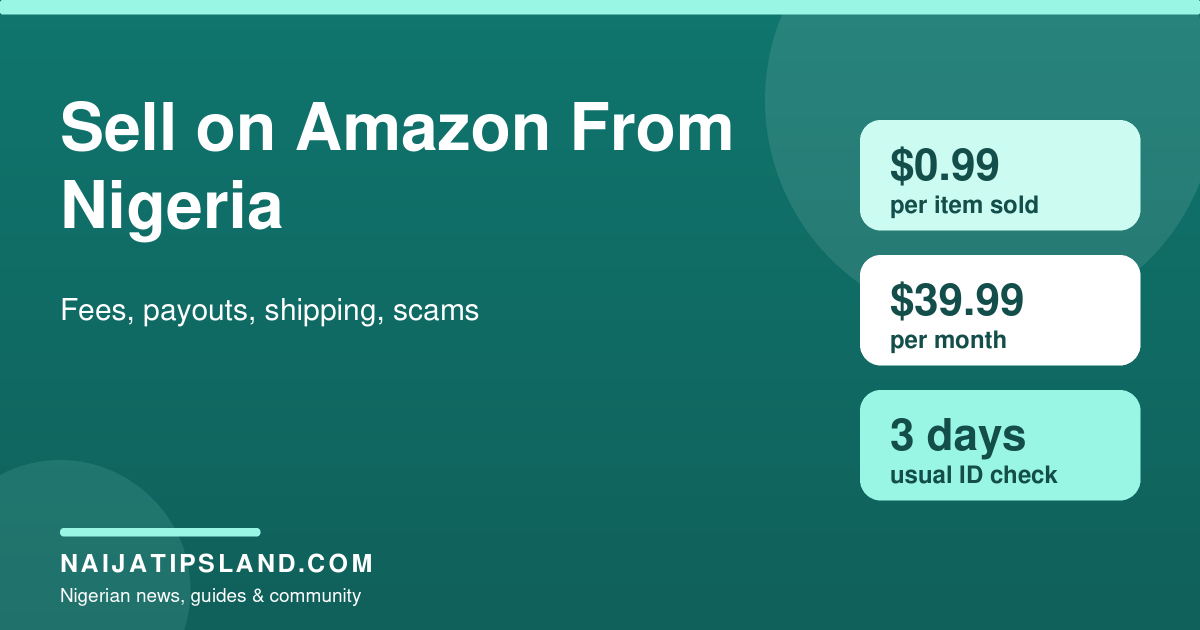
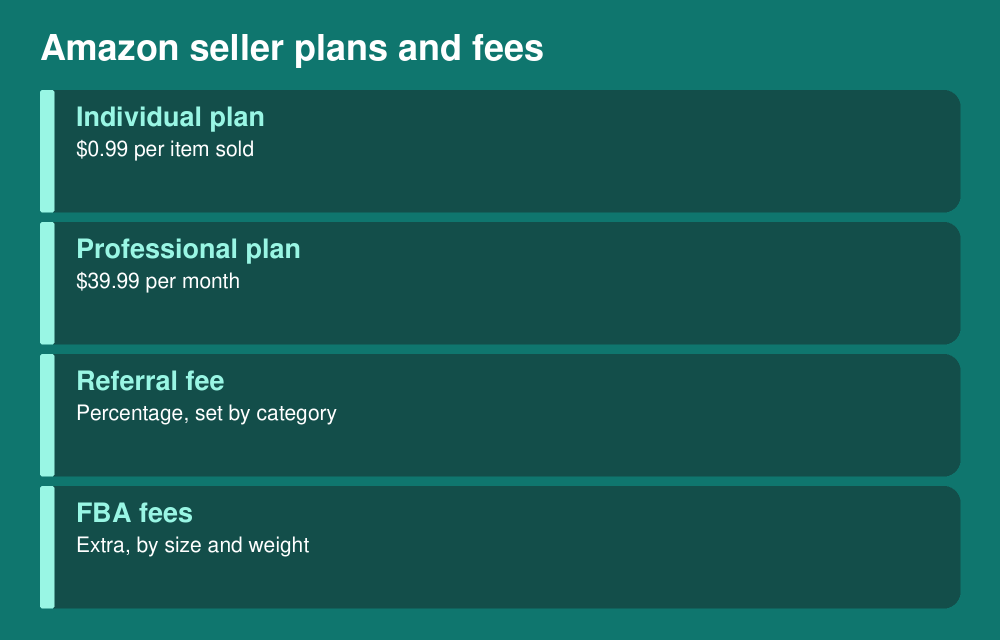
Amazon has two selling plans. The Individual plan costs $0.99 for each item sold, plus selling fees. The Professional plan costs $39.99 a month whatever you sell, plus selling fees. A simple way to think about it: at about 40 items a month the two plans cost the same, so Individual makes sense while you test and Professional once you pass that. Red Stag Fulfillment (updated 22 July 2026) says the same, putting the Individual plan at under 40 sales a month.
On top of the plan you pay a referral fee, which is a percentage of each sale and depends on the category. Red Stag lists clothing at 5%, computers at 8%, and footwear, jewellery and lawn and garden at 15%. Entrepreneurs.ng gives a general range of 8% to 15%. Look up your own category in Amazon’s fee schedule before you price anything. If you use Fulfilment by Amazon (FBA), there are pick-and-pack, storage and sometimes inbound placement fees on top. Those depend on size and weight, so run Amazon’s FBA revenue calculator for each product.
The identity check
After you upload your ID and proof of address, Amazon asks you to take a photo of your face and your ID, or to join a video call with an Amazon associate. Amazon says verification usually takes three business days or less. Scan documents in colour, show all four corners and avoid screenshots.
The check does not stop once you are approved. A seller-news site, Novadata, reported on 21 September 2026 that a review of about 20,000 Amazon accounts ahead of the peak season led to listings being removed and payouts held until sellers passed a live video check. Amazon had not announced a policy change, and the report relies on trade press, so treat the numbers with care. The practical lesson holds either way: keep your documents current and in the same name, and make sure the account owner can join a call and explain the business.
How to get paid
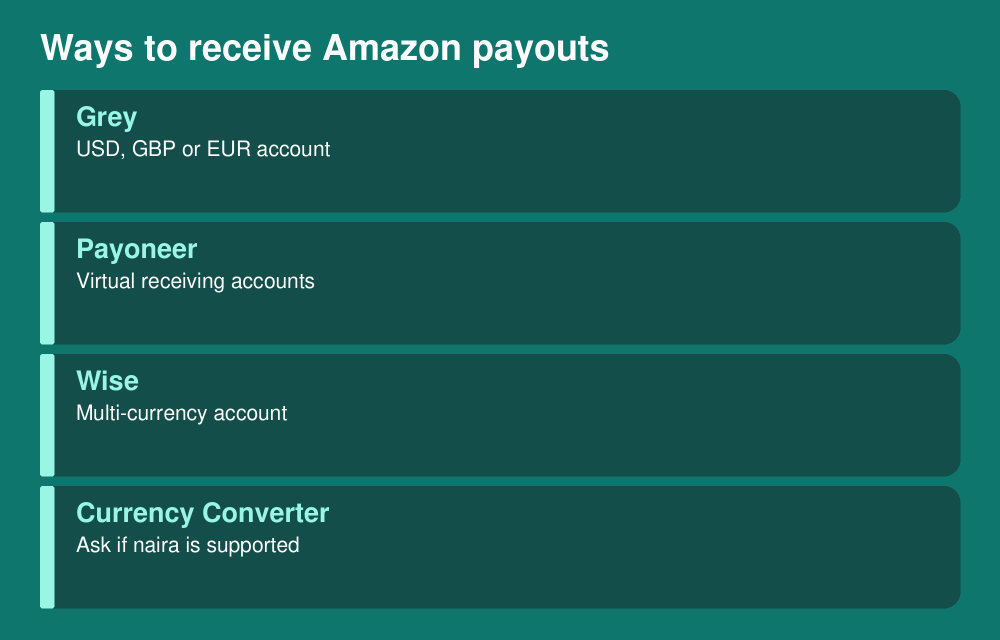
Amazon pays into a bank account in a supported location, in the currency of the store you sell in. Several routes are in use.
- Grey says you can receive Amazon payments into a Grey USD, GBP or EUR account, and that a Nigerian domiciliary account does not qualify. Its page was last updated on 2 October 2026 and states no fee for receiving Amazon payouts.
- Payoneer and Wise are named as alternatives in WorldFirst’s guide, which uses its own WorldFirst account as the example.
- Amazon Currency Converter for Sellers lets Amazon convert money for you. Its page puts the cost at 1.5% for sellers under $500,000 of cross-currency proceeds a year. It does not mention the naira, and I could not confirm Entrepreneurs.ng’s statement that it pays straight into a Nigerian bank account in naira. Ask Amazon or your bank before you rely on it.
Entrepreneurs.ng says Amazon pays every 14 days after fees, and that it may hold some money for returns or disputes. Our guides to receiving international payments as a Nigerian freelancer and opening a dollar account online compare the accounts and their fees.
Shipping from Nigeria
Amazon has no fulfilment centre in Nigeria. You have two choices. With Fulfilled by Merchant (FBM) you ship each order yourself by DHL, FedEx or UPS. With FBA you send stock in bulk to an Amazon warehouse abroad, usually through a freight forwarder, and Amazon handles delivery to the buyer. WorldFirst says trial shipments under 200 kg can go by air and larger ones usually go by sea.
Entrepreneurs.ng lists the export paperwork as NEPC registration, an NXP form, a commercial invoice and a packing list, and advises keeping products under 2 kg where you can. FBA stock needs FNSKU labels on every item and Amazon carton labels. My own view is that shipping single orders from Lagos to a US or UK buyer is slow and expensive enough to wipe out the profit on cheap goods, so FBM suits light, higher-value items, and bulk FBA suits products you have already proved will sell. For a sense of what customs and delivery cost going the other way, see our guide to buying from Shein, Amazon and Temu in Nigeria.
A worked example
Entrepreneurs.ng gives a sample for a skincare item sold at $20: product cost $4.00, shipping to the FBA warehouse $2.50, referral fee $3.00 (15%) and FBA fulfilment $3.22. That totals $12.72 and leaves $7.28, or about 36%. The figures check out arithmetically, but they leave out advertising, returns, currency conversion on payout and the cost of getting a sample batch right the first time. Skincare is also a category where Amazon can ask for approval or documents, so do not copy the example without checking the rules for your own product.
Tax
Amazon’s tax interview asks for a W-8BEN if you are an individual or a W-8BEN-E if you are a company. That form is about US withholding. It does not remove your duty to report income in Nigeria. Get a Tax Identification Number, read our explainer on personal income tax in Nigeria and speak to a Nigerian tax adviser about how export income is treated for your business.
Scams to avoid
- Anyone selling you a ‘verified’ or ‘ready-made’ Amazon seller account. Amazon ties an account to the verified owner, so a bought or borrowed account can be closed with your balance inside it.
- Courses or mentors that promise a guaranteed income. Nobody can guarantee sales.
- Messages on WhatsApp or Telegram from people claiming to be Amazon support. Use Seller Central for anything official.
- Buyers who ask you to take the sale off Amazon, or to pay with gift cards or a link they send.
- Cheap stock that turns out to be counterfeit. Selling fakes gets accounts banned.
Selling books instead of goods
If shipping looks too hard, Kindle Direct Publishing (KDP) removes it. KDP’s help page lists Nigeria among the countries where an author’s bank account is supported for direct deposit, and authors fill in a tax form before royalties are released. Grey’s guide shows where to enter a foreign account in your KDP settings. KDP does not suit everyone, but it needs no stock and no courier.
Mistakes that cost new sellers money
- Ordering a large batch of stock before testing a few units through the whole process.
- Pricing from the product cost alone and forgetting the referral fee, shipping and conversion.
- Registering with a name or address that does not match your documents.
- Choosing a payout account before checking that Amazon accepts it.
- Putting every naira of capital into stock and leaving nothing for returns.
For other ways to earn online while you learn, see our make money online in Nigeria hub and the guide to online business types.
If you live in the UK
Readers in the UK can sell on Amazon.co.uk with a UK address and bank account, and the registration rules above still apply. Selling goods to UK customers can carry VAT obligations, and the rules differ for sellers based outside the UK, so check HMRC’s guidance or speak to an accountant before your first sale. If you are helping a relative in Nigeria, remember that the account must be in the name of the person who will actually run it.
Related guide (updated 21 November 2026)
How to sell on Etsy from Nigeria explains why Nigeria is not on Etsy Payments, the fees and the legal alternatives.
FAQ
Can I sell on Amazon from Nigeria without a company?
Yes. Amazon’s registration guide says a business licence is not required if you register as an individual. You still need ID, proof of address, a chargeable card, a bank account and tax details.
How much does it cost to start?
The Individual plan is $0.99 per item sold and the Professional plan is $39.99 a month, plus referral fees, any FBA fees, your stock and shipping. Amazon does not charge to create an account.
How do I receive the money in Nigeria?
Most Nigerian sellers receive dollars, pounds or euros in a Grey, Payoneer or Wise account and then send the money to a Nigerian bank. Check fees and exchange rates at each step.
Does Amazon pay in naira?
Amazon’s Currency Converter page does not mention the naira. One guide says it does, but I could not confirm that, so check in Seller Central.
Is FBA or FBM better from Nigeria?
FBM is simpler for a first test with light, valuable items. FBA suits proven products you can ship in bulk, but it needs labelling, a freight route and storage fees.
How long does account verification take?
Amazon says usually three business days or less, though delays happen when documents are unclear or do not match.
This article gives general information and is not financial, legal or tax advice. Fees and rules change, so confirm current figures with Amazon and the relevant agencies.
Sources
- Amazon: Seller registration in 5 steps
- Amazon: Currency Converter for Sellers
- WorldFirst: How to sell on Amazon from Nigeria (17 August 2026)
- Entrepreneurs.ng: How to sell on Amazon from Nigeria (updated 17 February 2026)
- Red Stag Fulfillment: Amazon seller fees (updated 22 July 2026)
- Grey: How to get paid by Amazon in Nigeria (updated 2 October 2026)
- Amazon KDP: Getting paid
- Novadata: Amazon Section 3 video verification sweep (21 September 2026)
Join the discussion
Have you tried this, or do you have a question we did not answer? Be the first to share your experience. Leave a comment below. Every comment is read by the editor before it appears.





Editor note: have you tried selling on Amazon from Nigeria, or are you still deciding? Tell us in the comments which product you plan to sell, which payout account you use and where the process got stuck. Please leave out account numbers, IDs and phone numbers. We read every comment. – Ade