

Last updated: 16 October 2026 · By Naijatipsland Editorial Team · Editorial policy
Every few years, Nigerians lose huge sums to a platform that promised to double their money. MMM collapsed in 2016. CBEX collapsed in 2025, and according to investigations and victims’ accounts as much as N1.3 trillion may have been lost, though that is an estimate and not a confirmed figure. The names change, but the pattern does not: big promises, early payouts, a rush of referrals, then a locked account. In May 2026 the Securities and Exchange Commission (SEC) again warned the public about unregistered online investment schemes promoted on social media, many of which showed the characteristics of Ponzi schemes. This guide explains what a Ponzi scheme is, how the 2026 versions look, the warning signs, how to check a platform, what to do if you are caught, and how to invest more safely. It is general information, not financial or legal advice.
The short answer
- A Ponzi scheme pays earlier investors with money from newer investors, with no real business behind it. It collapses when new money dries up.
- The SEC says promises of guaranteed or unusually high returns are red flags, and that only operators registered with it can legally provide investment and advisory services.
- Check the SEC register before you send money, and be wary of anything that pays you mainly for recruiting others.
- If you are caught, do not pay any “release” or “recovery” fee, keep your evidence and report.
What is a Ponzi scheme?
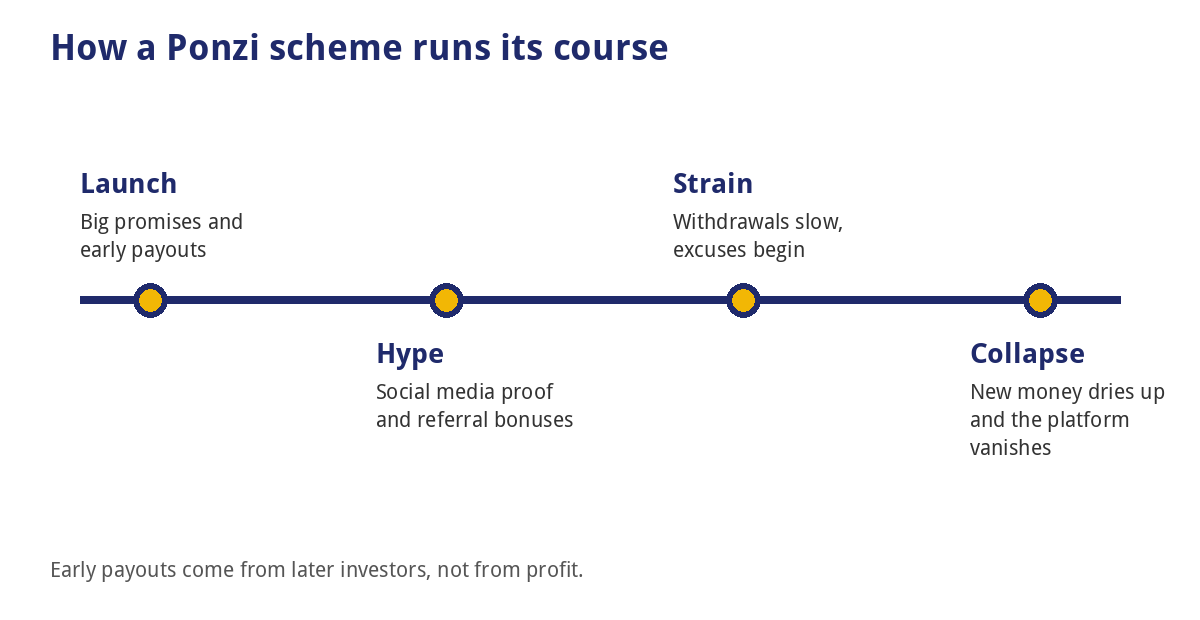
A Ponzi scheme sells an “investment” that appears to make steady profit. In reality, the early investors are paid out of the deposits of later ones. Because no real business is earning the profit, the scheme only works while new investors keep coming. Legit.ng, reporting the SEC’s warning in February 2026, put it this way: such operations collapse once new funds dry up, and many victims are left with total losses. A pyramid scheme is similar but pays you mainly for recruiting. Many Nigerian schemes mix both.
What the SEC has warned about in 2026
- February 2026. The SEC warned that Ponzi schemes have moved online, using social media, crypto promises and referral incentives, and said all companies soliciting funds from the public must be licensed. Legit.ng reported that the SEC flagged five platforms as not registered: Pocket Option, Forsman & Bodenfors Ltd, Value Growth Platform, CMTrading and Sapphire Scents Limited. We repeat the report and have no independent finding about them, so check the SEC’s own notice.
- May 2026. In a public notice dated 8 May, reported by Vanguard, the SEC warned against unregistered online schemes promoted on WhatsApp, Instagram, Telegram, Facebook, TikTok and other platforms. It said guaranteed or unusually high returns should be treated as red flags, and that people should confirm the status of any company through the SEC’s verification portal.
- The CBEX case. In December 2025 the SEC asked an Investments and Securities Tribunal to freeze accounts and seize assets of CBEX and 25 others, in a case with an estimated N1.3 trillion in investor losses. The SEC said CBEX, a crypto platform, promised returns of 100% within 30 days, and argued it operated unregistered. The cases were adjourned to January 2026, and we did not find a reported outcome, so it is not clear what victims will recover.
The SEC also says unregistered operations in forex and crypto are an offence under the Investments and Securities Act 2025. See our guide to forex trading in Nigeria for the details.
Warning signs
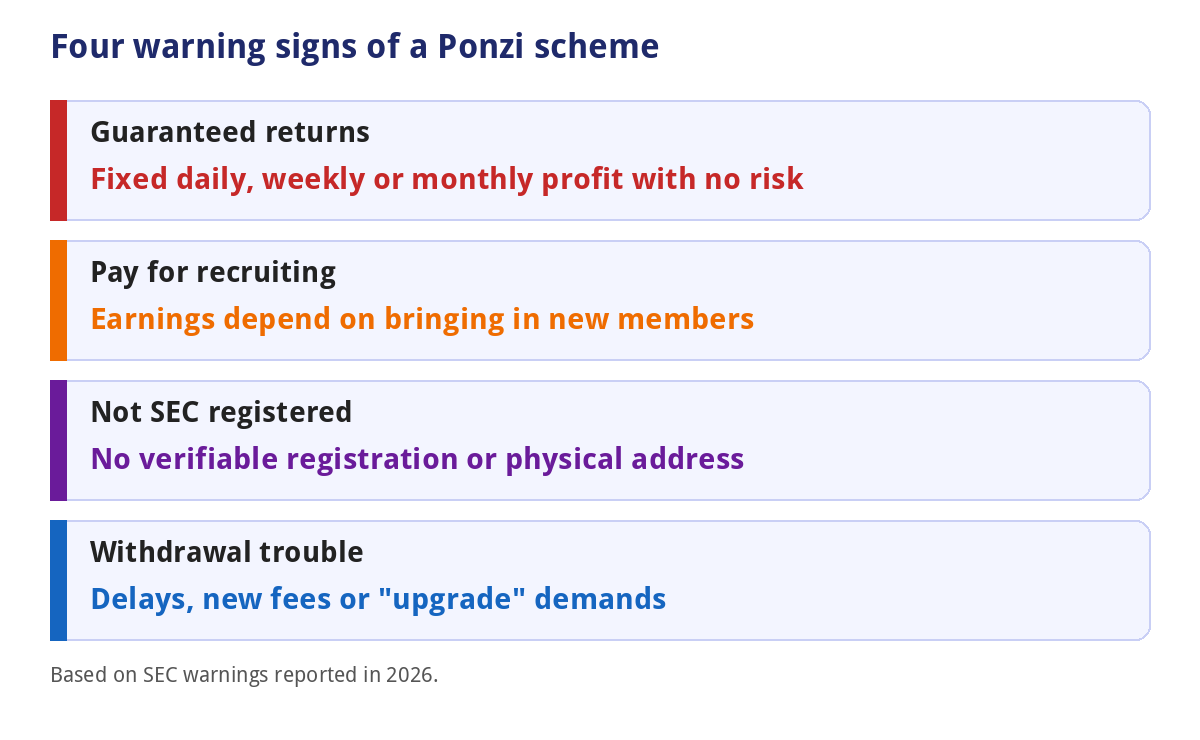
- Guaranteed or unusually high returns. Real investments can lose money. A fixed daily, weekly or monthly return with “no risk” is not real.
- You earn mainly by recruiting. Heavy reliance on referral bonuses is a classic mark of a scheme.
- No verifiable registration. No SEC registration, or a number you cannot verify.
- Opaque business. Nobody can explain simply where the profit comes from.
- Pressure to move fast, with countdowns and limited “slots”.
- No real address or customer service, only WhatsApp or Telegram.
- Trouble withdrawing. Delays, new fees, or “upgrade your level to withdraw”.
- Celebrity or media branding that looks cloned. The SEC flagged one platform for using cloned media branding and celebrity images, according to Legit.ng. See our guide to internet scams.
- Disguises. Schemes often appear as cooperatives, crypto platforms, e-commerce, or jobs. Our guide to recruitment scams shows the job version.
How to check a platform
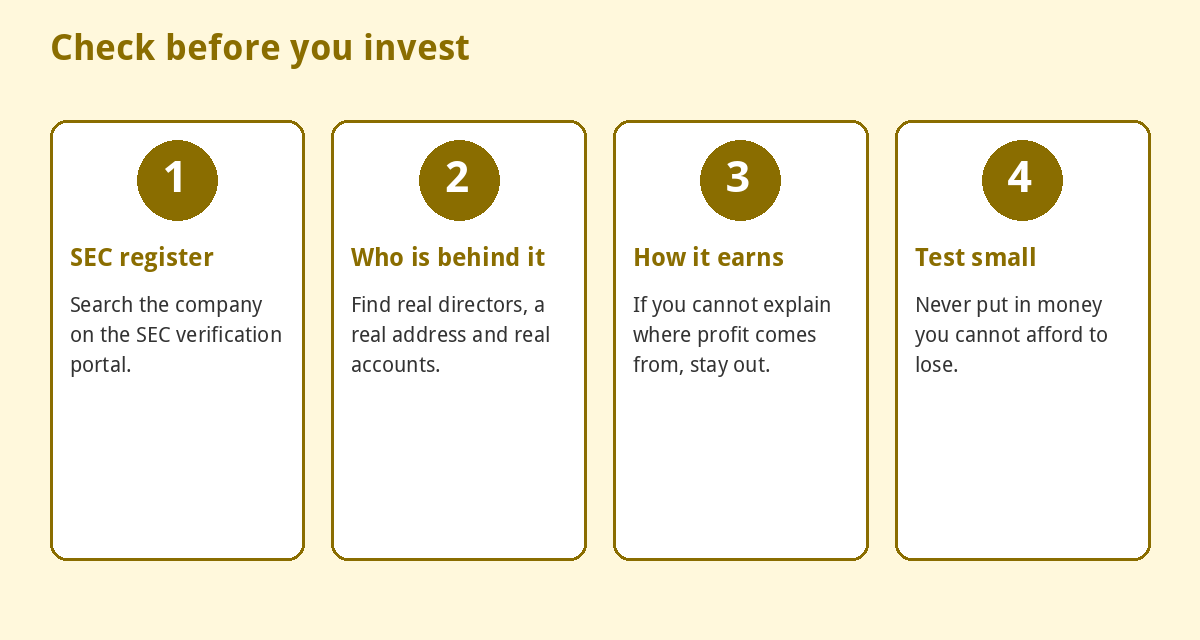
- Search the SEC’s register. The SEC says to confirm the status of any company or entity through its verification portal. Use the official sec.gov.ng website, and type the address yourself.
- Find the people. Look for real directors with a verifiable history, a physical office and a working customer care line that you call yourself.
- Understand the model. If you cannot explain where the returns come from, do not invest.
- Search the name with “scam” or “complaint” and read recent reports, but remember that fake reviews exist.
- Ask for audited accounts and a regulator’s licence number, then verify them with the regulator.
- Test small and withdraw early, and treat any new fee to withdraw as a stop sign.
- Be wary of friends’ proof. Early participants are often paid, which is how these schemes spread.
A single check can fail, so use several. Never rely on screenshots of profit, as with fake alerts. See our guide on fake credit alerts and phishing.
Why smart people still fall for them
- Inflation and high living costs make big returns tempting. See our guide to the Nigerian economy.
- Early investors really do get paid, which builds trust.
- Friends and family introduce people, so the scheme feels safe.
- Influencers and WhatsApp groups show screenshots of “proof”.
- Fear of missing out makes people skip checks.
Legal consequences for promoters
Promoters are at risk as well as operators. The SEC has said that promoting or operating unregistered investment schemes is an offence under ISA 2025, and in its September 2026 draft forex rules it cited Section 196(3), with a fine of at least N20 million or imprisonment. A scheme’s cheerleaders and agents who recruit others may also face action, so being a victim first does not protect you from becoming a promoter. In another case, the Federal High Court in Abuja convicted the secretary of an e-commerce company, Fortunetech Limited, in November 2025 of running an unregistered business and giving false information to the ICPC. The company was wound up, and N848 million was recovered, including N636 million ordered returned to a victim. Those convictions were for registration and false-statement offences, not specifically for running a Ponzi scheme.
If you have already invested
- Stop investing and do not recruit others.
- Do not pay any fee to withdraw or to “unlock” your account.
- Save the evidence: receipts, bank transfers, chats, platform screenshots, names, numbers and links.
- Tell your bank and ask what can be done. See our guide to recovering money sent to the wrong account.
- Report to the SEC, the EFCC and the police. Reports to the Nigerian Financial Intelligence Unit and the platform host are also recommended in one 2026 article. Our guide on how to report cybercrime in Nigeria has the order of steps.
- Avoid “recovery agents” who ask for fees. It is a common second scam.
- Look after yourself. Many victims feel shame or distress. Talk to someone you trust.
Safer ways to grow money
- Use registered banks, licensed brokers, treasury bills and regulated funds, and check the registration first.
- Build an emergency fund before taking risk.
- Diversify and expect that returns come with risk.
- Be sceptical of anyone who offers returns well above what regulated products pay.
- For earning money, see our guide to earning money online in Nigeria.
Common mistakes
- Investing because a friend got paid.
- Reinvesting early profits, which deepens the loss.
- Borrowing to invest.
- Using rent, school fees or business money.
- Recruiting others to “get your money back”.
- Paying a fee to withdraw.
- Trusting a platform because it has a slick app.
Frequently asked questions
What is the difference between a Ponzi and a pyramid scheme?
A Ponzi scheme pays old investors from new deposits. A pyramid scheme pays you mainly for recruiting. Many mix both.
Is CBEX a Ponzi scheme?
The SEC has described it as one in tribunal proceedings, alleging it guaranteed 100% returns in 30 days while unregistered. Those are the SEC’s allegations in a case whose outcome we did not find.
How do I know a platform is registered?
Check the SEC’s official verification portal, and do not rely on a certificate the platform shows you.
Can I get my money back?
Sometimes, but often not. Recovery is slow and uncertain, so report quickly and keep evidence.
Is it illegal to promote a Ponzi scheme?
The SEC says promoting or operating unregistered investment schemes is an offence. Get legal advice if you are worried.
Are crypto and forex platforms Ponzi schemes?
Not automatically, but many schemes use these names. Check registration and avoid anyone who guarantees returns.
Can I report anonymously?
Check the SEC’s and EFCC’s official channels for the options.
Bottom line
If an investment promises guaranteed returns, pays you for recruiting, or cannot be found on the SEC register, assume it is a Ponzi scheme until proven otherwise. Check the official register yourself, test with small sums, never pay to withdraw, and report quickly if you are caught. Boring, regulated products will almost always beat the platform that promises to double your money.
Sources
- Vanguard via allAfrica: SEC warns Nigerians against rising Ponzi schemes on social media (18 May 2026)
- Legit.ng: How Nigeria’s top Ponzi platforms disappear with your money, SEC’s latest warning (11 Feb 2026)
- Voice of Nigeria: IST begins hearing as SEC orders freeze of CBEX accounts (10 Dec 2025)
- Techeconomy: CBEX, SEC orders freeze of accounts over N1.3 trillion Ponzi scheme probe (11 Dec 2025)
- allAfrica: Court jails Ponzi scheme operator as ICPC recovers over N848 million (12 Nov 2025) (the convictions were for registration and false-statement offences)
- Nairametrics: SEC proposes N3 billion minimum capital for forex brokers (2 Sep 2026)
- Afrokonnect: Investment scams in Nigeria (4 Aug 2026) (self-promotional site; several statistics unsourced and not used)
Join the discussion
Have you tried this, or do you have a question we did not answer? 4 readers have already shared their views. Naijatipsland members help each other with real, first-hand experience.







Early investors really do get paid, which is exactly how these schemes spread. The proof from friends feels convincing. Has someone close to you ever pushed a scheme that later collapsed?
Promoters face risk too. Recruiting others into an unregistered scheme can be an offence under ISA 2025, even if you were a victim first. Did you know agents and promoters could face action?
A Ponzi scheme pays earlier investors with newer investors’ money, and the SEC says promises of guaranteed or unusually high returns are red flags. Which promise made you walk away from an “investment”?
Check the SEC register before you send money, and be wary of anything that pays you mainly for recruiting others. How do you verify an investment platform before trusting it?